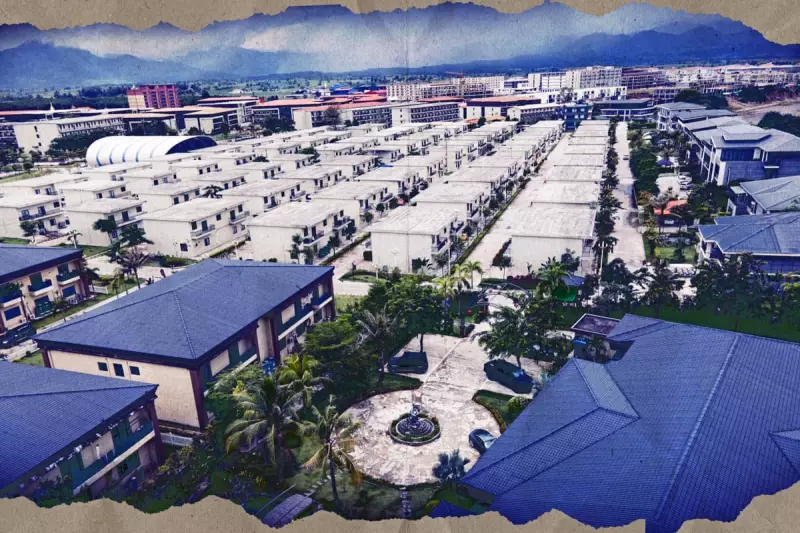
The demolition of KK Park in Myanmar's Myawaddy region was a spectacle of empty buildings and controlled explosions. Myanmar's military junta declared it the end of one of Southeast Asia's most notorious hubs for cyber scamming and human trafficking. Yet, as the dust settled on the levelled dormitories and silent karaoke bars, a stark truth remained: the operators had vanished, tipped off long before the raid, and up to 20,000 trafficked labourers had simply disappeared.
The Era of the 'Scam State' Dawns
This event underscores a disturbing new reality identified by experts: the arrival of the 'scam state'. Mirroring the concept of a narco-state, this term describes nations where an illicit industry has entrenched itself within legitimate institutions, reshaping the economy and corrupting governance. The multi-billion dollar global scam industry has achieved such monolithic scale that it now forms a dominant political and economic force in parts of the Mekong region.
Analysts view raids like the one on KK Park as largely performative, targeting minor players in what amounts to 'political theatre'. Jacob Sims, a visiting fellow at Harvard University's Asia Centre, describes it as a game of Whack-a-Mole where the powerful moles are left untouched. He states that scamming has transformed in just five years from small fraud rings into an industrial-scale political economy, becoming the dominant economic engine for the entire Mekong sub-region.

Industrialised Fraud and State Complicity
The industry has evolved far beyond the days of clumsy phishing emails. It now centres on sophisticated 'pig-butchering' scams, where scammers cultivate online relationships before convincing victims to invest in fake cryptocurrency schemes. Using generative AI, deepfake video calls, and mirrored websites, criminals are netting huge sums. One survey found victims lost an average of $155,000 each.
The profits are staggering. By late 2024, cyber scamming in Mekong countries was estimated to generate $44bn annually, equivalent to 40% of the region's combined formal economy. Jason Tower of the Global Initiative against Transnational Organised Crime notes this is a conservative figure, with the global market now exceeding $70bn a year—a size comparable to the illicit drug trade.
This wealth has built vast, public infrastructure. Organisations like Cyber Scam Monitor have identified 253 suspected scam compounds in Cambodia alone. In Laos, around 400 are reported in the Golden Triangle special economic zone. Their very visibility, experts argue, is proof of extreme impunity and deep state embedding.
High-Level Corruption and Global Repercussions
The tentacles of the scam industry reach the highest levels of power. In Cambodia, Chen Zhi, recently sanctioned by the UK and US for allegedly masterminding the Prince Group scam network, served as an adviser to the prime minister. In Thailand, a deputy finance minister resigned in October 2024 over alleged links to Cambodian scam operations. In Myanmar, scam centres are a key revenue source for armed groups.
Government responses have been dismissive. Myanmar's military claims it is working to 'eradicate scam activities from their roots', while Cambodia has labelled allegations of state-supported cybercrime networks as 'baseless'. Meanwhile, the industry continues its rampant growth, facilitated by conflict zones and poorly regulated border areas.
The phenomenon represents an unprecedented convergence of globalised crime and local corruption. As Tower concludes, it is a massive illicit market causing global harm, operating with blatant impunity and in full public view, marking a dangerous new chapter for the region and the world.