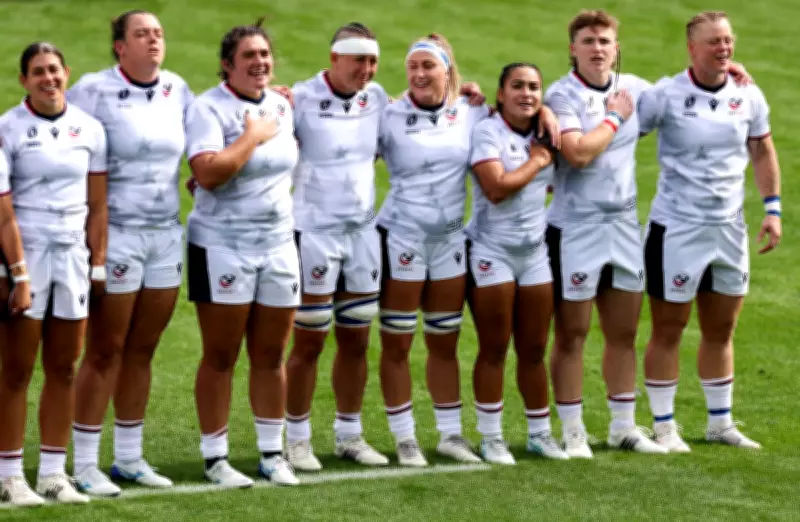
The USA women's rugby team is at the center of a heated debate after USA Rugby (USAR) updated its eligibility requirements in February to ban trans women from competing. The decision sparked outrage among players and fans, leading to a massive organizing effort. Within days, over 300 people joined a call to discuss next steps, dozens of teams announced they would not play without their trans teammates, and a fund was started to support legal action.
A Queer and Inclusive Sport Under Threat
Women's rugby has long been considered one of the most inclusive sports, with a guiding principle of 'every body is a rugby body,' according to Cameron Michels, a PhD student researching queer and trans players' experiences. 'In the US, no one has cared about women's rugby enough to hold cultural boundaries around femininity and performance, so it's been perceived as a countercultural, queer space,' Michels said.
The new USAR criteria align with recent policy updates from other national governing bodies, including USA Hockey, USA Fencing, and USA Climbing, driven by a 2025 executive order from Donald Trump aimed at 'keeping men out of women's sports.' The International Olympic Committee has also faced criticism for its trans policy.

Resistance and Organizing
Rugby for All, a grassroots group formed in 2020 after World Rugby banned trans women, is leading the resistance. Grace McKenzie, an organizer and former player for the Berkeley All Blues and New York Rugby Club, said, 'Towards the end of last year, all of us said, “We’re getting to the worst point now, and it’s encroaching upon our sport. Let’s go on the offensive, and let’s talk about why rugby is different.”' The group is using social media, virtual meetings, and direct conversations with USAR to keep the sport inclusive.
The ban affects not only elite competition but also local club teams. USAR created a third 'open' division for people of any sex or gender, but advocates say this 'others' trans players and may not provide meaningful competition due to low numbers.
Creative Solutions and the Open Division
During an emergency meeting hosted by Rugby for All, several solutions were proposed: forming an independent league, a mass strike, or moving en masse to the open category. The latter option gained the most traction on social media, with many teams hoping to force USAR to provide a functional, funded open division. However, minutes from a March senior council meeting of USA Club Rugby reveal that USAR has no concrete plan for how the open division will operate, with logistics 'still in development.'
Chris Mosier, an advocate for inclusion policies, said, 'The open division as a third category – I hope it backfires. I love seeing athletes finding creative ways to work around it, and every athlete can look to rugby for inspiration.'
Challenges and Community Solidarity
USAR CEO Bill Goren stated that the organization did not feel pressured by Trump's executive order, as it is not federally funded, but risked decertification if it did not comply. For the rest of the 2025-26 season, most women's teams cannot move to the open division while maintaining USAR-sanctioned status. However, USAR said it will not enforce the policy unless a challenge is filed, leading to a 'don't ask, don't tell' situation.
Most rugby unions plan to allow trans women to remain on teams, hoping solidarity holds. But some unions in red states fear losing their non-profit status. Rosie M, a player for the San Antonio Riveters, was initially assured she could play but later told she could not compete in sanctioned matches due to the union's decision. 'Trans rugby players have been made second-class athletes,' she said.
Despite the challenges, the fight continues. Rugby for All is building a collective bargaining movement, and unions like the Northern California Rugby Football Union are preparing to move teams to a new division. McKenzie concluded, 'There’s a lot of people who are passionate on the organizing side within our sport, so it’s not like we’re going to see all these Instagram posts, and then we’re going to stop talking about this and just accept what happened.'