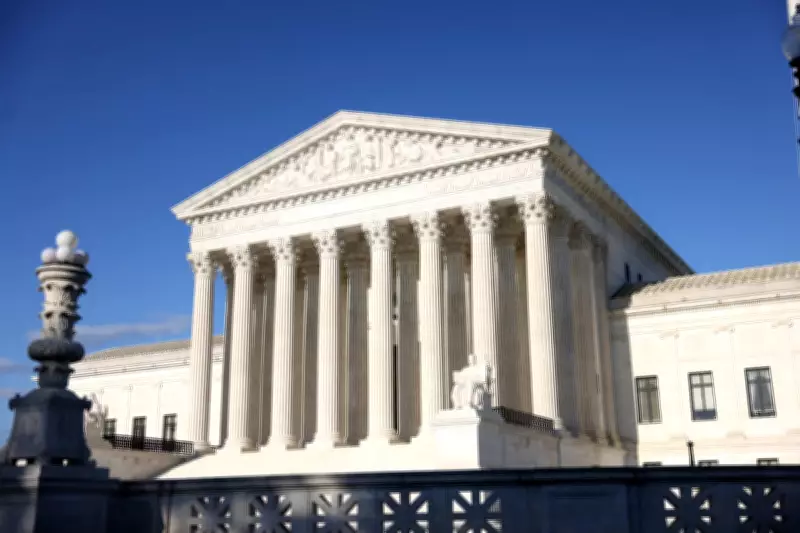
Supreme Court Expedites Voting Rights Act Ruling for Louisiana Redistricting
The United States Supreme Court took an unusual procedural step on Monday to assist Louisiana Republicans in redrawing their congressional maps ahead of the upcoming midterm elections. The court allowed a recent ruling that weakened a key provision of the Voting Rights Act to take effect earlier than standard procedure dictates.
This move comes less than a week after the court's landmark decision struck down Louisiana's congressional map and gutted Section 2 of the Voting Rights Act. Typically, the Supreme Court waits 32 days before formally issuing its judgment to the lower court. However, Louisiana requested an expedited process, citing the urgent need to redraw its maps. The court granted this request on Monday.
Justice Samuel Alito, writing for the majority, noted that the scheduled start of early voting for the primary had already passed and that the general election was only six months away. He stated, "The date scheduled for the beginning of early voting in the primary election has already passed. The congressional districting map enacted by the legislature has been held to be unconstitutional, and the general election will be held in just six months."

The decision is expected to provide additional legal cover for Louisiana Republicans, who took the extraordinary step of canceling the May 16 primary for Congress after mail-in ballots had already been sent to overseas voters. Ongoing litigation challenges that cancellation, and the Supreme Court's expedited judgment could strengthen Louisiana's legal arguments for holding new elections.
Dissenting from the court's decision, Justice Ketanji Brown Jackson sharply criticized the majority for deviating from standard procedures. She noted that in the last 25 years, the court had expedited its ruling only twice before. Jackson wrote, "To avoid the appearance of partiality here, we could, as per usual, opt to stay on the sidelines and take no position by applying our default procedures. But, today, the Court chooses the opposite. Not content to have decided the law, it now takes steps to influence its implementation."
Jackson further argued, "The Court's decision to buck our usual practice under Rule 45.3 and issue the judgment forthwith is tantamount to an approval of Louisiana's rush to pause the ongoing election in order to pass a new map." In strong language, she added that the court's majority "unshackles itself from both constraints today and dives into the fray. And just like that, those principles give way to power."
Justice Alito responded forcefully in an opinion joined by fellow conservatives Clarence Thomas and Neil Gorsuch. He called Jackson's accusations "baseless and insulting" and wrote, "The dissent goes on to claim that our decision represents an unprincipled use of power. That is a groundless and utterly irresponsible charge." Alito questioned what principle the court had violated, asking whether it was the principle that the default period should never be shortened when there is good reason, or the principle that the court should never act in a way that might be criticized as partisan.