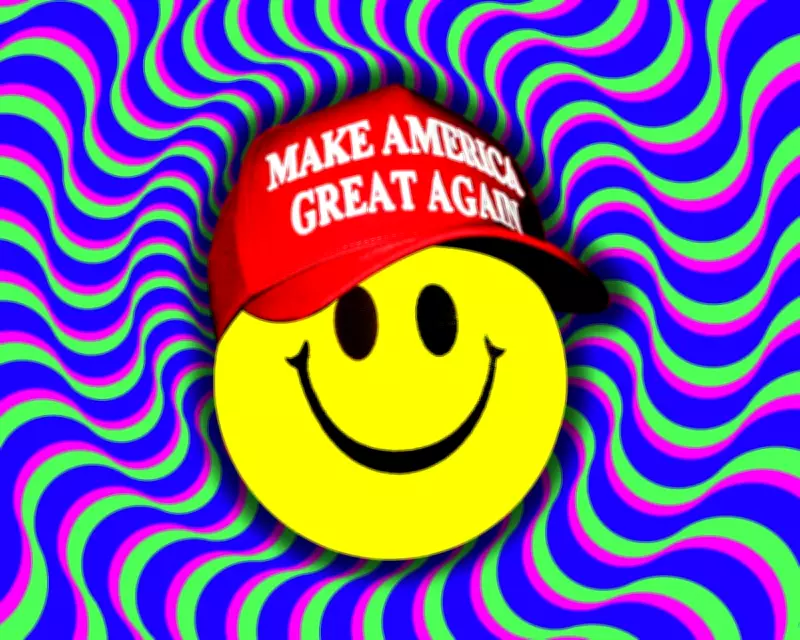
Illustration: Guardian Design/Anaïs Mims/Getty
Turn on, tune in, cash out … The US right used to fear psychedelics. Now it wants to sell them.
From Moral Panic to Mainstream Medicine
On 13 May 1966, a US Senate subcommittee questioned Dr Timothy Leary, a former Harvard clinical psychologist considered “the most dangerous man in America,” on the risks of psychedelics. Senator Ted Kennedy led the inquisition, asking: “This is a dangerous drug – is that right?” Leary replied: “No, sir. LSD is not a dangerous drug.” Kennedy remained unconvinced, reflecting the establishment’s moral panic linking psychedelics to hippy movements, anti-war protests, and societal breakdown.

Almost exactly 60 years later, Ted Kennedy’s nephew, Robert F. Kennedy Jr., stood behind Donald Trump as he signed a presidential executive order accelerating mainstream access to psychedelic-based medical treatments, with a focus on ibogaine—a psychoactive compound from a West African shrub shown to treat chronic mental health issues. Kennedy Jr., alongside podcaster Joe Rogan, championed psychedelics within the MAGA coalition. Rogan revealed he encouraged Trump via text message.
A Shift in Perception
This executive order reflects a long-gestating shift. Psychedelics, once caricatured as countercultural decadence, have been rebranded by clinical research as transformative mental health treatments for depression, PTSD, and suicidal ideation. In 2023, former ultra-conservative Texas governor Rick Perry argued that psychedelic legalization is “more supported by the Republicans” at the federal level. Once the preserve of anti-war lefties, psychedelics are now backed by a warmongering rightwing president.
What Changed?
First, scientific research into therapeutic potential has rallied traditionally conservative communities, such as military veterans, who lobby for psychedelics to address PTSD. Even police officers now call for similar reforms. Second, there is money to be made. Forbes predicts the psychedelic mushroom market will surpass $3.3 billion by 2031. With mental health disorders affecting 1 billion people, cutting-edge treatments could become as lucrative as Ozempic. As biotech investor Christian Angermayer said, “We have the solution for the biggest problem in healthcare.”
Silicon Valley's Role
Investment flows from tech oligarchs. In 2020, Peter Thiel backed a psychedelic biotech startup in a $125 million funding round. In 2024, Google co-founder Sergey Brin invested $15 million in ibogaine research for traumatic brain injury. Silicon Valley’s enthusiasm is unsurprising; from California computer scientists to Steve Jobs, Bill Gates, and Sam Altman, psychedelics have inspired tech geniuses. This worldview fits comfortably in a Republican administration transforming America’s drug policy. Trump quipped about ibogaine, “Can I have some, please? I’ll take it,” alarming traditional Republicans.
While drug policy reform enjoys bipartisan support, with psychedelic therapy advancing in blue states like Colorado and Oregon, the Trump 2.0 alliance with Silicon Valley accelerates change. Leary’s mantra “turn on, tune in, drop out” has evolved into Davos panels on “brain capital and human flourishing.” The energy behind psychedelics has moved from beatniks to biohackers, from flower power to finance capital. This may expand access to life-changing medicine, but in Trump’s trippy second term, mental health treatment remains largely in the hands of the few.
Kojo Koram is a professor of law and political economy at Loughborough University. His new book, The Next Fix: Winners and Losers in the Future of Drugs, is out on 4 June.