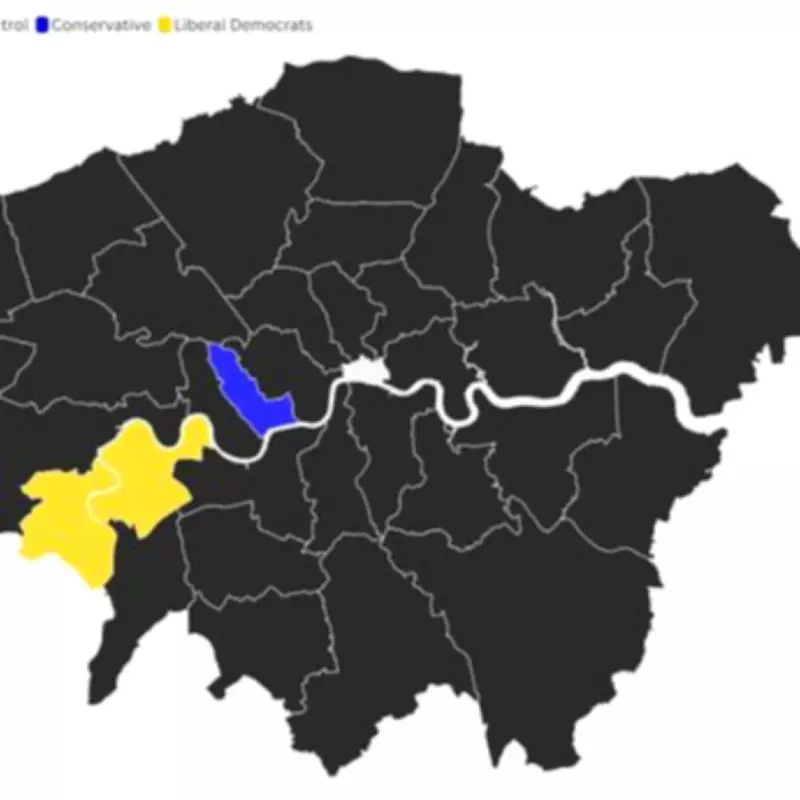
A striking new map illustrates that under a proportional voting system, 30 out of London's 32 boroughs would be under no overall party control. The Labour Party suffered significant losses across London in the recent local elections, losing 450 seats and control of 12 councils. Meanwhile, the Green Party gained ground, taking control in Hackney, Lewisham, and Waltham Forest, while Reform UK won its first London council in Havering.
How the Current System Works
Britain uses the 'first-past-the-post' voting system for both general and local elections. Locally, residents cast between one and three votes to choose their ward councillors, depending on the number of representatives for that ward. Once votes are tallied, the top candidates are elected, and the party with the most seats forms the council administration. This system is simple and traditionally produces strong, one-party results, but it is frequently criticized for not accurately reflecting voters' wishes. For example, Labour won 29.7% of the vote in Ealing but secured 66% of the seats, meaning 70% of voters did not support the party that gained a strong majority.
What a Proportional System Would Look Like
Under a 'party list' electoral system, where the percentage of votes directly correlates with the number of seats, only two boroughs would have a majority party: Kensington and Chelsea under Conservative control, and Richmond under Liberal Democrat control. All other boroughs would be under no overall control, a stark contrast to the current layout where 24 of 32 boroughs are governed by a single party.

Dr. Tony Travers CBE, professor at the London School of Economics, noted that an increase in minority-governed councils would present short-term challenges. He explained that people are accustomed to majority administrations, where one party wins and forms a stable government. Minority councils would face difficulties in creating consistent administrations and governing with certainty over four years, though they might adapt over time.
Potential Alternative Systems
The most proportional system used in Britain was for European Parliament elections before Brexit, where voters in each region voted directly for a party, with each party submitting a list of candidates. The proportion of votes translated exactly into seats. Dr. Travers cautioned that a pure list system could undermine hyperlocal representation, as councillors would have no neighbourhood link. He suggested a hybrid model, such as the one used for the Greater London Authority, where one vote is for ward representatives and another for city-wide party list members. This would combine proportionality with local representation.
Dr. Travers also commented on the increasingly fragmented nature of London's local politics, even under first-past-the-post. He predicted that councils under no overall control would struggle to form formal coalitions, leading to minority administrations that must negotiate vote by vote. Setting a long-term vision would be nearly impossible for such councils, unlike those with strong majorities like Ealing and Hammersmith and Fulham.