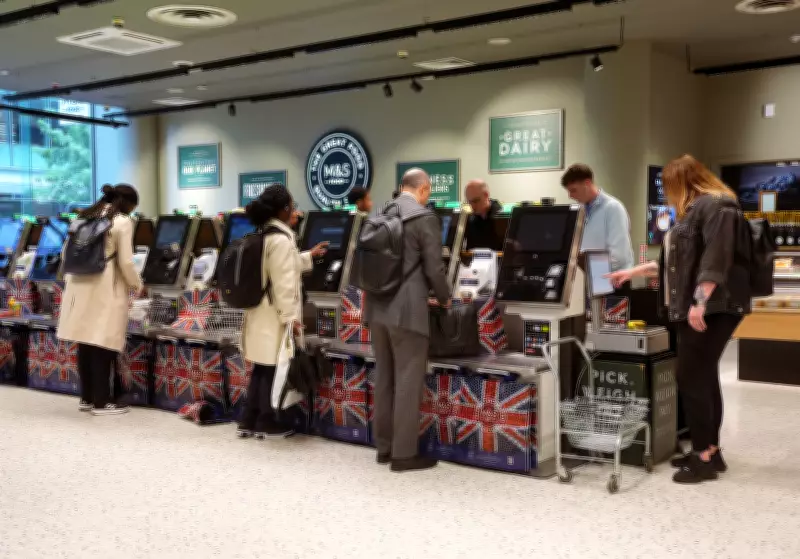
Marks & Spencer has been vocal about its ambition to conquer the British weekly shop, and the retail giant is approaching a crucial update on its foray into the UK’s fiercely competitive grocery market.
M&S Food accounts for more than half (54 per cent) of the retailer’s revenues, and recent warehouse expansions suggest the FTSE 100 retailer is hungry for a larger slice of the UK’s supermarket pie.
The firm will announce its full-year results on Wednesday, hoping its food expansion will help regain a narrative dominated by the cyber attack that hit last year.
On Monday, M&S spent £66 million on a 437,000 square foot warehouse from online retailer Asos, and later in the week announced it had started building a new £340 million food distribution centre in Northamptonshire. The new warehouse – M&S’s biggest-ever investment in its food arm – was described by food logistics chief Kevin Bennett as the company’s “major step in transforming into a true destination for the weekly shop.”
M&S Hails Record Grocery Share
The retailer has recently piled investment into revamping its stores, which it says is pulling in more shoppers. Sales in the firm’s food business jumped 5.6 per cent year-on-year according to M&S’s Christmas trading update, as the retailer toasted its biggest-ever grocery market share – up to four per cent in November.
This suggests M&S Food is muscling in on up-market rival Waitrose, which holds a 4.6 per cent market share, but remains leagues behind sector giants Tesco and Sainsbury’s. However, UK supermarkets have been battling to keep prices down amid looming food inflation caused by the Iran war, which a key industry body warns could reach double figures this year.
Tesco and Sainsbury’s have both refused to put a number on likely price rises to avoid spooking customers, but have called on the government to cut grocers’ energy bills.
M&S will also hope that its flourishing food arm bears few scars from the devastating cyber attack that hit the retailer in April last year. The attack revealed fragilities in the company’s supply chains, leaving some shelves empty and forcing its website into a 12-week blackout.
It was “not an overstatement to describe [the attack] as traumatic,” M&S chairman Archie Norman said in July, telling MPs it felt like hackers were “trying to destroy” his business.
M&S Hopes to Forget ‘Traumatic’ Cyber Attack
M&S managed to recover only a third of its £300 million lost sales through insurance, and saw the hit to trading profit surge to £324 million in the first half of that year alone. But chief executive Stuart Machin has since sought to apply his blunt, hands-on approach to the retailer’s turnaround – a strategy he describes as “positive dissatisfaction.”
In recent months, M&S’s retail director Thinus Keeve has led – at times scathing – calls for the government and the Mayor of London to crack down on violent shoplifting, which he dubbed a “systemic issue.”
Richard Hunter, head analyst at Interactive Investor, said: “M&S will be glad to see the end of a year where the cyber disruption was the unfortunate highlight. Even so, the group’s healthy financial position helped it to weather the storm, and indeed M&S continued to make investments in the business despite the cyber-related costs elsewhere.”
The retailer’s share price has been on a wild ride in recent months, surging to a recent high just before the Iran war broke out, before sliding back towards its cyber attack lows. The stock has fallen by around three per cent in recent days, to 317p, and stands 11 per cent lower than at this time last year.
If M&S is to win over investors, it will need to meet consensus forecasts of £16.4 billion total sales and a £603 million pre-tax profit.