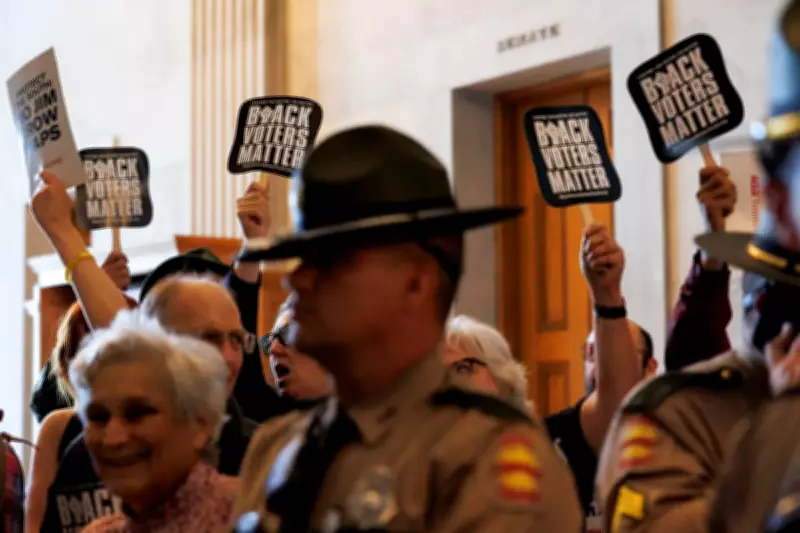
Black voters in Mississippi, Louisiana, Tennessee and elsewhere are again being asked to prove that their power can survive the ingenuity of those determined to contain it, writes Jamil Smith in a Guardian US column. The Supreme Court has gutted one of the strongest federal tools against the most effective weapon in US politics: gerrymandering.
The Power of Maps
Maps can guide us home, showing where we are and where we might go. But electoral maps do something more sinister: they often dictate what and who is allowed to matter. They can decide, before a single ballot is cast, whether an entire voting bloc becomes powerful or is buried by a party's design. Memphis is the latest warning. Tennessee's largest majority-Black city can vote, organize, and resist, yet it was cut into pieces by politicians who fear its power. Republicans carved up the Memphis-centered congressional district, dividing its only majority-Black district into three Republican-leaning seats while weakening voter-notice requirements.
Gerrymandering's Brutal Impact
Gerrymandering does more than help one party win. It teaches a community that even overwhelming local political will can be made irrelevant by a map. The US may celebrate 250 years since the Declaration of Independence, but a multiracial democracy is barely older than the Voting Rights Act of 1965 (VRA). The VRA addressed ballot access, voter registration, and racial vote dilution, but it was incomplete. Racism remains a shapeshifter, and the old VRA was not built to combat modern electoral mapmaking tools: data analysts, algorithms, partisan alibis, and lawmakers who cloak racial harm in party politics.

In the Louisiana v. Callais ruling, the six conservative Supreme Court justices weakened a key VRA section that prevented states from drawing maps diluting Black political power. What was lost is not abstract; it was one of the only federal tools against a potent weapon. The trap is cruel: if a state draws a map that dilutes Black political power, it can claim it targeted Democrats, not Black voters. Since the 2019 Rucho v. Common Cause ruling, partisan gerrymandering claims are beyond federal courts, making the mapmaker's excuse a shield. The Callais ruling strengthened this with misleading data, as Justice Alito's opinion lifted a central claim about Black turnout from a Justice Department amicus brief, using cherry-picked numbers from 2008 and 2012.
What Must Come Next
Smith argues that if Democrats regain Congress, they must pass a new Voting Rights Act immediately, including a federal ban on gerrymandering in congressional districts—not just racial, but partisan gerrymandering by either party, under one national standard. This would be extremely difficult, requiring Congress to bar maps drawn by Republicans in the South and Democrats in states like California, Illinois, New York, and Virginia, where the state supreme court struck down a voter-approved Democratic redistricting plan. A genuine ban means giving up the gerrymander we like along with the one we hate, trusting policies and voters more than cartographers.
While some argue for counter-gerrymandering, Smith contends that this logic leads to an arms race that mutilates democracy. Gerrymandering is a nuclear weapon for democracy; the danger is that once enemies use it, allies insist they need it to survive. Democracy then becomes a contest among mapmakers, not voters.
Recent Events
The past week alone tells the story: Callais, Mississippi preparing a redistricting vote in the old capitol where it seceded in 1861 and ratified Jim Crow in 1890, Louisiana postponing its congressional primary, and Tennessee enacting the first post-Callais map. Then came Virginia: the FBI searched the office of state senator L. Louise Lucas, an 82-year-old great-grandmother and leader of the redistricting fight. Though the investigation may be legitimate and predates the fight, in the current climate, law enforcement is understood through map wars. Two days later, Virginia's supreme court struck down the newly approved Democratic redistricting plan, wiping out a ballot measure voters approved on April 21. The ruling turned on procedure, but it reveals that once gerrymandering becomes a live weapon, every institution becomes part of the battlefield.

A New Voting Rights Act
A new VRA must do what the old one could not: end the legal fiction that gerrymandering is only a state-court problem, restore preclearance so states with discrimination records cannot change election rules first, require independent redistricting commissions or a uniform federal standard for compactness, contiguity, and transparency with explicit racial fairness and partisan symmetry requirements, prohibit states from laundering racial vote dilution through partisan language, and bar noncompliant maps from future federal elections, including those already drawn this decade. Any reform that leaves today's damaged maps in place freezes the battlefield as mapmakers designed it.
Smith acknowledges some Democrats may disagree due to fear of losing responsive maps, but after Callais, they are wrong. Simultaneous disarmament under one national standard is necessary. Whether reform happens depends on November. Trump is sinking in polls, and midterms could deliver a House majority willing to begin this work. The South will be the test, as cuts come faster there. Black voters in Mississippi, Louisiana, Tennessee, and elsewhere are again asked to prove their power can survive containment.
Powerlessness Is Not Helplessness
Voters cannot reverse Callais alone, but they can elect a Congress with a mandate to answer it. Civil-rights legislation passed in the 1960s not because white people became generous, but because Black Americans and allies applied pressure until Congress erected bulwarks against racism. Now a new movement for a new VRA is needed, requiring voters, not spectators: registration drives where cutting is sharpest, turnout numbers that make the line a story, and persistence. Punishing voter suppression after damage is done is insufficient; we must prevent it outright by taking the tools of racism away from practitioners, including the gerrymandering weapon from everyone. A party unwilling to do that is not defending democracy but managing its decline.