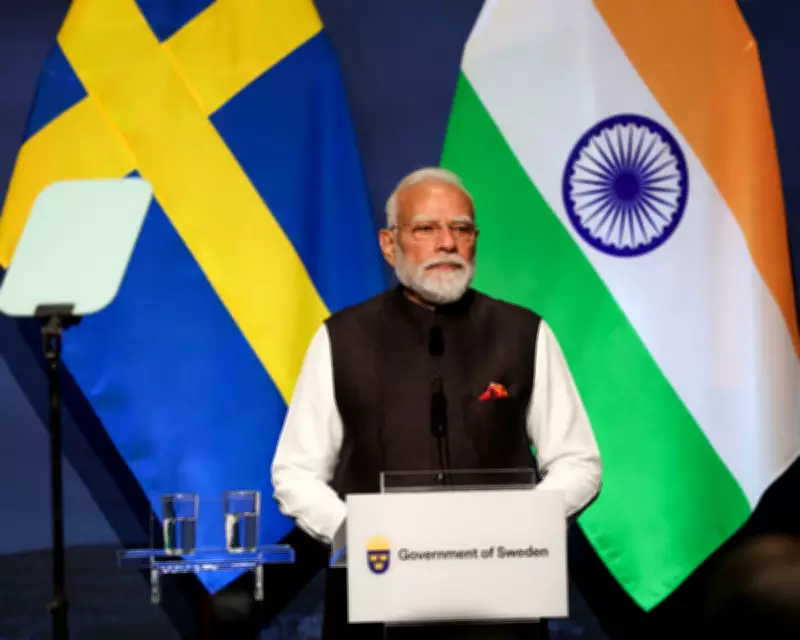
Indian Prime Minister Narendra Modi's recent call for sacrifice marks a fundamental shift in the country's economic stance. Speaking after key regional elections, he urged India's 1.4 billion people to consume less fuel and fertiliser, buy less gold, and curb foreign travel as global energy prices surge due to the war in Iran. This message, reminiscent of Covid-era restrictions, signals a retreat from neoliberal globalisation in Asia and the return of strategic economic management.
Modi's explicit economic argument is that India must conserve its foreign exchange by reducing energy imports. About 90% of India's oil and gas needs come from abroad, leading to higher import bills in dollars, inflation, and pressure for increased subsidies when prices spike. Despite recent economic success, India has not built sufficient productive, export, or homegrown green-power capacity to reduce its vulnerability. To prevent the rupee from crashing, India's central bank reportedly burned through more than $40 billion in reserves.
Analysts from Nomura see a deeper rethink on how India manages its external sector. The crisis in the Strait of Hormuz demonstrates that Asia's post-1990 growth model, which India increasingly embraced, depended on a geopolitical environment that is ending. Once the assumptions of secure, US-policed shipping lanes, cheap Gulf hydrocarbons, and low freight costs vanished, the balance-of-payments constraint for developing nations returned with a vengeance.

A generation shaped by India's 1991 balance-of-payments crisis had a deeper instinctive feel for this danger than parts of today's policy establishment. The death of former Prime Minister Manmohan Singh, who was finance minister during the 1991 emergency, silenced an authoritative voice for whom the current account deficit was existential. That experience shaped a cautious, strategic mindset through India's opening-up phase in the 1990s and 2000s.
What changed in 2014 with Modi was a sense that India had arrived, partly because the country had experienced a long period of trouble-free economic growth. Modi treated globalisation as durable enough to justify India's deeper integration into world markets. China's rise also altered Indian ambitions. The underlying assumption among elites was that India was too big to fail, breeding complacency.
The United Nations warned in April that South Asia, with India as the biggest actor, faces the largest losses from the US-Israel war on Iran, with its regional economy potentially shrinking by 3.6%. In East Asia, dominated by China, the figure is just 0.4%. The UN suggests that resilience comes not from deeper dependence on fragile global markets, but from domestic productive capacity, strategic buffer stocks, and prioritisation of economic security over brittle efficiency—a repudiation of globalisation tenets.
The post-1990 era was an unusually stable order that allowed countries like India to tolerate external dependencies once considered risky. The Iran crisis and wider geopolitical fragmentation are exposing how contingent and fragile that world always was.