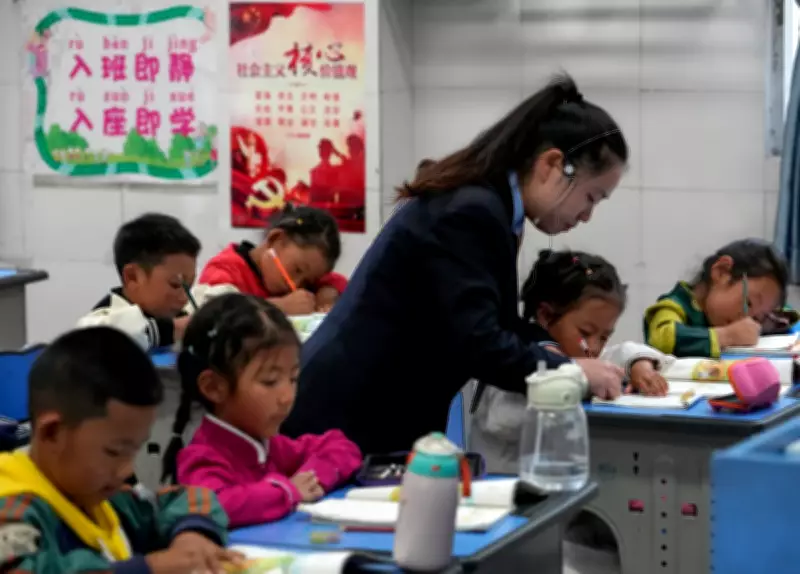
Since 2021, the Chinese government has required Mandarin to be used in all Tibetan preschools, a policy that parents and activists say is eroding the Tibetan language and culture. According to a report by Human Rights Watch (HRW), children are being taught to identify as Chinese and to idolize the Chinese Communist Party and the People's Liberation Army (PLA), severing their connection to their heritage.
Impact on Children and Families
Weeks after a Tibetan-speaking five-year-old started preschool, she had completely stopped speaking Tibetan, according to her mother. Nine months later, although the child could still understand Tibetan, she only answered in Mandarin, and at best a few single-word answers in Tibetan after some time. Instead, the girl keeps saying that she can only speak Chinese and that she is Chinese, not Tibetan. The mother believes her daughter is simply repeating what she is constantly told at school and that the government aims to eradicate Tibetan.
Maya Wang from HRW explains that children are now taught to identify with the Chinese Communist party, idolize the PLA, and see themselves as part of the Chinese nation. Recent videos from Tibet show young children unable to say their names in Tibetan, pronouncing them as if they were Chinese. This is breaking children's link to their language and culture and severing their connection to their families, says Lhadon Tethong, director of the Tibet Action Institute.

Government Policy and Its Consequences
In 2021, the Chinese Ministry of Education began requiring Mandarin as the medium of instruction in all schools nationwide, taking precedence over minority languages like Tibetan, Uyghur, and Mongolian. The government has also pressured parents and children to speak Mandarin at home, promoting it as a civilized language while implying Tibetan is inferior. Parents and elders try to instill Tibetan in children before school, but authorities have cracked down on unsanctioned language classes.
After attending these preschools, children become reluctant to speak Tibetan even at home, including with their parents. Since grandparents often speak only Tibetan, the loss of language has a cascading effect, says Wang. Tethong adds that not only can children and families no longer communicate, but the transmission of culture and identity through generations is cut.
Broader Implications
In 2024, children at a kindergarten in Gertse county dressed up as the Chinese red army, reenacting resistance against Japanese imperial forces. A Tibetan official involved in cultural policy implementation told HRW that by age six, even if both parents are Tibetan, the children think they are Chinese. Day by day, children are coming back acting in bizarre ways, and no one can tell where this will lead for the culture.
Tibetan parents face a dilemma: some Chinese education is desirable for employment, but it leads young Tibetans to associate Chinese language and culture with opportunity and Tibetan with social disadvantage. Wang emphasizes that Tibetans should have the right to educate their children in their language, culture, and religion as they choose.