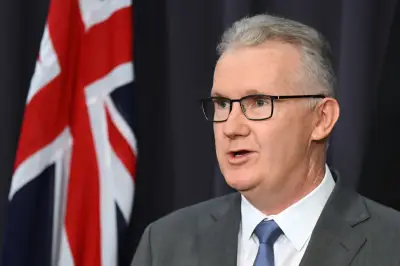
Australia's Labor prime minister Anthony Albanese's closest advisers include Penny Wong, Mark Butler and Katy Gallagher for the party's Left faction. Will the evolution of Labor's Left from firebrands to centrists define Albanese's leadership? Labor's activist wing has probably never held such power, yet the PM offers uncritical support for Aukus and refuses to criticise Trump's acts of war.
Standing inside Victorian Trades Hall in inner-city Melbourne, the left-wing Labor firebrand Doug Cameron unleashed a withering attack on his faction's federal MPs. Where are the 'peace activists in the caucus', the former New South Wales senator raged, and why have MPs allowed themselves to be 'defanged and co-opted' into supporting US military aggression? He contrasted their approach to the left-wing revolt in 1985 that forced then-prime minister Bob Hawke to retreat from plans to allow US missile testing in the Tasman Sea. 'The Left parliamentary caucus used to reflect the views of the progressive rank-and-file; they acted as the party's conscience. Those days seem to be long gone,' Cameron said in the 2025 Carmichael Lecture.
The speech, much like the stream of anti-war, anti-Aukus messages that Cameron posts to social media, generated barely a ripple among federal Labor MPs, many of whom politely dismiss the old manufacturing workers' union leader as a relic of another era. But Cameron's criticism does highlight one of the defining features of the Albanese government. Labor's historically activist wing has arguably never held so much power to shape the country; a prime minister ensconced in the Lodge, surrounded by a praetorian guard of factional allies and a majority Left caucus. Labor's own constitution describes it as a democratic socialist party. So why is it so centrist?

'No longer the insurgents'
Support for Scott Morrison's Aukus deal and refusal to criticise Donald Trump's acts of war and aggression are the clearest points of friction between the Labor caucus and sections of its grassroots base, who view the acquiescence to the US as the antithesis of what a Labor government should do. But it feeds into a wider debate about the Labor Left under Anthony Albanese and how it wields power and pursues progressive change. The Albanese government's record includes a long list of progressive policies, including wage rises in female-dominated care sectors, climate targets and new nature laws, expanded paid parental leave and billions for women's health, social housing and Medicare.
The prime minister's legacy project of a universal childcare system is, as one colleague argues, a democratic socialist concept. But his government has also approved gas projects, rejected advice to substantially increase jobseeker payments, proposed cuts to the national disability insurance scheme, sought consensus – rather than contest – with corporate Australia and struck a highly secretive deal to resettle criminal noncitizens on Nauru, all without a public backlash from Left. It is a member of the Right – the former cabinet minister Ed Husic – who has often appeared to act as the party's conscience, including throughout Israel's war in Gaza.
Guardian Australia spoke with more than a dozen Labor Left figures about the faction in the second part of a series examining the Albanese government's mission as it enters its fourth year in power. What emerges is a picture of a political grouping that no longer acts as an insurgent force within Labor, which believes that changing the country is achieved not through a Gough Whitlam-style rush to reform but patient, incremental progress.

Members of the Left are loyal, trusting and in some cases fearful of Albanese, which helps explain why MPs have so often resisted breaking ranks when their government adopts positions that challenge them philosophically. Albanese leads with the support of the Right but his closest advisers, Penny Wong, Mark Butler and Katy Gallagher, and most loyal lieutenants, Tim Ayres, Pat Conroy and Andrew Giles, are all from the Left. 'I think the modern Labor Left has become much more comfortable with the idea of holding and exercising power rather than just being an opposition force,' said one Labor Left figure, who was granted anonymity to speak freely about internal party matters. 'I guess we've moved from being insurgents to being leaders and that involves a level of responsibility that we haven't historically held.'
'A sensible progressive approach'
No two policies in recent years have caused more friction in the Labor movement – and tested the modern Left – than the push to recognise a Palestinian state and the Aukus security pact. Just under seven years after the Left's Penny Wong and the Right's Tony Burke engineered a motion at the party's national conference calling on the next Labor government to recognise a Palestinian state, Wong and Albanese announced the historic step in August 2025. The decision was reached almost two years into Israel's war in Gaza and after persistent external and internal pressure, including from the Labor Friends of Palestine member group.
The government's refusal to act earlier – in keeping with the national platform – was the catalyst for first-term Left senator Fatima Payman to cross the floor in parliament and ultimately resign from the party, which has proven the only major episode of disunity during Albanese's prime ministership. The ostracisation of Payman was a case study in Labor's internal culture, in particular the Left, which prioritises collective action over individual freedom. Payman, who now sits as an independent, is scathing of the culture of the Left and the overall direction of the party. 'I just think Labor is regressing year by year,' said the Western Australian, who continues to resent Albanese for refusing to grant her the same staffing allocation as other crossbenchers.
Senior figures in the Left describe the internal process that led to the recognition of Palestine statehood as an example of a 'sensible progressive approach' that has defined Albanese's leadership. They point out the announcement was made despite opposition from the Trump administration, which runs counter to the narrative that Albanese routinely falls in behind the US. The public criticism of Trump's trade tariffs, refusal to remove Kevin Rudd as US ambassador and overall support for climate action are cited as other examples.
But Albanese and his caucus have not publicly criticised Trump or questioned the legality of his military interventions in the Middle East, which experts have concluded were in breach of the UN charter. Left MPs were alarmed at the government's rush to unequivocally support the US and Israel's bombing of Iran in late February but their concerns were aired in private, internal meetings – and never repeated publicly. Three senior sources said navigating the US relationship and war in Gaza had been the biggest challenge for members of the Left, including Albanese. In justifying their approach, MPs said it would be easy to openly criticise Trump or Israeli prime minister Benjamin Netanyahu. 'But what will be the impact of those actions, and will they actually make a difference? The answer almost certainly is no,' said one MP, who went on to question the wisdom of 'torching' the US relationship and risking economic retribution that would ultimately hurt Australian workers.
The view is not shared by sections of the Labor rank and file, many of whom are also implacably opposed to the Aukus project that further entrenches the US alliance. More than 95 local Labor member groups – including branches and state and federal electorate councils – have passed anti-Aukus motions, while motions condemning the US and Israel's war in Iran have been endorsed by two-dozen. Debate is expected on both in the lead up to the party's national conference in Adelaide in July, as is the push for a 25% gas export tax – a policy supported in the Labor movement but so far resisted by the Albanese government.
Marcus Strom, a national convener of the Labor Against War group, said Albanese's consolidation of the party leadership had marked the 'final disappearance of the Left'. 'It is now up to the broader labour movement to re-establish a left that isn't simply focused on winning power at any cost but focused on rebuilding a genuine socialist movement,' he said. Labor members and the federal caucus agree – the Left has evolved. Whether it has been for the better is a question of perspective.