Defense Secretary Pete Hegseth denied that the US-Israel war on Iran, which the Pentagon estimates has cost the United States at least $25 billion, is a quagmire. He further claimed that critics of the operation pose a greater threat to the US than Iran itself.
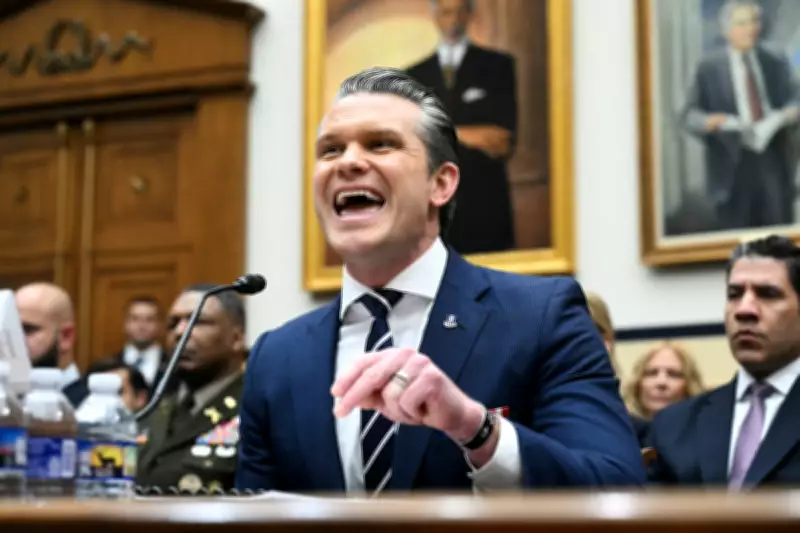
Hegseth faced pressure to outline Washington's strategy for the conflict during a marathon hearing before the House Armed Services Committee on Wednesday, alongside General Dan Caine, chair of the Joint Chiefs of Staff. The defense secretary asked lawmakers to approve $1.5 trillion in military spending, then described some of those lawmakers as the biggest challenge to the war effort.
“The biggest adversary we face at this point are the reckless, feckless and defeatist words of congressional Democrats and some Republicans,” Hegseth declared. These remarks were not included in a prepared statement submitted to the committee.

The financial cost of the war continues to escalate. Jules Hurst III, chief financial officer for the Pentagon, told the committee that the estimated cost for the US is $25 billion and rising, mostly from munitions, operations, maintenance, and equipment replacement.
Two months into a conflict that President Donald Trump predicted would last four to six weeks, Hegseth invoked the US's long and painful deployments in Vietnam, Iraq, and Afghanistan—wars he has bitterly criticized—as a benchmark for endurance. He described the war against Iran as an existential fight for the safety of the American people, stating that the administration is proud of this undertaking.
Protesters chanted in the hallways, calling Hegseth and Caine war criminals, and many members of the public struggled to gain admission to the hearing.
Trump posted an AI-generated image of himself holding a weapon amid explosions on social media with the caption “NO MORE MR. NICE GUY” and wrote that Iran “better get smart soon.” He also told Axios that he is prepared to keep Iran under a naval blockade until a deal is reached, raising the prospect of a prolonged conflict.
Tensions soared when California Democrat John Garamendi took the floor and hammered Hegseth over what he called astounding incompetence that has led to political and economic disaster at every level.
“The president has gotten himself and America stuck in a quagmire of another war in the Middle East,” Garamendi said. “He is desperately trying to extricate himself from his own mistakes; it is in America’s, and indeed the world’s, interest he succeed in that.”
Hegseth, incensed by the statement, attacked the congressman. “Who are you cheering for here? Who are you pulling for?” Hegseth shot back. “Your hatred for President Trump blinds you to the truth of the success of this mission and the historic stakes that the president is addressing that the American people support.” He added, “You call it a quagmire, handing propaganda to our enemies? Shame on you for that statement.”
Hegseth claimed that Trump has stared down Iran and will now get a better deal than anyone ever has, ensuring Iran never obtains a nuclear weapon.
Committee chair Mike Rogers, a Republican, signaled his support for the administration's budget proposal. “All of our adversaries are spending more of their GDP on defense than we are,” Rogers said, calling the $1.5 trillion figure one that accounts for the true cost of American deterrence. Hegseth noted that the budget includes a historic troop pay increase of 7% for lower enlisted personnel.
Ranking Democrat Adam Smith of Washington questioned whether the 50-60% spending increase would be responsibly managed, saying, “We have every reason to doubt that.” He challenged the administration over the diplomatic isolation in which the war is being fought. “We’re doing this on our own, as we increasingly push away all our allies, sometimes just gratuitously insulting them,” Smith said. “In the middle of this war where we’re asking NATO to come join us, the president took time to insult President Macron of France and his wife. How is that helping us?”

Smith also raised the strike on a school in the Iranian city of Minab during the opening phase of the joint US-Israeli campaign, in which Iranian officials say at least 168 people were killed, most of them children. The Pentagon had said the attack was under investigation, but Hegseth and Caine had not been required to address it under oath until Wednesday.
“We made a mistake, and that happens in war,” Smith said. “Two months after it happened, we refused to say anything about it, giving the world the impression that we just don’t care.”
Another tense exchange occurred when Hegseth declared that Iran’s nuclear facilities had been obliterated. Smith pressed: “Whoa, whoa, whoa. We had to start this war, you just said, because the nuclear weapon was an imminent threat. Now you’re saying it was completely obliterated?” When Hegseth replied that Iran had not abandoned its nuclear ambitions, Smith asked, “So Operation Midnight Hammer accomplished nothing of substance?” Hegseth responded, “You’re missing the point.”
The hearing split along partisan lines. Democrats pressed Hegseth on surging fuel costs and economic damage from Iran’s closure of the Strait of Hormuz, arguing this contradicts Trump’s promises to lower household bills. Hegseth consistently pushed back without directly answering questions, asking, “What is the cost of Iran having a nuclear weapon that they wield?”
Republicans were largely supportive. Nancy Mace, who had publicly questioned the war’s justification as recently as late March, told Hegseth she was impressed with where we are today and that he had surpassed all her expectations.
The broader picture remains a stalemate. A fragile ceasefire is in place, but three US aircraft carriers remain in the Middle East for the first time in over two decades. Trump said Wednesday he was rejecting Iran’s offer to reopen the strait in exchange for lifting the US naval blockade. Democrats have repeatedly failed to pass war powers resolutions that would force the president to seek congressional authorization. While Republicans say they back Trump for now, some are watching quietly for the moment that position becomes harder to hold.
Just before Hegseth’s opening statements, Massachusetts Democrat Seth Moulton said in the hallway he was expecting to hear a bunch of bullshit. “I’d really like him to just tell the truth” about the war with Iran, Moulton said.
Hegseth and Caine return to the Hill to face the Senate on Thursday.