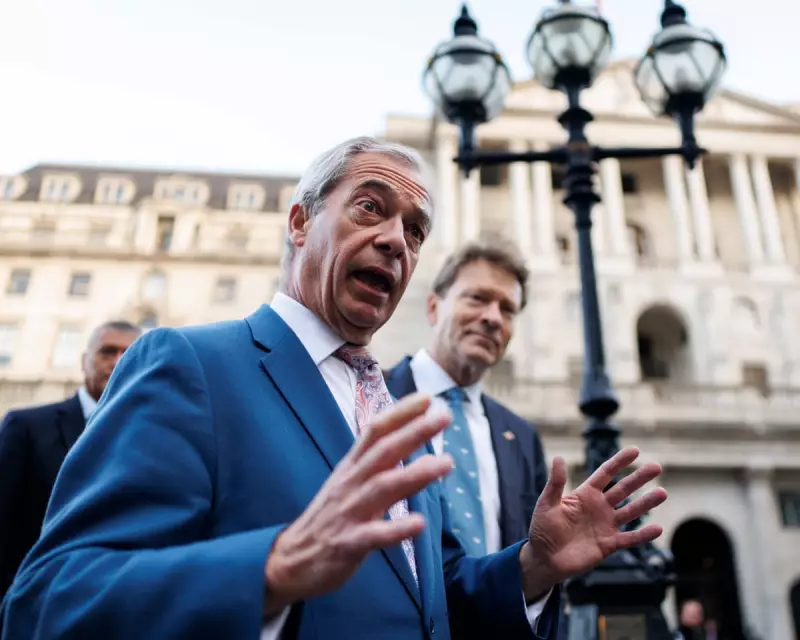
As Nigel Farage positions himself for a potential role in British government, questions are emerging about whether the Reform UK leader can follow the path of Italy's Giorgia Meloni in transitioning from hard-right populist to pragmatic leader.
The Meloni Model: From Far-Right to Mainstream
Giorgia Meloni's journey offers a compelling blueprint for political transformation. The Italian prime minister, who leads the Brothers of Italy party with neofascist roots, has remarkably shifted from her hard-right origins to become a respected figure on the world stage.
During her three years in power, Meloni has demonstrated significant pragmatism and flexibility, earning praise from leaders including Keir Starmer. Her appearance in informal discussions at June's G7 summit highlighted her acceptance among global power brokers.

Meloni's approach combines ideological principles with practical governance. She has mixed controversial plans to process asylum claims in Albania with a substantial increase in work visas to address labour shortages. Her ability to speak English, French and Spanish fluently has facilitated relationships with diverse world leaders.
Farage's Political Evolution
Nigel Farage has already achieved one parallel with Meloni's success, having transformed a hard-right party from single-digit support to mainstream popularity. His ideological consistency includes a long-standing refusal to ally with openly far-right groups, from avoiding the British National Party in UKIP's early days to recently distancing himself from Elon Musk and far-right agitator Tommy Robinson.
According to Gawain Towler, Farage's former press chief, the Reform leader's principles haven't changed significantly, though his perspective has evolved. Farage's 'blood and thunder Thatcherism' from his City trading days has been tempered by 25 years visiting Britain's poorer areas, recognising that pure Thatcherism didn't benefit everyone.
Like Meloni, Farage demonstrates message flexibility for different audiences. He has aired conspiracy theories associated with the far right in US interviews, rhetoric he has since abandoned. He has also shown willingness to drop policies hindering Reform's rise, notably recently abandoning £90 billion in planned annual tax cuts promised just last year.
The Critical Difference: Experience and Temperament
The comparison between Farage and Meloni breaks down significantly when examining their political experience and governing temperament. Meloni brings nearly 20 years of parliamentary experience, including serving as a minister in Silvio Berlusconi's coalition government back in 2008.
In contrast, while Farage is a political veteran as a founding UKIP member over three decades ago, his experience has primarily involved leading small groups of outsiders. Former colleagues question his adaptability to the compromises necessary for national government.
'Nigel was not at all collegiate back in the day,' recalled someone who observed his work as an MEP. 'It was his way or the highway, and he'd consider genuine disagreement to be treachery. The question is, has he changed?'
Robert Ford, professor of political science at Manchester University, emphasises that Meloni 'has had a lot of experience at bargaining, compromise, negotiation - the more subtle arts of manoeuvring yourself into a position where you win and get what you want. None of this is necessarily familiar political terrain for Farage.'
Farage's leadership style has historically been autocratic, with his word treated as 'holy writ' in organisations he controls. This approach has led to repeated splits whenever his parties developed more complex internal structures. The Brexit Party and Reform were explicitly designed so that 'if anyone disagrees with Nigel, Nigel wins' - a model that doesn't work in government.
The fundamental challenge for Farage lies in transitioning from campaigning poetry to governing prose. While Meloni successfully navigated this shift through her extensive experience with political compromise, questions remain whether Farage can overcome his reputation for inflexibility and adapt to the realities of coalition-building and pragmatic governance.