In the wake of the recent Supreme Court decision that weakened the Voting Rights Act (VRA), civil rights activists are speaking out against what they see as a direct assault on the hard-won gains of the movement. The ruling, which struck down key provisions of the landmark 1965 law, has sparked outrage among those who marched, bled, and died for the right to vote.
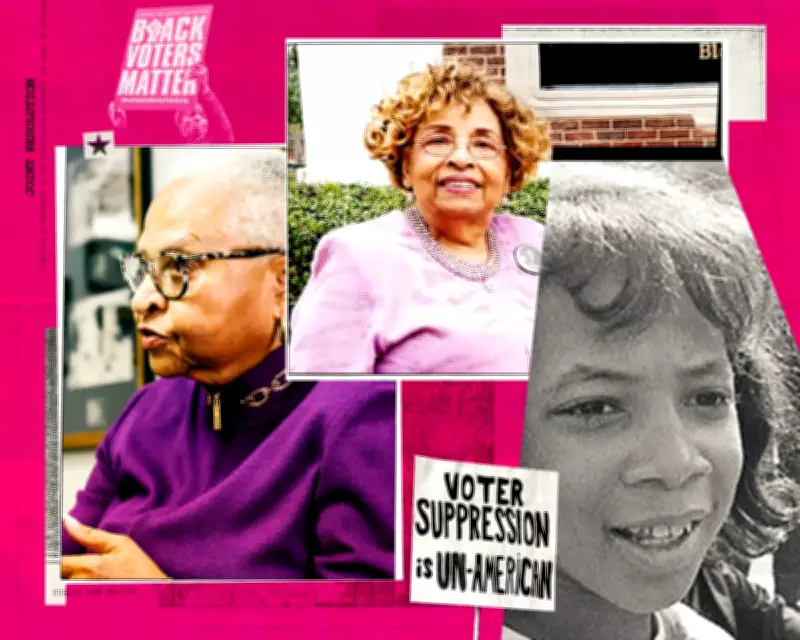
“When we look at the Supreme Court’s action against the Voting Rights Act, it’s really a kneecap – a way to discriminate, to silence voters who fought so hard for this right,” said Sheyann Webb-Christburg, who was just eight years old when she marched with civil rights leaders in Selma, Alabama, in 1965. Known as the “smallest freedom fighter,” Webb-Christburg’s words echo the sentiments of many who see the decision as a step backward.
The case, Louisiana v Callais, eviscerated Section 2 of the VRA, which prevented racial discrimination in voting practices and gave minority voters the opportunity to elect candidates of their choice. Just eight days after the decision, the Republican-led Tennessee legislature passed new redistricting maps, eliminating the state’s only Democratic, Black-majority congressional district. Other southern states, like Mississippi, are expected to follow suit.

A Long Struggle for Voting Rights
The fight for voting rights is as old as the United States itself. When the country was founded, voting was limited to white male landowners. After the Civil War, Black American men were granted the right to vote under the 15th Amendment, and they did so in droves, electing Black senators and representatives to Congress. However, white southern Democrats responded with violence, fraud, poll taxes, and literacy tests that gutted Black political power and erased Black congressional representation for generations.
Despite these obstacles, Black Americans continued organizing and fighting for voting rights through strategic litigation, mass organizing, and protests. The fight was not easy. Pillars of the civil rights movement, such as Medgar Evers, Martin Luther King Jr., and Vernon Dahmer, were assassinated for their efforts. Others, like Fannie Lou Hamer, Amelia Boynton, and John Lewis, were assaulted. Across the South, voting rights activists were murdered, kidnapped, beaten, firebombed, and harassed.
A turning point came in 1965, when hundreds of activists were brutalized by state troopers on the Edmund Pettus Bridge in Selma as they marched for equal voting rights. Remembered as “Bloody Sunday,” that assault on peaceful protesters was broadcast nationally, galvanizing public pressure that led to the passage of the Voting Rights Act just five months later. The VRA outlawed literacy tests and poll taxes, fundamentally transforming Black political participation across the country.
Voices from the Movement
Sheyann Webb-Christburg: ‘It’s an Assault on the Struggle’
Webb-Christburg, now 70, recalled the day she first understood what freedom meant. As a little girl living next to Brown Chapel church in Selma, she met Dr. Martin Luther King Jr., who treated her with kindness and respect. Despite her parents’ fears of the Ku Klux Klan, she slipped out to attend meetings and marches. On Bloody Sunday, she marched as the youngest participant. “I remember the teargas burning my eyes,” she said. “People were being beaten down to the ground, as if they weren’t human beings.”
She sees the Supreme Court decision as a direct attack on that struggle. “To put a special effort of voter suppression, at this time, in 2026 – that saddens me. This is not only illegal and unconstitutional, but it’s an assault on the struggle of the civil rights movement.”
Constance Slaughter-Harvey: ‘Racism is Still the Root’
Constance Slaughter-Harvey, 79, the first Black female graduate of the University of Mississippi Law School and the first Black female judge in Mississippi, said she knew from age six that African Americans faced barriers. She met Medgar Evers in 1963, and his murder fueled her determination. “The mindset for this country tells us we must fight to keep whatever semblance of freedom we have,” she said. “Racism is still the root of the structure. Survival is not sufficient.”

Benny Tucker: ‘We’re Going Backwards’
Benny Tucker, 86, a Selma foot soldier and Martin Luther King Jr.’s bodyguard, recalled the horrors of segregation and the struggle to vote. On Bloody Sunday, he was beaten and teargassed. “I didn’t think we needed a Voting Rights Act,” he said. “I told Dr. King, ‘Someone is going to come along and change it.’ Now, we have to keep marching. We’re going backwards. There’s no leadership.”
Flonzie Brown-Wright: ‘Don’t Be Discouraged’
Flonzie Brown-Wright, 83, the first Black woman elected official in Mississippi post-Reconstruction, helped register thousands of voters. She faced a 21-item questionnaire and arbitrary denials. “Our ancestors fought with nothing,” she said. “Now, we have business people, lawyers, doctors. Don’t be discouraged, even though this is a discouraging time. The journey of 1,000 miles begins with one step – your one vote.”
Doris Crenshaw: ‘Work Harder and Smarter’
Doris Crenshaw, 83, started organizing at age 12 with Rosa Parks. She traveled the state collecting information about attacks on Black people and encouraging voter registration. “When they gutted Section 2, I was expecting it,” she said. “We’ve got to put our shoulders to the plow and work harder and smarter. We’ve got to register people to vote like we never registered before.”
The activists agree that the fight is far from over. They urge continued organizing, voter education, and mobilization to counter the Supreme Court’s decision and protect the right to vote for all Americans.