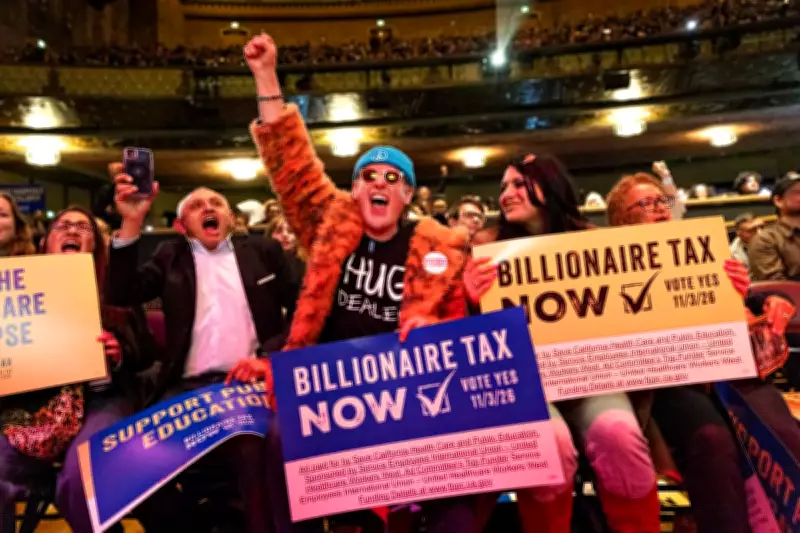
Proponents of a proposal to levy a one-time tax on California billionaires say they have gathered enough signatures to place the measure on the ballot in November. The campaign reports collecting more than 1.5 million signatures, according to a statement.
Measure Details and Opposition
The proposal has ignited a political uproar in Silicon Valley, with tech titans threatening to leave the state and Governor Gavin Newsom opposing the measure. The tax imposes a one-time 5% levy on the assets of billionaires, including stocks, art, businesses, collectibles, and intellectual property, to backfill federal funding cuts to health services for lower-income people signed by Donald Trump last year. Sponsored by the Service Employees International Union-United Healthcare Workers West, the tax would apply retroactively to billionaires living in the state as of January 1.
California is home to more billionaires than any other state, with a few hundred by some estimates. Nearly half of the state's personal income tax revenue, a financial backbone in its nearly $350 billion budget, comes from the top 1% of earners. More than 870,000 signatures were required for the measure to qualify for the ballot.

Tech Billionaires Fight Back
Tech billionaires have battled the proposal with large donations to the campaign against it, including current and former CEOs from Google, DoorDash, Reddit, LinkedIn, and Facebook. Alphabet president Sergey Brin has donated at least $45 million to a Super PAC dedicated to blocking the tax, while Alphabet's former CEO Eric Schmidt contributed more than $3 million.
The proposal has created a deep rift between Newsom and prominent members of his party's progressive wing, including Senator Bernie Sanders of Vermont, who endorsed the measure and said it should be a template for other states. "Our nation will not thrive when so few have so much while so many have so little," Sanders said on X. Another supporter, and a potential 2028 Newsom rival, is Representative Ro Khanna, who mocked billionaires for threatening to flee over a tax intended to provide health care for lower-income people.
Newsom's Position and Economic Concerns
Newsom has long opposed state-level wealth taxes, believing such levies would be disadvantageous for the world's fourth-largest economy. At a time when California is strapped for cash and he is considering a 2028 presidential run, he is trying to block the proposal before it reaches the ballot. Analysts say an exodus of billionaires could mean a loss of hundreds of millions of tax dollars. "It's one of the reasons why Newsom's path to the Democratic nomination is not going to be an easy one," said Jack Pitney, a political scientist at Claremont McKenna College. "He's already facing a budget deficit the size of which is uncertain... and in the years to come, a billionaires tax that could backfire badly."
The measure's lead proponent, the Service Employees International Union, sees the threat of an exodus as exaggerated. The tax is a "workable response to a crisis created by Congress," said Suzanne Jimenez, chief of staff of SEIU-United Healthcare Workers West, in a statement. She added that it would "keep emergency rooms open, hospitals staffed and health care systems functioning." The California Business Roundtable, meanwhile, is leading an effort to defeat the measure, saying it would "undermine our economy, decimate the state budget, drive investment out of the state and ultimately make everyday life more expensive for working families."