EU Leader Issues Stark Warning Over Ukraine's Sovereignty
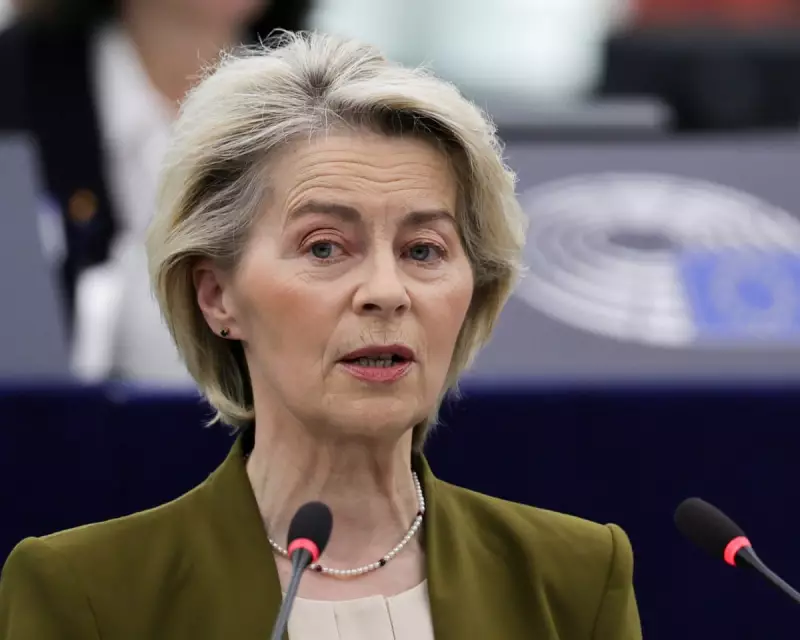
European Commission President Ursula von der Leyen has delivered a powerful address to European lawmakers, cautioning against what she described as "the unilateral carving up of a sovereign European nation." Speaking during a crucial debate on Ukraine at the European Parliament in Strasbourg, von der Leyen emphasised that changing borders by force would create a dangerous precedent for future conflicts.
No Signs of Russian Willingness for Peace
The EU leader stated that Russia shows "no signs of true willingness to end the conflict" and continues to operate with a mindset unchanged since the 1945 Yalta conference that established the post-war order. She made her comments as European foreign ministers held an emergency video conference to discuss the rapidly evolving situation.
"So we need to be clear that there cannot be unilateral carving up of a sovereign European nation, and that borders cannot be changed by force," von der Leyen told assembled MEPs. "If today we legitimise and formalise the undermining of borders, we open the doors for more wars tomorrow, and we cannot let this happen."
Trump's Peace Efforts and European Concerns
While welcoming Donald Trump's efforts to broker peace as "a starting point," von der Leyen expressed significant European concerns about details in the original 28-point US-Russian plan. Some of the most Russia-friendly demands have since been removed according to Ukrainian officials, though key sticking points remain unresolved.
The situation was described as both volatile and dangerous, though the Commission president noted she saw "an opportunity here to make real progress." However, she stressed that maintaining pressure on Russia remains essential given Moscow's apparent unwillingness to genuinely engage in peace efforts.
Military Restrictions and Security Guarantees
Von der Leyen outlined several non-negotiable positions for Europe, including opposition to any limits on Ukraine's armed forces. She argued that such restrictions would "leave the country vulnerable to future attacks" and emphasised Ukraine's need for robust, credible and long-term security guarantees.
The comments came amid revelations from a leaked recording to Bloomberg showing that Donald Trump's special envoy Steve Witkoff had told a senior Kremlin official last month that achieving peace would require Russia gaining control of Donetsk and potentially other territorial exchanges.
Frozen Russian Assets and Reconstruction Funding
In significant financial developments, von der Leyen promised the European Commission would present draft legal proposals for using Russia's frozen assets to fund Ukraine in 2026 and 2027. This follows EU leaders' failure to endorse the idea last month due to legal concerns from Belgium, which hosts approximately €183 billion of Russian sovereign wealth - representing two-thirds of the worldwide total.
Trump's proposal for the US to take 50% profits from a $100 billion reconstruction investment fund based on frozen Russian assets has increased pressure on European leaders to resolve the issue. The US plan also expects Europe to contribute $100 billion to the reconstruction effort.
Von der Leyen reiterated her support for using frozen assets, stating "I cannot see any scenario in which the European taxpayers alone will pay the bill." EU leaders are scheduled to discuss the frozen assets question next month as they work to finalise funding for Kyiv from 2026-27, with Ukraine expected to run out of money from next spring.
Forcibly Deported Ukrainian Children
Another critical priority highlighted by von der Leyen was the return of Ukrainian children forcibly deported to Russia. She announced plans to host an international conference on the issue in 2026, noting "There are tens of thousands of boys and girls whose fate is unknown, trapped in Russia by Russia. We will not forget them."
Ukrainian authorities have identified nearly 20,000 children unlawfully deported or forcibly transferred to Russia since the full-scale invasion began in 2022. A Ukrainian organisation working on repatriation efforts, Bring Kids Back, reports that 1,835 children have so far returned from deportation, forced transfers and occupied Ukrainian territories.
The situation remains particularly sensitive given that Russian President Vladimir Putin is wanted for war crimes by the International Criminal Court specifically concerning child abductions. The original 28-point peace plan had proposed a full amnesty for all parties involved in the conflict.