
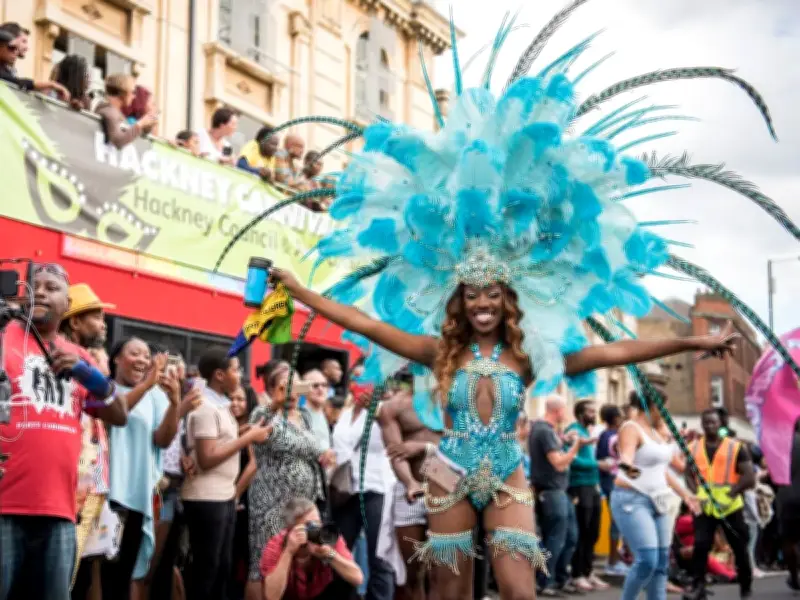
Hackney Carnival, an East London parade that once drew crowds of more than 100,000, remains in limbo after the council withdrew its main funding in 2025, citing the need to protect frontline services. The event, which has run in various forms since the 1970s, was cancelled in 2024 and has not been held since. However, the new Green-led council, under Mayor Zoë Garbett, has pledged to explore a range of funding options, including sponsorship and crowdfunding, to bring the carnival back.
A Carnival with deep roots and a distinct identity
Known informally as Notting Hill's “last lap,” Hackney Carnival has been a fixture of East London's cultural calendar for decades. Residents would return from West London's parade and continue celebrations down Stoke Newington High Street. Over the years, the event has operated under various names, including Mare De Gras, Hackney One Carnival, and Carnival Roadshow, before settling on Hackney Carnival. At its height, it featured more than 1,000 performers and 25 carnival groups, celebrating not just Caribbean traditions but the borough's diverse communities.
Marva Antoine, founder of the performance group Tropical Isles, described the carnival's unique role: “It's the only time in the year that we get everybody out in Hackney and everybody just mixes. It doesn't matter what colour you are, or what nationality: it's just a day of celebration and just being out there.” Tropical Isles, which has performed at Notting Hill for 25 years, sees Hackney Carnival as a vital showcase for community-led work, including summer camps, costume design, and performing arts classes.
Financial strain and the road to cancellation
The carnival's overheads ballooned to around £1m, with the bulk going towards policing, road closures, traffic management, and security. The Covid-19 pandemic led to a hiatus, and the parade's return was deferred in 2022 after the death of Queen Elizabeth II. The council later confirmed it could only support the carnival as a biennial event due to financial strain. After the last carnival in 2024, budget cuts forced the council to withdraw funding, although it ring-fenced some money and continues to fund £150,000 in carnival activities.
The funding withdrawal became a political issue, with the Green Party lamenting the “huge loss” and pledging to restore Carnival in their election manifesto. After winning power in May, the Green-led council reaffirmed this commitment. Mayor Zoë Garbett has promised to “explore a range of funding options to fund future carnival events, including sponsorship and crowdfunding.” The council is also helping establish a Carnival Trust to diversify funding streams, including public grants, private trusts, and brand sponsorships.
Community voices and the path forward
Arts producer Frank Sweeney, who is helping steer the trust, noted the deep interdependence between the carnival and the council: “The life force of Carnival and how it moves and breathes is different to the local authority system, but they're like skin and bone. You can't have one without the other.” He added that carnival groups have been dependent on small grants and lack the capacity to self-fund, but sees the financial stress as an opportunity to harness the spirit that has sustained the event for decades.
“There's a university of knowledge within Hackney Carnival. We've got pioneers of Notting Hill here in terms of expertise. We've got the best here. They've been doing it for a lifetime,” Sweeney said. Marva Antoine suggested that costs could be slashed if authorities like the police offered services for free as a community contribution. Richard Selim Sleeman, co-founder of the inclusive dance group Paracarnival, proposed scrapping road closures, “consultants and sound systems,” or cutting the route in half to accommodate performers in wheelchairs. “You have to start small,” added Bettina Sleeman.
A model for the country?
Richard Sleeman drew inspiration from the Deixa Falar samba group in Rio de Janeiro, formed in 1928 by disenfranchised people from the favelas with no money but enough enthusiasm to make it happen. That spirit, he said, gave rise to the Rio Carnival as it exists today. Frank Sweeney's entry into producing Carnival began with an exchange between Rio and UK-based performers, including Tropical Isles, which brought inspiration back for a Rio-inspired segment in Hackney's 2012 parade.
Despite the uncertainty, Hackney Carnival's survival will be driven by artistic curiosity and community spirit, even if it has to downsize. “Necessity is the mother of invention,” Richard said. “It could be a model for the rest of the country. Easily.”




