
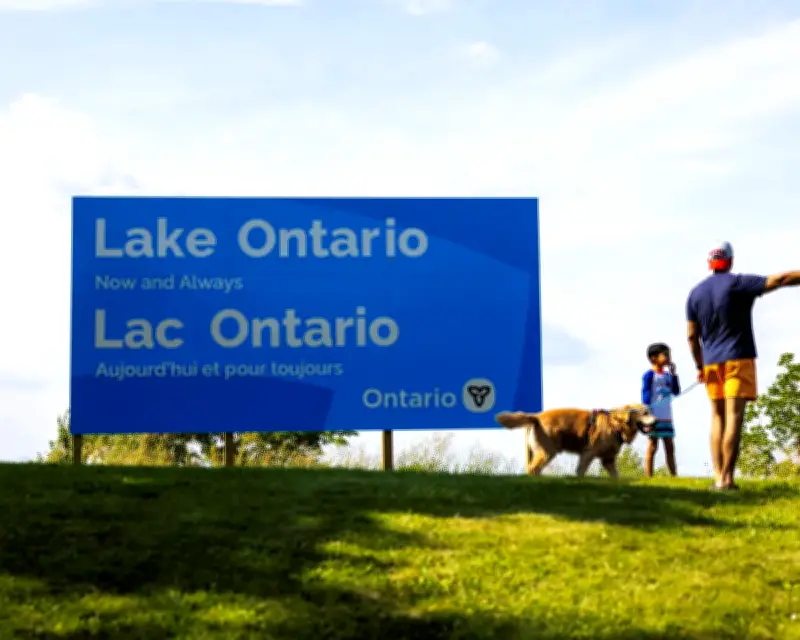
Canada erected a giant sign reading “Lake Ontario. Now and Always” near Grimsby, Ontario, on Saturday, as a verbal dispute with US President Donald Trump over the administrative renaming of the lake escalated. Trump, meanwhile, posted a video of himself kicking over an avatar of that sign, erecting a replacement marked “Lake America,” and dancing to the Village People’s “YMCA.”
The naming spat is the public face of an escalating trade dispute between the US and Canada, which involves a 50% US tariff on Canadian steel and retaliatory tariffs from Ottawa.
Trump’s executive order and Google Maps change
Trump issued an executive order on Thursday directing US federal agencies to refer to Lake Ontario as “Lake America,” effective immediately. The order follows stalled talks to resolve the trade dispute and revives memories of a similar move earlier in his second presidency, when he directed US agencies to refer to the Gulf of Mexico as the Gulf of America.
“We’re going to be changing the name of Lake Ontario effective immediately to Lake America,” Trump told reporters before signing the order. The directive affects the US’s federal Geographic Names Information System (GNIS), “which sets the standard for official US maps,” according to Google.
Google Maps has changed the lake’s name to “Lake America” for US users, reflecting the president’s executive order. The tech company explained that its practice is to “reflect name changes in official government sources.” However, Google stated that the name change “does not have any impact on Canadian naming conventions or how the rest of the world refers to the lake.” Those in Canada will continue to see “Lake Ontario” on Google Maps, while those outside the US and Canada will see both names. Google did the same for the Gulf of Mexico, which US users now see as the “Gulf of America.”
Canada’s response and Indigenous heritage
Canada’s Prime Minister Mark Carney has rejected the renaming, explaining that Lake Ontario derives from an Indigenous Wendat word meaning “the lake is beautiful, the lake is great,” a term that dates back more than 400 years. Wendat Nation grand chief Pierre Picard called Trump’s move an attempt to erase Indigenous history. “I want to tell him that it is unacceptable for us, as a nation, to have a president who can eradicate our history, our culture and our identity,” Picard said.
Ontario Premier Doug Ford replied with a two-storey-high billboard near Grimsby, Ontario, declaring “Lake Ontario. Now and Always.” Ford said Trump was trying to rename the lake because Ontario and Canada were “standing up for ourselves,” and he argued the name would outlast the president. “Long after President Trump is gone, it will still be called Lake Ontario,” Ford said in a video posted on social media. In an interview with the Associated Press, Ford also said the late Ronald Reagan would be “throwing up” over Trump’s tariff policies.
Trump’s AI-generated videos and Manitoba’s reaction
On Saturday, Trump raised the volume again by posting AI-generated imagery. One video showed an army of Canada geese with Trump-like blond hair firing rifles in protection of Lake America. Another showed him kicking over a Lake Ontario sign, replacing it with a Lake America sign, and dancing to “YMCA,” a song he has used in public appearances for years.
Manitoba’s Premier Wab Kinew likened Trump’s provocation to an aging rock band trying to revive an old hit. “You know when, like, a rock band is really over the hill and you see them like in a casino playing some song from like 50 years ago, I think that’s the part of Donald Trump’s presidency we’re at now,” Kinew said. “Like he thought he had a real hit, a real golden oldie, with the Gulf of Mexico. He’s trying to bring back that, and he’s trying to play the hits for his base. But I think everybody here thinks it’s a little sad, and it’s not his best work.”
Lake Ontario is one of North America’s five Great Lakes, alongside Superior, Michigan, Huron and Erie. At 7,340 square miles, it is the smallest of those in terms of surface area.




