
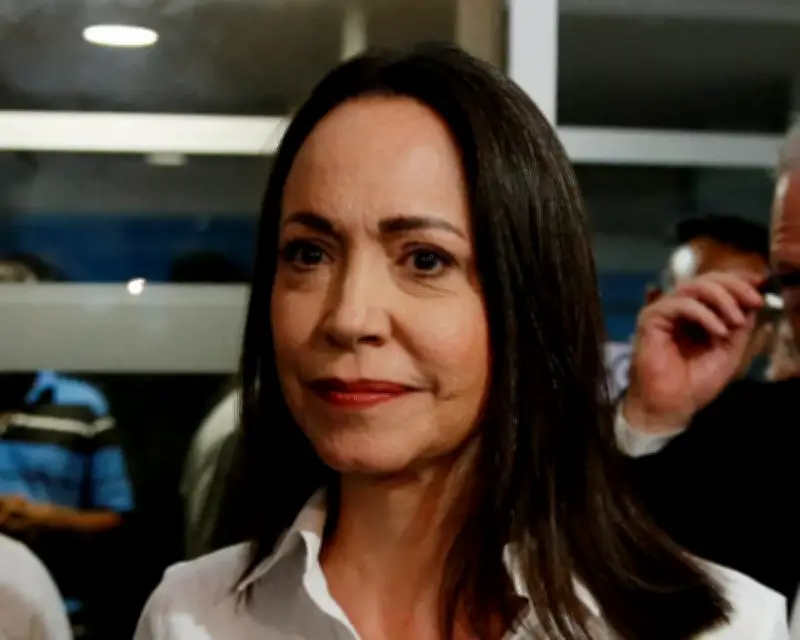
Venezuelan opposition leader María Corina Machado has publicly questioned Donald Trump's oil deal with Venezuela's interim government, asserting that the country's natural resources do not belong to "an illegitimate regime." In her first public comments since Trump announced what he called "the biggest oil deal in world history" last Friday, Machado walked a diplomatic tightrope between challenging the controversial agreement and avoiding direct confrontation with the White House.
Machado's Balancing Act
In a video posted on social media, the Nobel peace prize winner acknowledged the importance of the United States as a partner. "Of course the United States is the principal partner Venezuela needs to fully develop its strategic potential. This is what the majority of Venezuelans believe … and it is something I've spent my whole life defending," Machado said.
However, she was unequivocal in her criticism of the current occupants of the Miraflores presidential palace in Caracas, describing them as "enemies of the US" and claiming they lacked the right and democratic mandate to negotiate Venezuela's natural resources. "The wealth of our subsoil does not belong to an illegitimate regime – it belongs to the Venezuelan people," said Machado, acknowledging that her supporters felt "sadness and anger" at being excluded from the decision-making process.
The Deal and Its Scope
Venezuela holds the world's largest proven crude oil reserves, estimated at 303 billion barrels, with more than 65 billion barrels involved in the agreement. Trump's deal was struck with the unelected interim president, Delcy Rodríguez, who took power in January after her predecessor, Nicolás Maduro, was abducted by US special forces.
Many observers had expected Trump to replace Maduro with Machado, a conservative democracy activist who later gave the US president her Nobel prize award. Instead, Trump backed Rodríguez, warning: "If she doesn't do what's right, she is going to pay a very big price – probably bigger than Maduro." Machado has been sidelined.
US Objectives and Criticism
The White House claims the oil deal will help secure US "energy dominance for the next century" and "purging foreign malign influence from our back yard" by excluding China and Russia from oilfields in the country with the world's largest proven reserves. Speaking outside the Miraflores palace on Wednesday, US energy secretary Chris Wright said the aim was "to massively grow production and economic opportunities in Venezuela." "President Trump has a clear mission in Venezuela. The mission is to bring peace, freedom, opportunity, and prosperity to everyone in Venezuela," Wright told reporters.
But the deal has drawn widespread condemnation from critics who call it a predatory and colonial-style land grab. Machado's supporters fear the agreement makes Washington far less inclined to push for fresh presidential elections. Machado's movement is widely believed to have beaten Maduro by a landslide in the last such vote in 2024, but he refused to accept the result and clung to power until his dramatic rendition on 3 January 2026.
No Election Date Set
On Wednesday, both Trump and Rodríguez brushed off questions about when an election might be held. "You had a very powerful, very nasty dictatorship in Venezuela – and they're just not going to be ready for it yet," Trump told reporters, before adding vaguely: "But soon." Asked when an election would be held, Rodríguez said: "There will be an electoral process, but when Venezuela is ready." "I don't set dates," she added.




