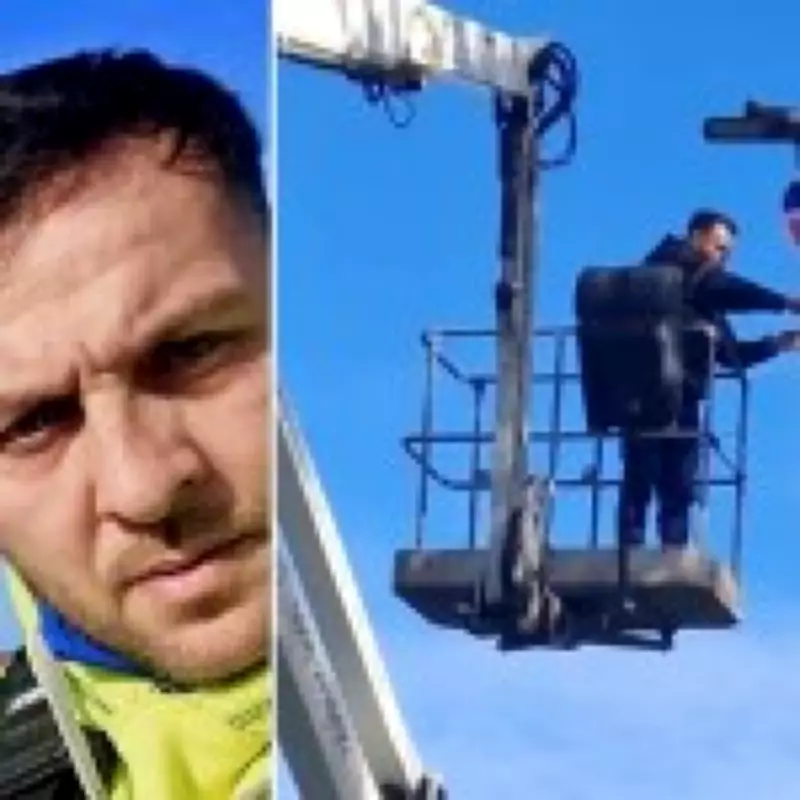
A businessman from Scarborough has expressed outrage after receiving a substantial invoice from local authorities for his patriotic display of flags on public lampposts. Will Haylett, a 43-year-old entrepreneur, described feeling 'disgusted' when North Yorkshire Council demanded £2,785.50 for the removal of 64 Union and St George's flags he had erected around the coastal town.
Community Spirit or Regulatory Breach?
Haylett, who operates an exterior cleaning and high-level maintenance business, stated that his intention was purely to 'lift people's spirits' in his hometown. 'I've lived in Scarborough all of my life,' he explained. 'For years, I've been driving around and seeing local people down and depressed. I thought, what's going on? I have a cherry picker, so I thought I could help lift people's spirits by putting up a few flags here and there.'
The council's letter to Haylett's business indicated that the flags had been removed as they were 'believed to be your property.' The authority offered to return them at a cost of £36.27 per flag plus VAT, but Haylett negotiated an alternative resolution. 'To solve the problem, I said I'd make a donation to a veterans charity instead – and they accepted that,' he revealed.
Safety Concerns and Public Complaints
North Yorkshire Council defended its actions, stating that attaching flags to lampposts without permission constitutes an offence and could pose safety risks. The authority confirmed it had received complaints about the appearance of the flags, which prompted their removal. This incident reflects a broader national conversation about public displays of patriotism, with similar flag installations appearing in towns and cities across the UK last year.
While some residents praised such displays as expressions of national pride, others found them intimidating or politically charged, leading to complaints and subsequent removals in various regions. The phenomenon appears to have originated with a group called the Weoley Warriors in Weoley Castle, near Birmingham, who have raised over £20,000 for flags, poles, and cable ties through a fundraising campaign.
National Trend and Social Media Divide
The Weoley Warriors describe themselves as 'proud English men' aiming to 'show Birmingham and the rest of the country how proud we are of our history, freedoms and achievements.' Their initiative has inspired similar displays in cities from Bristol to Newcastle, indicating a growing trend of grassroots patriotic expressions.
Social media reactions to these flag displays have been sharply divided. Commenters have ranged from labeling participants 'absolute idiots' to praising them for 'saving the country.' This polarization highlights the complex interplay between community initiatives, regulatory frameworks, and public sentiment in contemporary Britain.
Haylett's case underscores the challenges individuals face when attempting to enhance public spaces without official authorization. 'The council wanted me to stop putting things on 'our' lampposts,' he recalled. 'I thought, what's the problem? It was to bring us all together and put smiles on people's faces.' Despite his charitable compromise, the incident raises important questions about the balance between civic regulations and community-driven efforts to foster local pride and unity.