
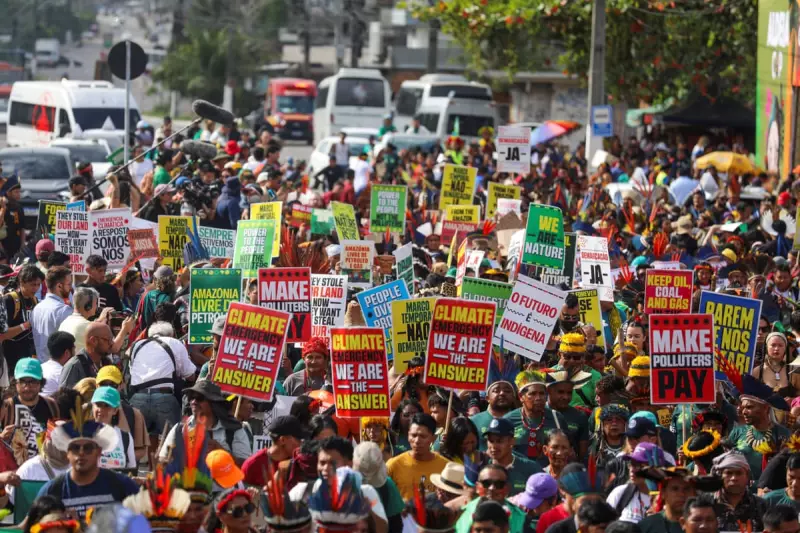
An explosive investigation has uncovered that more than 300 industrial agriculture lobbyists participated in this year's UN climate talks in Belém, Brazil, despite the sector being responsible for up to a third of global emissions.
Lobbyists Outnumber National Delegations
The joint investigation by DeSmog and the Guardian found that 302 delegates representing industrial cattle farming, commodity grains and pesticides attended Cop30, marking a 14% increase from last year's summit in Baku. This number surpasses the entire delegation of Canada, the world's tenth largest economy, which brought only 220 representatives to the Amazon-hosted conference.
Alarmingly, 77 of these agribusiness lobbyists gained access as part of official country delegations, with six obtaining privileged entry to closed-door negotiations where critical climate policies are debated.
Agriculture's Climate Impact and Indigenous Response
The revelations emerged as Indigenous protesters gathered outside the conference demanding climate justice and protection for their territories. Vandria Borari of the Borari Kuximawara Indigenous Association voiced strong criticism: "More than 300 agribusiness lobbyists occupy the space at Cop30 that should belong to the forest peoples. While they talk about energy transition, they release oil into the Amazon's basin and privatise rivers like the Tapajós for soy. For us, this is not development, it is violence."
The timing is particularly significant given that cattle ranching remains the primary driver of Amazon deforestation, followed by industrial soy production primarily used for animal feed. Scientists warn that up to half of the Amazon rainforest could reach a tipping point by 2050 due to combined pressures of water stress, land clearance and climate disruption.
Corporate Influence and Climate Consequences
The investigation analysed the UNFCCC's provisional list of 56,000 Cop30 delegates, identifying representatives from major corporations across multiple sectors:
- Meat and dairy companies sent 72 delegates - nearly double Jamaica's delegation despite the Caribbean nation's recent devastation from Hurricane Melissa
- Pesticides and synthetic fertiliser companies accounted for 60 representatives
- Biofuel interests saw a 138% increase with 38 delegates
Notably, JBS, the world's largest meat company responsible for 24% of sector emissions, sent eight lobbyists including CEO Gilberto Tomazoni. Pesticides giant Bayer deployed 19 representatives, the highest single-company contingent.
Raj Patel, author and University of Texas professor, condemned the situation: "What's happening in Belém is not a climate conference but a hostage negotiation over the future of the planet where those holding the detonators - the soy barons, the beef cartels, the pesticide peddlers - are seated at the table as honest brokers."
Systemic Concerns and Calls for Reform
The findings highlight growing concerns about corporate influence in climate negotiations. Lidy Nacpil of the Asian Peoples' Movement on Debt and Development stated: "These findings are proof that industrial agriculture has been allowed to co-opt the climate convention. Cop will never deliver real climate action as long as industry lobbyists are allowed to influence governments and negotiators."
Despite food systems not being a formal focus of this year's negotiations, the sector stands to benefit from discussions on biofuels and climate finance. Brazil is advocating to quadruple biofuel use, though recent studies suggest some biofuels may generate 16% more emissions than fossil fuels due to land use impacts.
Karen Perry Stillerman of the Union of Concerned Scientists echoed calls for reform: "Advocates are already calling for the fossil fuel industry and its disinformation to be banned from future climate talks, and the influence of big ag is similarly toxic... we won't have sustainable, fair, healthy, or climate-resilient food systems anywhere in the world as long as giant agribusiness and food corporations are making the rules."
The investigation exposes the stark contrast between corporate access and the urgent need for meaningful climate action, particularly as scientists confirm that radical changes to food production and consumption are essential to meeting Paris Agreement targets.




