
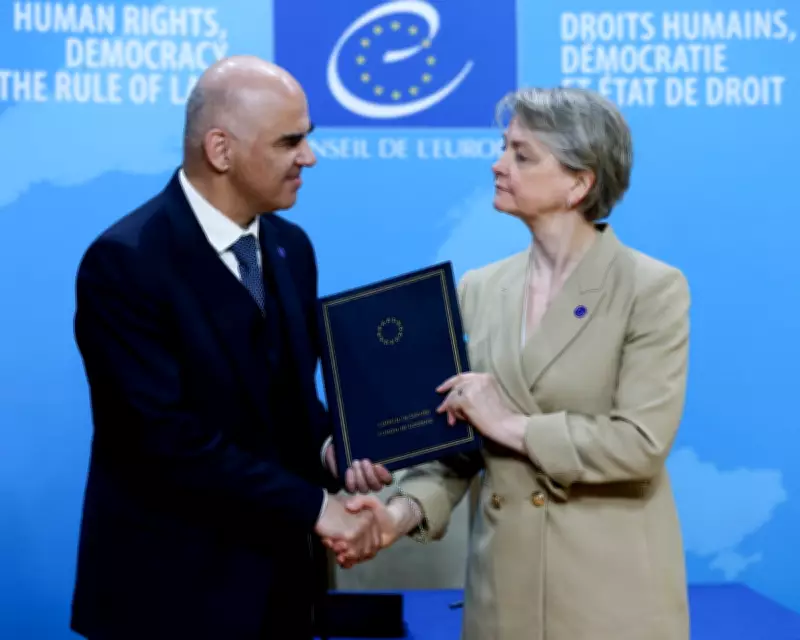
The United Kingdom and 45 other European nations have signed a political declaration that explicitly endorses the establishment of third-country hubs for processing and housing rejected asylum seekers. The agreement, reached under the auspices of the Council of Europe, the body responsible for overseeing the European Convention on Human Rights (ECHR), asserts that states possess an "undeniable sovereign right" to control their borders.
Key Provisions of the Declaration
The seven-page document emphasizes that countries should be free "to address and potentially deter irregular migration." It specifically mentions "processing requests for international protection in a third country, third country 'return hubs,' and cooperation with countries of transit" as viable approaches. The agreement also seeks to expand the scope for deporting individuals to places where they might face a risk of inhuman or degrading treatment, while limiting the ability of courts to intervene in such cases.
Controversy Over Human Rights Protections
Ministers have argued that Articles 3 and 8 of the ECHR—which protect against torture and respect for family life—have been used to prevent the removal of individuals with no legal right to remain in the UK. The declaration states that "caution should be exercised … when assessing whether the expulsion or extradition of an individual to a non-state party would violate a state's obligations under article 3 of the convention." This has drawn sharp criticism from human rights organizations and legal experts.
Political Reactions
UK Foreign Secretary Yvette Cooper, who finalized the agreement at a high-level meeting in Chişinău, Moldova, defended the move. She stated that Labour is "reforming the ECHR with partners from across the continent" to strengthen national security while maintaining international law. Cooper criticized both the Conservatives and Reform UK for advocating withdrawal from the ECHR, and the Greens for opposing border controls.
Skepticism from Experts
Madeleine Sumption, director of the Migration Observatory at Oxford University, expressed doubts about the declaration's impact, noting that it does not alter domestic or international case law. Professor Eirik Bjorge KC of the University of Bristol described the attempt to modify Article 3 protections as "deplorable." Human rights groups, including Liberty, voiced deep concern, warning of a gradual weakening of human rights safeguards.
Background and Future Steps
The UK government has been promoting return hubs as a deterrent to irregular migration. Home Secretary Shabana Mahmood told Parliament in November that "active negotiations" were underway with several countries, though no deals have been confirmed. The previous government's Rwanda plan, which cost £715 million, was scrapped after failing to deport anyone. The European Union has also endorsed the concept, with countries like Austria, Denmark, Germany, Greece, and the Netherlands involved in talks. Discussions have reportedly focused on 11 countries, including Armenia, Egypt, Ethiopia, Ghana, Libya, Mauritania, Rwanda, Senegal, Tunisia, Uganda, and Uzbekistan, though Montenegro has denied interest.




