
Political Thunderstorm: Trump's Focus on Somali Americans Intensifies
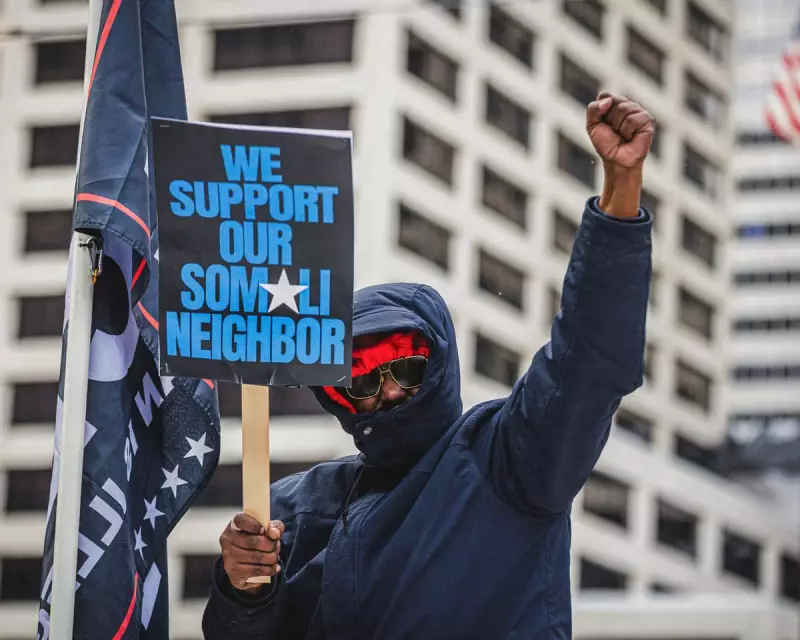
Counter-protesters in Minnesota have recently mobilised in opposition to pro-Trump, anti-Muslim influencer Jake Lang, highlighting the escalating tensions in the state. This comes as Donald Trump's administration continues its clampdown on immigration, with a particular focus on the Somali community, entrenching long-established reserves of solidarity and sparking widespread concern.
Communal Trauma and Targeted Rhetoric
For much of his second term, Donald Trump has fixated on Somali Americans, making derogatory comments about both them and Somalia. He uses these opinions to justify anti-immigration policies, especially in Minnesota, home to over 100,000 people of Somali descent. Trump appears personally exercised by Minnesota congresswoman Ilhan Omar, of Somali origin, who has exchanged barbs with him. When Omar was attacked this week by a man spraying her with an unknown substance, Trump responded by calling her a fraud who "probably had herself sprayed".
According to Prof Idil Abdi Osman at Leicester University, the Somali community is a convenient target. She describes the shift towards the right in Europe and the US as a "political thunderstorm" that Somalis have become absorbed in, as they embody communities that Trump can easily target and use as scapegoats for populist narratives.
Intersecting Vulnerabilities and Global Reverberations
Somali ethnic and religious profiles intersect in ways that make them easy targets, being Black, Muslim, and immigrant. This renders them vulnerable to racism, Islamophobia, and anti-immigration sentiments. While the sharpest manifestations occur in the US, similar shades are seen in Europe, with reverberations across a tightly connected global diaspora.
A Uniquely Connected Diaspora
The Somali diaspora is exceptionally connected, driven by culture and geopolitics. Large waves of immigration followed the Somali civil war in the late 1980s, meaning the diaspora is rooted in forced migration. Diasporas who left forcibly due to conflict tend to have stronger homeland connections, with some migrants born outside Somalia speaking better Somali than those in the country.
Settlement schemes in countries like the US offered limited spaces, leading large families to split, creating a global extended family. Jawaahir Daahir, founder of UK-based Somali Development Services, notes that Somali communities respond to events through strong family networks and solidarities. For instance, if a family member faces trouble in Minnesota, relatives in the UK feel it deeply.
Heightened Concerns and Generational Impacts
Political and media discourse often overlooks the intimate impact of racism and anti-immigration on individuals. Daahir explains that the current climate has created heightened concerns about safety, belonging, and equality. Young people navigate schools and identity, while parents worry about discrimination and safety.
A Minnesota-based academic, who requested anonymity, highlights generational impacts, with some parents fearful of sending children to school due to ICE, even when the children are American citizens. The repercussions on child development and socialisation are comparable to those during the pandemic, adding to existing trauma from fleeing militarised threats.
Shock, Solidarity, and Civility
Daahir observes that Somali-origin communities have histories of reckoning with far-right forces, but what is new is how state policies increasingly echo groups like the English Defence League. Clamping down on immigration and increasing deportations are becoming commonplace in the EU, while in the US, the rule of law feels unreliable.
However, Somali communities excel in grassroots organising and solidarity, distributing food and pooling resources in Minnesota. Prof Abdi Samatar at the University of Minnesota notes that these solidarities are reciprocated, with Minnesota showing generosity to immigrants due to decentralised policymaking. He hopes for a return to civility and humanity, as the global Somali diaspora braces for future challenges with tenacity and communal strength.




