
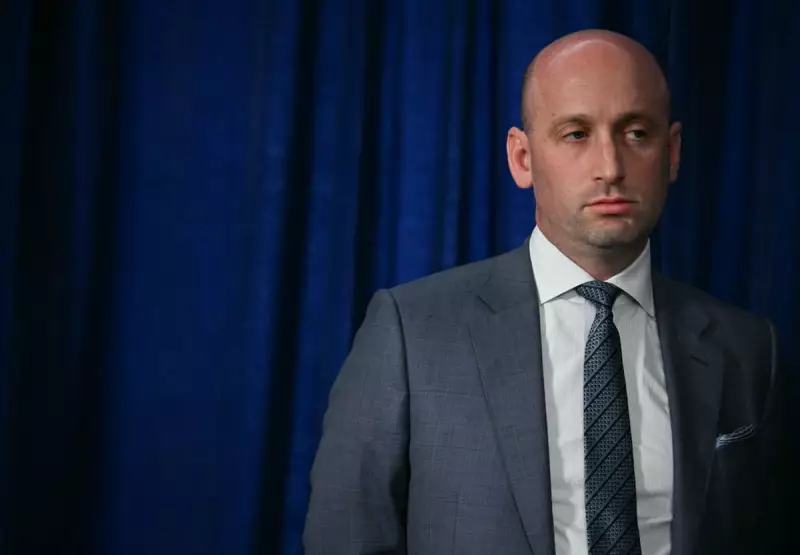
Pressure Mounts on Stephen Miller After Minneapolis Border Patrol Shooting Fallout
White House senior adviser Stephen Miller, the architect of Donald Trump's hardline immigration policies, is facing growing pressure following the fatal shooting of intensive care nurse Alex Pretti by border patrol agents in Minneapolis. The incident and its politically charged aftermath have placed Miller in an unusually vulnerable position, with President Trump publicly contradicting him and excluding him from key decisions.
Contradiction and Exclusion from the Oval Office
Approximately three and a half hours after the tragic shooting on Saturday, Miller took to social media to describe the 37-year-old Pretti as a "would-be assassin" who "tried to murder federal agents." However, when questioned about this characterization on Tuesday, President Trump offered a starkly different assessment, simply stating: "No."
This public contradiction was accompanied by Miller's conspicuous absence from a crucial two-hour Oval Office meeting on Monday evening between President Trump and Homeland Security Secretary Kristi Noem. The meeting, held at Noem's request, addressed the Minneapolis situation without Miller's involvement, signaling a rare moment of exclusion for the influential adviser.
Unraveling Narratives and Administrative Reversals
According to reports from Axios citing four unnamed sources, Miller was responsible for the Department of Homeland Security's baseless claim that Pretti intended to "massacre" officers, a narrative subsequently echoed by Secretary Noem. "Stephen heard 'gun' and knew what the narrative would be: Pretti came to 'massacre' cops," one source revealed.
However, the administration's attempt to control the narrative quickly unraveled as multiple witness videos exposed inconsistencies in their account. The public outcry that followed, involving business leaders and even some Republicans, forced a partial climbdown from the White House.
In a rare reversal, Miller admitted to CNN on Tuesday that border patrol agents "may not have been following" proper protocol before the fatal shooting. This acknowledgment marked a significant departure from his typical pattern of reinforcing and intensifying his positions regardless of circumstances.
Administrative Recalibration and Political Fallout
President Trump responded to the growing controversy by pulling border patrol commander Greg Bovino out of Minneapolis and deploying border czar Tom Homan, who has been critical of Miller's approach, to "recalibrate tactics" and improve cooperation with state and local officials. The president also held cordial phone conversations with Minnesota Governor Tim Walz and Minneapolis Mayor Jacob Frey.
These actions raised questions about Secretary Noem's future, with more than 160 House Democrats signing on to an impeachment effort against her. When asked whether Noem would step down, President Trump insisted she would not, stating: "I think she's doing a very good job. The border is totally secure."
Miller's Central Role and Questioned Future
Despite being officially titled as White House deputy chief of staff, Miller has been described by some observers as functioning more like Trump's prime minister. According to Axios reports, his influence extends to effective oversight of cabinet-level officials like Noem, with the secretary reportedly telling one interlocutor: "Everything I've done, I've done at the direction of the president and Stephen."
Larry Jacobs, director of the Center for the Study of Politics and Governance at the University of Minnesota in Minneapolis, argues that Miller's approach has discredited Trump's deportation policy. "Stephen Miller is the architect," Jacobs stated. "He's the guy who has been haranguing ICE to get tougher and deliver more numbers, bring people in and we'll sort them out as to whether you got the right people later. The recklessness, the brutality, the lack of legal process – all of that has its roots with Stephen Miller."
Jacobs continued: "So the fact that he was locked out of the White House meeting is a strong message to Washington that the president does not approve of this process and that there has to be a change. I do not expect Stephen Miller to be fired because Donald Trump supports the policy, just not how it was done."
Resilient Influence Despite Setbacks
At 40 years old, Miller has demonstrated remarkable skill in converting Trump's impulses into concrete policy. His centrality to the Make America Great Again project and his ostentatious loyalty have made his position appear secure despite the Minneapolis misstep, where he arguably moved ahead of his boss in the narrative.
Henry Olsen, a senior fellow at the Ethics and Public Policy Center thinktank in Washington, predicts: "He'll have much less of a public role in the foreseeable future. It's clear that Trump personally does not like the PR aspect of what's been going on, and he's sensitive to that and always has been."
However, Olsen doesn't believe Miller faces imminent dismissal: "Miller's been with him for quite some time. Trump has no problem getting rid of non-performing subordinates but one suspects that Miller in many ways is performing and he is not going to toss him over the side lightly."
Enduring Power Within Trump's Inner Circle
Miller's value to Trump extends beyond policy formulation to television appearances, where he serves as a pugnacious defender of the president, employing colourful language that characterizes Democrats as a "domestic extremist organisation" and promotes a worldview "governed by strength, that is governed by force, that is governed by power."
Rick Wilson, co-founder of the anti-Trump Lincoln Project and a veteran Republican strategist, argues that Miller remains too entrenched in Trump's political thinking to be marginalized: "Stephen Miller is too dominant in Trump's mental schema about what the Maga base wants to truly be cut out of a loop. I don't think there's a world where Stephen Miller doesn't retain his authority and his power with Trump."
Wilson added: "Strategically he may step back a half step, but this is not a world where Stephen Miller is going to give up power. He's worked too hard to get to where he is. The problem with Stephen Miller is that evil is resilient. He doesn't feel any shame. He doesn't think that this is a bad thing."
The Minneapolis incident represents a rare moment of vulnerability for Miller, but his deep integration into Trump's political project and his demonstrated loyalty suggest his influence will endure, even if his public profile diminishes temporarily as the administration weathers the political storm.




