
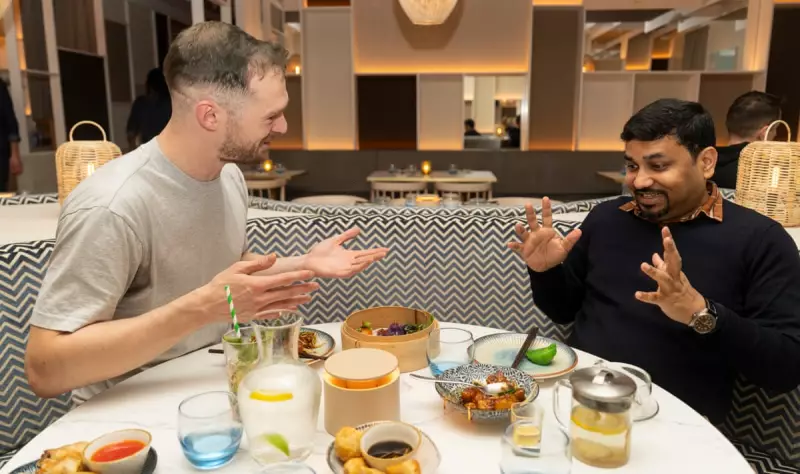
Two men from opposite ends of the political spectrum came together for an extraordinary dinner conversation in London that tested whether bridges can be built across Britain's deepening political divides.
The Political Opposites
Peter, a 34-year-old former civil servant now studying public health, represents the left-wing perspective. A Green Party member who previously voted Labour, he describes himself as "left, and globalist rather than nationalist." Originally from Dublin, he has lived in the US and Spain before settling in London.
Akshat, a 43-year-old risk manager from India who has called Britain home for five years, brings the right-of-centre viewpoint. A Conservative voter working in the infrastructure industry, he has international experience having lived and worked in Qatar, South Korea and the United States.
The Dinner Conversation Begins
The meeting at Huo Belsize Village in London began with shared nervousness and starters. "I was a little nervous, as I think Akshat was," Peter admitted. "Was he going to attack me for being a snowflake?"
They bonded over their mutual love of London while sharing fishy spring rolls, dumplings and daikon cakes with beansprouts. Akshat enjoyed beers while Peter sipped mojitos during the two-and-a-half hour conversation.
Immigration: The Salt Metaphor
The discussion quickly turned to one of Britain's most divisive issues: immigration. Akshat presented his carefully considered analogy: "I look at immigration like adding salt to a dish. When you add a little bit, the dish tastes wonderful. Add too little or too much and the dish is either too bland or too salty."
Peter countered this perspective, questioning whether governments should be determining ideal ethnic compositions. "It would be a funny place to be if the government was choosing some ideal ethnic makeup of the country," he remarked.
Akshat distinguished between refugees and economic migrants, arguing that "a lot of people coming to the UK are economic migrants who do not necessarily contribute much and can weigh on the benefit system." He maintained that immigrants should be self-sufficient, stating "you should only go if you can take care of yourself and your family."
Peter challenged this with practical realities of Britain's immigration system, noting the "hostile environment since Theresa May" with high visa fees, NHS surcharges and restricted benefit access. "The red carpet isn't rolled out for anyone," he observed, criticising recent policies that prevent workers from bringing families as "incredible to say: we want your work, but we don't want you."
Finding Common Ground
Despite their political differences, the two men discovered surprising areas of agreement. Both expressed scepticism about unchecked capitalism, though Akshat maintained that "wealth creation benefits society and should be encouraged."
They identified as internationalists and concurred that some parts of society – particularly politics and media – "thrive off stoking division." Peter reflected that "we did find common ground in fundamentals and values."
The Colonial Reparations Debate
The conversation took a historical turn when discussing Britain's colonial past. Peter advocated for reckoning with colonial history, citing how "when I first moved to the UK, people weren't aware of the Irish famine and the part that colonialism played in it."
He views decolonisation as more than financial compensation, suggesting it should involve "looking at what went wrong and where we should be now."
Akshat firmly rejected the reparations argument, stating "you cannot judge history with present day morality." He questioned both the principle and practicality, asking "Let's say the UK had to compensate India, it would be a huge amount of money. Is the UK in a position to do that? No."
After Dinner Reflections
As the evening concluded with Akshat enjoying dessert and Peter sampling sweet Japanese wine, both men emerged with greater understanding if not changed positions.
Akshat acknowledged that while the discussion wouldn't alter his thinking, "I understand Peter's concerns." He values such exchanges, believing "it's about bringing everyone to the same page, so that all of us can work towards the betterment of society."
Peter recognised that he hadn't persuaded his dining companion, but valued the civil discourse. "We both enjoyed dinner, so we could hopefully be more open to having conversations with other people in future," he concluded.
The experiment demonstrated that while political opposites may not resolve their differences over dinner, they can engage in respectful dialogue that acknowledges shared humanity beneath divergent viewpoints.




