
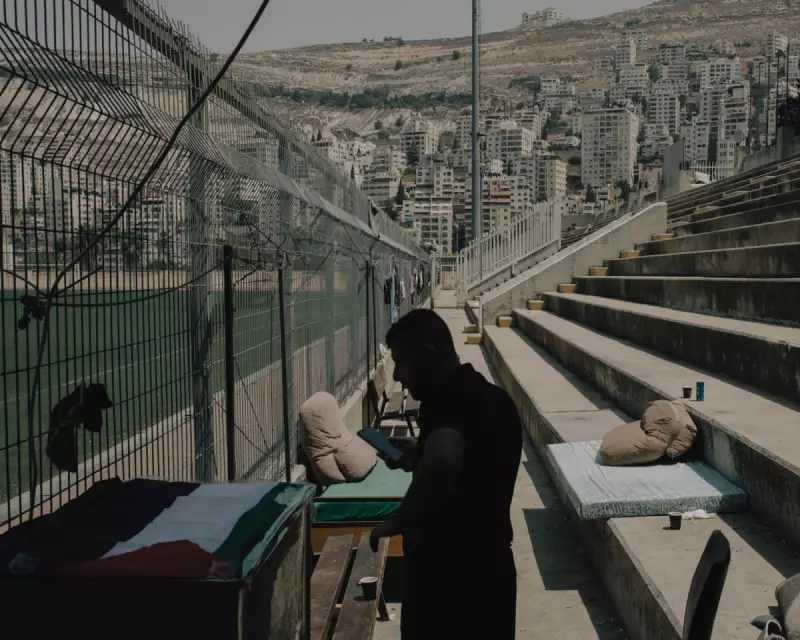
For more than two years, a group of Palestinian men from Khan Younis have been living in a state of suspended animation, their lives dictated by the news flickering across a television screen inside a converted locker room.
They are residents of an unlikely refugee camp: the Nablus municipal stadium in the occupied West Bank. These men, mostly construction workers, found themselves stranded here after the Hamas attack on Israel on 7 October 2023.
Life Suspended Between Exile and War
Baker Majjar, 37, is one of the approximately 50 men who remain in the crumbling stadium facilities. He typifies the group's plight, having previously split his time between his family in Gaza and work in Israel. Now, he is trapped, watching the war unfold from a distance while his wife and two young sons live in a tent in the al-Mawasi camp.
"They killed my nephew and his two children," Majjar says, recounting the personal toll of the conflict. "I've lost more than a hundred people – relatives and friends – to Israeli attacks since the war began. Then I stopped counting."
Majjar was among the 18,500 married men from Gaza who held Israeli work permits. In the chaotic hours after the 7 October attack, Israeli forces began rounding up such workers. While thousands were imprisoned or deported back to Gaza, Majjar and hundreds of others fled to the West Bank, crossing at Barta'a and eventually finding their way to the Nablus stadium.
A Crumbling Refuge and Fading Hope
Life inside the stadium is bleak. The men sleep on mattresses and battered sofas in former locker rooms, with only a few electric fans to combat the suffocating summer heat that can top 40C. Laundry hangs from the fences surrounding the football pitch.
Financial support is meagre. The Palestinian Authority's labour ministry provides about 700 shekels (£162) every one to three months, which the men send to their families in Gaza. However, commissions often halve the amount by the time it arrives.
The psychological strain is immense. Maher Qudeh, 53, who has seven children in Gaza, witnessed a fellow resident die from a heart attack after learning his son had been killed. Wajdi Yaeesh of the Human Supporters Association recalls a man who had written his eight children's names on the wall, eventually crossing out four after they were killed.
Broader Crisis of the Stranded
The situation extends beyond the stadium. According to figures from the Qatar Red Crescent and UNRWA, more than 4,400 stranded Palestinian workers and patients from Gaza are currently in the West Bank.
This includes at least seven women from Gaza who were in the region for cancer treatment, either for themselves or their children. Five children from Gaza being treated for cancer in a Jerusalem hospital in March 2024 have since died, their mothers now cut off from their families and relocated to West Bank towns.
For some, like cook Khaled from Tuffah, the hope is simply to be reunited with his wife and three surviving children after two of his five children were killed in an airstrike. For others, like Samir Hajjaj Abu Salah, 55, from Khan Younis, the desire to return to Gaza has vanished.
"I never want to set foot in my home again," he states. "Once my family is evacuated, we'll settle somewhere far from the Strip."
As the conflict continues with no end in sight, these men remain in their stadium limbo, their lives indefinitely paused between a home they cannot return to and an exile they cannot escape.




