
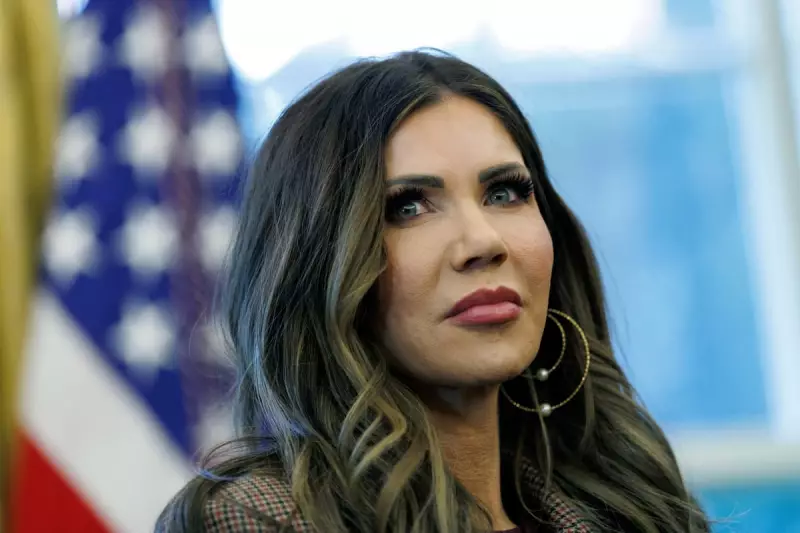
Homeland Security Secretary Kristi Noem personally directed the continuation of deportation flights to El Salvador for Venezuelan immigrants, a move that defied a federal judge's directive, according to a recent court filing from the US Justice Department.
The Legal Standoff Over Deportation Flights
The controversy stems from events in March, when the Trump administration invoked the 18th-century Alien Enemies Act to deport approximately 250 alleged Venezuelan gang members. These individuals were sent to El Salvador's CECOT mega-prison, a facility notorious for its conditions.
In response, US District Judge James Boasberg issued a temporary restraining order. He also gave a verbal directive demanding that any deportation flights already in the air be returned to the United States immediately.
However, the White House contested this, arguing that the detainees were no longer on US soil when the order was given and that the ruling was therefore not applicable. The planes continued to their destination.
Justice Department Defends Noem's Decision
In a court filing made on a Tuesday, the Justice Department formally stated that Kristi Noem was the official who made the final decision to proceed with the transfers after receiving legal counsel.
The filing detailed that Deputy Attorney General Todd Blanche and Principal Associate Deputy Attorney General Emil Bove provided legal advice to the Department of Homeland Security (DHS) through its Acting General Counsel, Joseph Mazzara. This advice concerned the court's order and its application to flights that had departed before the order was issued.
"After receiving that legal advice, Secretary Noem directed that the AEA detainees who had been removed from the United States before the Court’s order could be transferred to the custody of El Salvador," the Justice Department wrote.
The department maintained that this interpretation was lawful and reasonable, arguing that the written order did not explicitly require the return of detainees already removed and that the earlier oral directive was not a legally binding injunction.
Aftermath and Repatriation
This legal filing emerged as Judge Boasberg reopened his inquiry into whether the Trump administration had violated his initial orders to halt the deportation programme.
The Venezuelan nationals at the centre of this dispute spent several months in the Salvadoran prison before being repatriated to Venezuela in July. This transfer was part of a deal struck between the US and Venezuelan governments.
The White House and the Department of Homeland Security did not provide an immediate comment on the new court filing, leaving the legal and political ramifications of the decision to continue unfolding.




