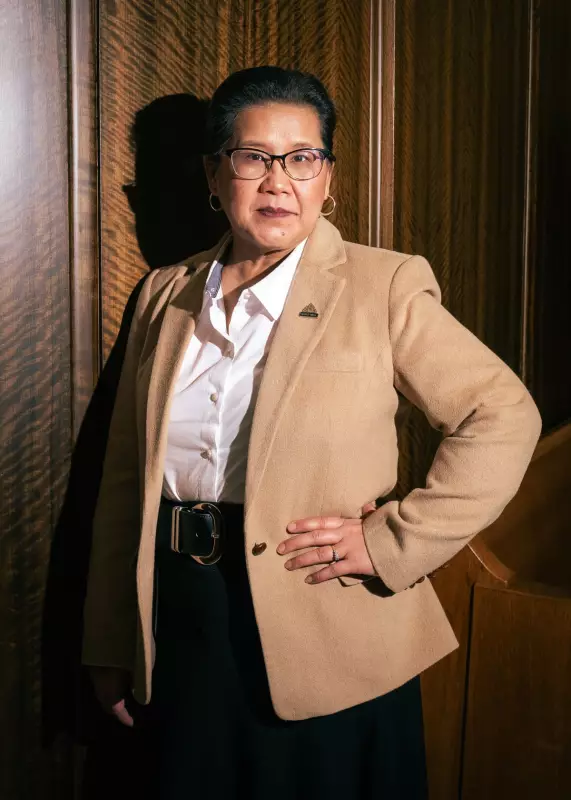
Mayor Kaohly Her, photographed at her office in Saint Paul City Hall on 22 January 2026, finds herself at the centre of a growing immigration enforcement storm that has gripped Minnesota's Twin Cities. While Minneapolis protests have captured national attention, Her's city has endured half a year of targeted operations by Immigration and Customs Enforcement (ICE), prompting the mayor to declare that "Saint Paul has been under siege."
A Mayor's Baptism by Fire
Her, who began her term just three weeks before speaking with the Guardian, represents one of America's most remarkable political journeys. Born in a bamboo hut in Laos as a Hmong refugee, she arrived in the United States at age three through a Vietnam War-era resettlement programme. Now serving as Saint Paul's first woman, first Asian American, and first Hmong American mayor, she faces what she describes as "the incursion" of federal immigration policies.
The situation escalated dramatically when Renee Good, a Minneapolis mother of three, was killed by an ICE officer during the mayor's first week in office. Since that incident, Her has been placed under federal investigation for allegedly obstructing immigration enforcement, while her city has become a flashpoint for tensions between local authorities and federal agents.
Community Impact and Controversial Arrests
The human impact of the ICE operations has been particularly stark in Saint Paul's substantial Hmong community. In one disturbing incident, ChongLy Scott Thao, a 57-year-old US citizen, was photographed being taken from his home by ICE officers wearing only shorts, a blanket, and sandals in freezing temperatures. Although Thao was later returned home, the Department of Homeland Security claimed his arrest was part of an operation targeting sex offenders at his address, without providing supporting evidence.
Her described witnessing such scenes as "heartbreaking" and noted significant changes in community behaviour. "In Saint Paul's Hmong community, I've noticed that the markets are empty and it's easy to find parking," she observed. "They would normally be bursting at the seams. Everyone is afraid. I have family members who haven't opened their drapes in days because they're afraid someone can see in and see that they are Asian."
Local Response and Federal Pushback
The mayor's office has implemented several measures to support affected communities, including constitutional observer courses to train people in documenting ICE operations without interference, and programmes to help residents retrieve vehicles abandoned after ICE detentions without incurring large fees. Saint Paul maintains a separation ordinance prohibiting coordination with ICE and has joined litigation challenging the federal surge, though the US Justice Department has dismissed this action as "legally frivolous."
Her attributes the increased federal scrutiny to political motivations, stating: "His disdain toward the state, and the fact that he has never been able to win here, made it very clear that there was a retribution to be paid and he is making good on that." She emphasises that Minnesota has historically welcomed refugees and immigrants, arguing that current enforcement represents a departure from this tradition driven by political change rather than genuine immigration concerns.
Racial Profiling Concerns and Political Context
The mayor points to what she perceives as underlying racial dimensions to the enforcement actions. "We have undocumented immigrants here who are from European countries, but none of those people are being targeted," Her notes. "If you are an immigrant who has darker skin colour or an accent, [the message is] you do not belong here. That's a very new stance because that's what America stands for."
These claims have been strongly denied by Department of Homeland Security officials. Tricia McLaughlin, assistant secretary for public affairs, stated that allegations of racial profiling "are disgusting, reckless and categorically false," maintaining that enforcement targets are determined solely by immigration status rather than ethnicity or race.
Political Background and Leadership Approach
Her's path to leadership included fifteen years in investment and finance before transitioning to community organising, directing a Hmong women's organisation, and serving on Saint Paul's human rights commission and board of education. She represented Minnesota's left-liberal Democratic-Farmer-Labor party in the state house of representatives from 2019 to 2025 before unseating two-term mayor Melvin Carter.
Despite the tensions, Her maintains a measured rhetorical approach, perhaps reflecting Minnesota's particular political culture where even ideological opponents maintain working relationships. "At the federal level, they do not realise that we are different in Minnesota," she explains. "Even if we disagree, there is a fundamental belief in humanity. I hope that people can see what was happening here is bigger than parties – it's really about people's fundamental human rights."
Remarkably, Her suggests that federal actions may be having an unintended unifying effect. "What the administration is doing is unifying us, bringing us together and making us strong," she observes. "People want this to be a partisan issue, but it is not."
Looking Forward
As protests continue and legal challenges proceed, Mayor Her remains committed to her community-focused approach, shaped by her cultural background and personal history. "In my culture, you never leave my house without a meal," she reflects. "There's nothing that has prepared me better to take care of a city in a time of crisis than by being raised as a Hmong woman."
With Vice President JD Vance recently visiting the Twin Cities without contacting her office, and federal investigations ongoing, Her's leadership continues to be tested. Yet she remains open to dialogue, stating simply: "I would gladly meet with him." As Saint Paul navigates what the mayor calls "an unprecedented time in our country," her story and stance continue to resonate far beyond Minnesota's borders.