
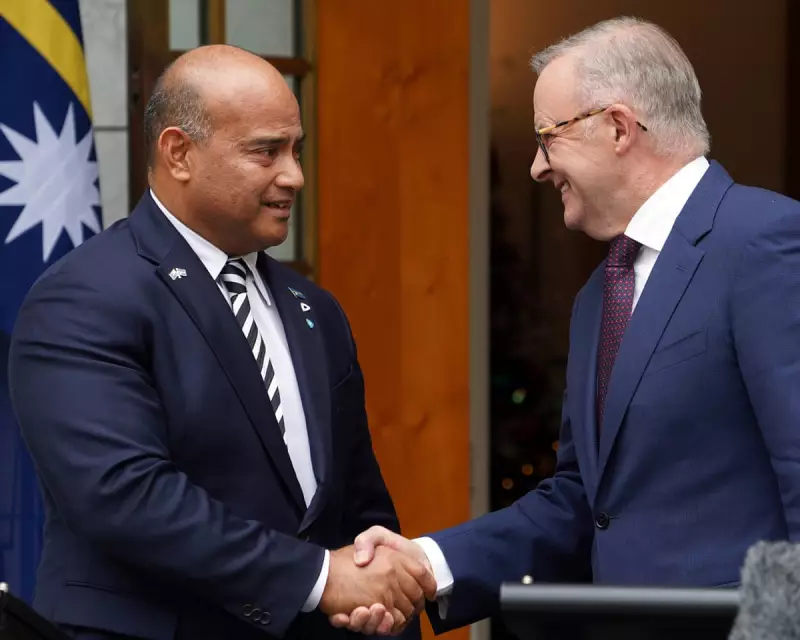
Australia's controversial $2.5 billion agreement with Nauru to resettle asylum seekers on the Pacific island for three decades is facing renewed examination following serious corruption allegations against senior Nauruan politicians.
Corruption Claims Surface in Parliament
Prime Minister Anthony Albanese has defended the government's newly signed resettlement arrangement as "entirely appropriate" despite revelations that Nauru's President David Adeang is suspected of money laundering and corruption in a classified Austrac report.
The Australian financial intelligence agency's findings were dramatically read into Senate records this week by Greens senator David Shoebridge. The documents allege that President Adeang, Foreign Affairs Minister Lionel Aingimea, and other politically connected figures participated in transactions "indicative of money laundering and corruption" between January and September 2020.
According to the Austrac report, these suspicious transactions involved over $2 million in combined credits and more than $1 million in combined debits during the nine-month period.
Transparency Advocates Sound Alarm
Transparency International Australia's chief executive, Clancy Moore, has issued a stark warning that Australian taxpayers could be inadvertently supporting a "kleptocracy" in Nauru. Moore emphasised that the secrecy surrounding Australia's arrangements with its former colony has created ideal conditions for corruption and financial mismanagement.
Ogy Simic from the Asylum Seeker Resource Centre expressed grave concerns, stating that the Australian government has been aware of corruption allegations surrounding key Nauruan political figures for years, dating back to 2015. "Yet Australia continued funnelling hundreds of millions of taxpayer dollars into a system built on cruelty and secrecy," Simic noted.
The advocacy groups are now demanding a royal commission to fully investigate Australia's offshore processing regime and expose what successive governments knew about the corruption allegations.
Government Response and Historical Context
When questioned about the Austrac findings, Prime Minister Albanese dismissed concerns, noting that the reported incidents occurred under the previous Coalition government. "I'm happy to answer questions and be accountable for what we've done in office, and what we've done in office is entirely appropriate," Albanese stated.
The controversy emerges against the backdrop of Australia's troubled history with offshore processing centres. The detention facility on Papua New Guinea's Manus Island was ruled illegal by that country's supreme court in 2016, resulting in Australia paying more than $70 million in compensation to individuals illegally detained there.
Subsequent to the Austrac reports, the Albanese government commissioned former defence chief Dennis Richardson to review corruption allegations in Nauru during 2023. Richardson's investigation found that some contractors suspected of drug smuggling and weapons trafficking had received multimillion-dollar offshore contracts, though he concluded the government "may have had no option" but to work with these companies due to the high-risk nature of offshore processing environments.
The Nauruan government, President Adeang, Minister Aingimea, and the Nauruan embassy in Canberra have not responded to repeated requests for comment on these allegations.




