
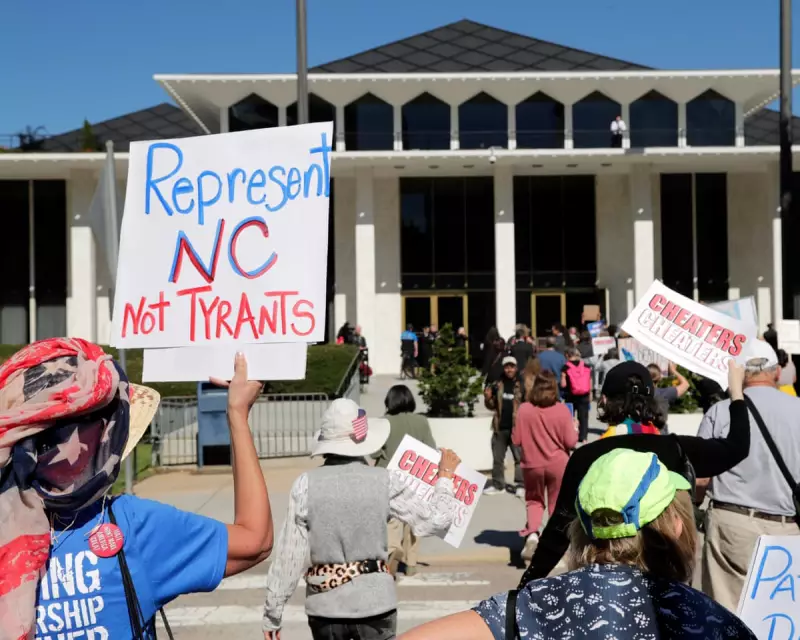
Federal Judges Greenlight Controversial North Carolina Congressional Map
A federal three-judge panel has ruled that North Carolina can proceed with a Republican-drawn congressional map that could significantly alter the state's political landscape. The decision, delivered on Wednesday, represents a victory for GOP strategists aiming to strengthen their position in the US House of Representatives ahead of the crucial 2026 elections.
Targeting North Carolina's Swing District
The newly approved map takes direct aim at North Carolina's only swing seat, currently represented by Democrat Don Davis. This district, known as the first district, has been held by Black members of Congress for over 30 years and encompasses more than 20 counties in the state's north-eastern region. The redistricting effort is part of a broader, multi-state campaign spearheaded by former President Donald Trump's political operation.
The judicial panel denied requests for preliminary injunctions following a hearing in Winston-Salem during mid-November. Notably, the day after this hearing, the same judges upheld several other redrawn US House districts that were initially enacted by GOP state lawmakers in 2023. These districts previously contributed to Republicans gaining three additional congressional seats during the 2024 elections.
National Redistricting Battle Intensifies
North Carolina finds itself at the centre of a national political struggle, with Trump breaking with more than a century of tradition by directing the Republican party to redraw maps mid-decade without court mandates. This strategic move aims to prevent losing control of Congress in next year's midterm elections.
The stakes are exceptionally high, as Democrats need to gain just three seats to secure control of the House and potentially obstruct Trump's legislative agenda. Beyond North Carolina, Republican-led bodies in Texas, Missouri, and Ohio have all adopted new districts designed to enhance Republican prospects in upcoming elections.
Democratic strongholds have mounted counter-offensives, with California voters adopting districts favourable to Democratic candidates. Meanwhile, Virginia's Democratic-led general assembly has initiated steps toward redistricting through a proposed constitutional amendment.
North Carolina's Republican-controlled general assembly gave final approval to the map changes on 22 October, with the approval of Democratic governor Josh Stein being unnecessary for implementation.
Legal Challenges and Political Fallout
The ruling addresses two separate lawsuits challenging the new map. One case, filed by the state NAACP, Common Cause, and several voters, sought a preliminary injunction on First Amendment grounds. Plaintiffs argued that Republican lawmakers unconstitutionally targeted North Carolina's "Black belt" regions rather than Democratic-voting areas with higher white populations.
A second lawsuit from voters contended that using five-year-old census data for mid-decade redistricting violates constitutional principles, including the 14th amendment's one-person, one-vote guarantee. The case also alleged that lawmakers improperly relied on race during the mapmaking process.
Republican Senate leader Phil Berger celebrated the decision, stating it "thwarts the radical left's latest attempt to circumvent the will of the people" in a state that consistently supported Trump in 2016, 2020, and 2024.
With Republicans already holding 10 of the state's 14 House seats thanks to the 2023 map, they now hope to secure an 11th seat through the latest redistricting changes affecting the first and adjoining third districts. Candidate filing for these and other 2026 North Carolina races is scheduled to begin on 1 December.




