
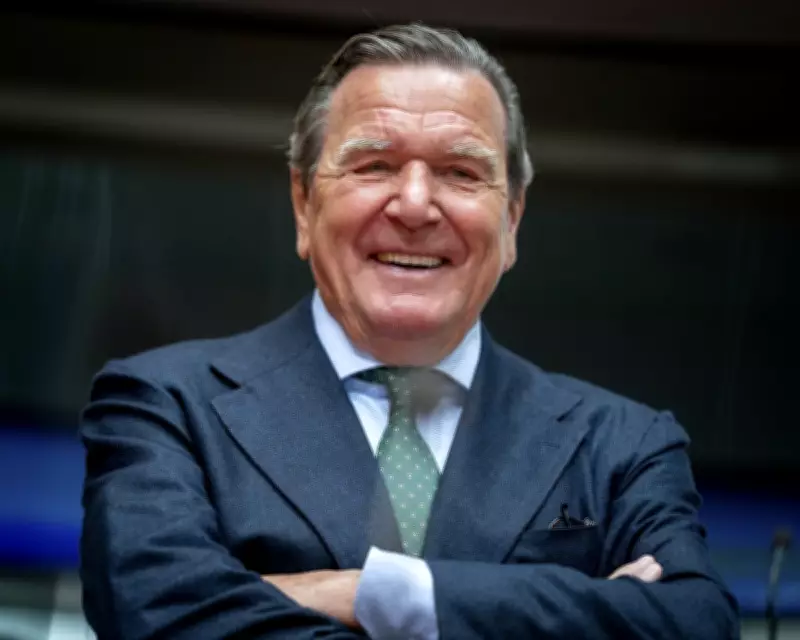
The European Union has rejected Russian President Vladimir Putin's suggestion that former German chancellor Gerhard Schröder could act as a European mediator in peace talks to end the war in Ukraine. Top EU diplomat Kaja Kallas stated that Schröder, who has held senior positions in Russian energy projects, cannot be considered impartial.
Putin's Proposal
Over the weekend, Putin proposed Schröder, a longtime ally, as a potential figure to help restart negotiations with Europe. The Russian leader said he would "personally" favor the former German leader for the role. Schröder, 82, previously held senior positions in Russian energy projects, including work on the Nord Stream gas pipelines and a seat on the board of Rosneft. He stepped down from the Rosneft role several months after Russia's full-scale invasion of Ukraine, under mounting pressure, but has never explicitly condemned Putin over the invasion.
EU Response
Kaja Kallas, the EU's top diplomat, told journalists in Brussels before a meeting of foreign ministers: "First, if we give Russia the right to appoint a negotiator on our behalf, that would not be very wise." She said Schröder could not be considered an impartial mediator given his past work as a "high-level lobbyist for Russian state-owned companies." Kallas added: "It is clear why Putin wants him to be the person, so that actually he would be sitting on both sides of the table."
Putin's Remarks on War's End
Putin suggested the conflict in Ukraine could be drawing to a close, a rare hint at a possible timeline. However, his top advisers have said the Kremlin continues to demand that Ukraine withdraw its troops from the eastern Donbas region as a precondition for future negotiations. People familiar with Putin's thinking told the Guardian that he remains determined to seize the remaining parts of the region by force this year before any serious talks begin. Ukraine has flatly rejected any suggestion of unilateral withdrawal from its own territory, a position bolstered by recent battlefield dynamics where Russian advances have largely stalled.
Military Stalemate
The two armies are showing mounting signs of exhaustion and sustaining heavy casualties, while trading strikes on each other's energy infrastructure. Analysts say a diplomatic breakthrough is unlikely against this backdrop.
German Defense Minister's View
Germany's defense minister, Boris Pistorius, suggested Putin's peace remarks were likely a ruse. "If he sees the end of this war approaching, couldn't he simply end it himself? Then he would have control over the timing," Pistorius said during a visit to Kyiv. "Instead, as always, he sets conditions. It's to be feared – and I hope I'm wrong – that this is yet another deception. But it can't be ruled out, and it seems to be part of his hybrid war strategy." He added that Putin "was trying to divert attention from his own weaknesses."
Broader Context
A US-brokered ceasefire is due to expire on Tuesday, and Moscow has rejected prolonging the truce. EU leaders have stepped up efforts to secure the bloc a seat at the table in any future substantive peace negotiations. European capitals have long insisted that no discussions or decisions about Ukraine should take place without Kyiv's involvement. Many across the continent now fear that talks between the US, Russia, and Ukraine have made little progress, leaving the EU increasingly sidelined and vulnerable to pressure to accept a deal it does not support.
Schröder's Record
There is little prospect of Schröder emerging as Europe's representative with the Kremlin. His record of defending Moscow has repeatedly put him at odds with mainstream European opinion. After evidence of mass killings emerged in the Kyiv suburb of Bucha in April 2022, he said he did not believe the massacre had been ordered by the Kremlin. Germany's Europe minister, Gunther Krichbaum, said Schröder had "not necessarily demonstrated in the past that he could act as a neutral mediator, as an honest broker," as he was "heavily influenced" by Putin. "Close friendships may be legitimate everywhere in the world, but they don't contribute to being perceived as an honest negotiating partner," Krichbaum added.
Estonia's foreign minister, Margus Tsahkna, said: "Gerhard Schröder is Putin's idea. I think they are very close. Gerhard Schröder will not be representing Europe." Mark Galeotti, an expert on Russian politics, described the suggestion as a "classic Putin idea." "He tries to sound reasonable, but frames any potential dialogue in terms most comfortable to him," Galeotti told Times Radio. Schröder has not publicly commented on the idea.




