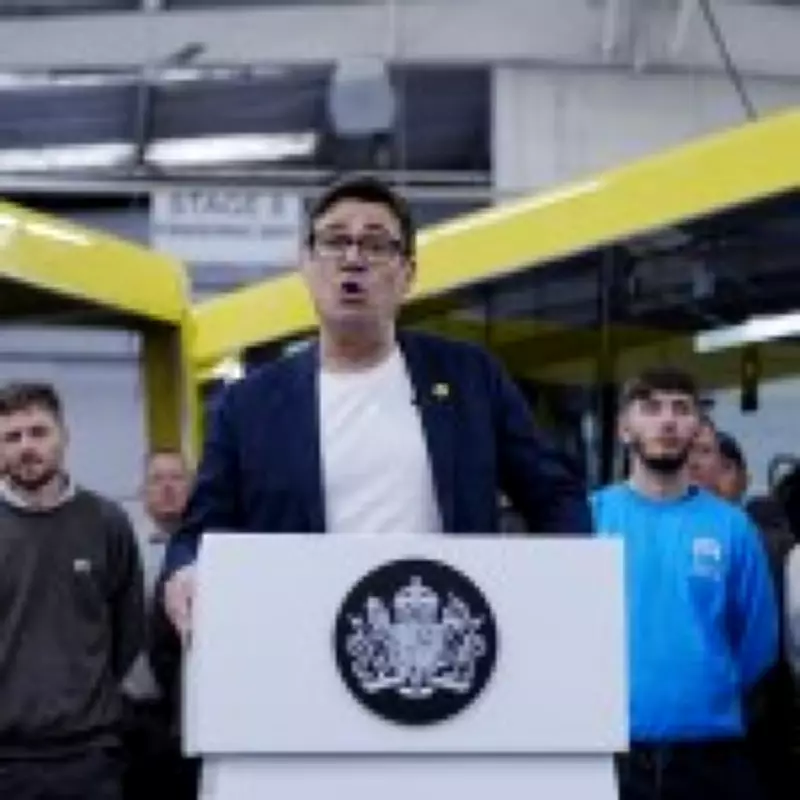
After a dramatic week in British politics, Andy Burnham is being treated as the heir apparent to Sir Keir Starmer as Labour Party leader and Prime Minister. The path ahead of the Greater Manchester Mayor is far from smooth, but polls suggest he is considerably more popular across the country than the Downing Street incumbent. And with Labour in deep trouble following a disastrous round of local elections, MPs are clamouring for a swap at the top. If he is confirmed as Labour's candidate on Thursday as expected, a massively consequential by-election in Makerfield next month will determine Burnham's future – and possibly that of his party. After two failed leadership bids, will it be third time lucky? Here, we explain all you need to know about the so-called King of the North, and his potential return to Westminster.
Burnham's Background
Burnham was born in Aintree, Lancashire, the son of a telephone engineer and a receptionist. When his dad got a new job in Manchester soon after he was born, the family moved to the town of Culcheth north-east of Warrington. This is where he grew up – less than 20 minutes' drive from the constituency of Makerfield which he is now hoping to represent in Parliament. He was educated at Catholic school before studying English at the University of Cambridge. He has previously described himself as 'Catholic by upbringing' though 'not particularly religious'.
A Whistle-Stop Tour of Burnham's Political Career
After joining the Labour Party when he was just 15, Burnham has had many political roles across his lengthy career. He began as a researcher, then joined the Transport and General Workers Union. Following the 1997 election he became a parliamentary officer for the NHS Confederation, before becoming an administrator. Burnham was then made a special adviser to the Culture Secretary Chris Smith, until he was elected as an MP in 2001. He sat as an MP for Leigh in Greater Manchester from 2001 to 2017. In 2005 he was promoted to the Government, serving as a Parliamentary Under Secretary of State. In Gordon Brown's cabinet of 2007, he was appointed Chief Secretary of the Treasury. In a cabinet reshuffle in 2008, he was promoted to Culture Secretary. He was promoted again in 2009, this time to Health Secretary. After serving in the opposition, Burnham announced he would be running to become the first Mayor of Greater Manchester in 2016. That meant he had to resign as Jeremy Corbyn's shadow home secretary, and he was elected to the position in 2017. Burnham has described his experience of Westminster as a 'journey' that led him back home to Manchester.
What Does Burnham Do Now?
Burnham remains the Mayor for Greater Manchester. He has tackled issues such as homelessness, public transport and investigated child exploitation in Manchester and Rochdale. His profile was boosted by clashes with the Conservative government over funding for the Greater Manchester area during the Covid pandemic. In February 2020, then-North of Tyne Mayor Jamie Driscoll jokingly dubbed him 'King of the North' – a nickname that has stuck. However, he has also been criticised for spending tens of millions of pounds on a Clean Air Zone scheme which was ultimately scrapped. He lives in Warrington with his Dutch wife, Marie-France van Heel, his son and two daughters. Burnham and his wife have been together since university.
Where Does He Stand Policy-Wise?
In an interview with The Telegraph, Burnham set out a general manifesto of policies that he said would 'turn the country around', which included tax cuts for lower earners and greater taxes for the highest-paid. He proposed borrowing £40bn to build council houses and higher council tax on expensive homes in London and the South-East. Burnham also told the Telegraph the current government's education vision 'hasn't really been clear' and called for a greater focus on technical education. In an interview with The New Statesman, Burnham advocated for 'public control'. Though he acknowledges it will be expensive, he wants to see housing, water, energy and the railways returned to public ownership. Burnham launched the Mainstream group in September, with the aim of making Labour more left-wing amid allegations that Starmer had shifted the party to the right. In Manchester, he brought buses back under control and capped a single bus fare at £2 in the process, even as Starmer's government raised the nationwide cap to £3. Burnham introduced A Bed Every Night programme, helping thousands off the streets and cutting rough sleeping.
Why's There Talk of Him Returning to Westminster?
Speculation about Burnham's potential return to Parliament and government had been swirling for months before last week. Notoriously, he mounted criticism of Starmer in the lead-up to last year's Labour party conference… before being forced to climb down. But things came to a head when Labour had a record-breakingly poor showing at the May 7 local elections. In the days that followed, Keir Starmer's grip on power weakened dramatically with the resignation of Health Secretary Wes Streeting and a 'stalking horse' effort from north London MP Catherine West. Then, on Thursday, Makerfield MP Josh Simons announced he was stepping down with the explicit motive of giving Burnham an opportunity to return. The following day, Labour's National Executive Committee confirmed he would be allowed to stand – a dramatic reversal from earlier this year, when the mayor was blocked from running in Gorton and Denton. It won't be smooth sailing, though. Reform swept the local elections in the area last week, while the right-wingers were widely tipped to nab the seat at the next election. A defeat to Nigel Farage's party would plunge Labour into an even deeper crisis. If even their most popular figure can't beat Reform, what hope do the rest of them have? Even if he wins a seat in Parliament, it's looking like he'll face a battle to take control of Labour and the government.
How Would Burnham's Run for Leadership Work?
To run for leader of the Labour party for a third time (he lost to Ed Miliband in 2010 and Jeremy Corbyn in 2015), Burnham would first have to win the by-election, and then gain nominations from at least 80 Labour MPs. This shouldn't be difficult for a man whom many consider a potential party saviour, but he may not be alone. Wes Streeting has also confirmed he would run, while Sir Keir Starmer has previously said he would fight to keep his job in any leadership contest. Previous contests have taken four months to complete – but this would be the first time Labour has ever run one while in power, so party operators may be keen to speed the process up.