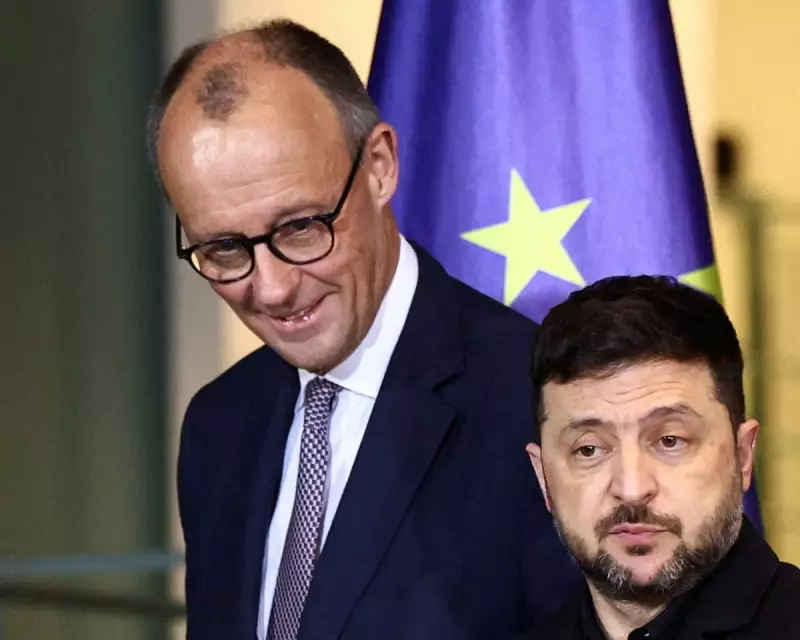
In a significant development from high-level talks in Berlin, German Chancellor Friedrich Merz has outlined a potential future security framework for Ukraine involving international peacekeepers. The proposal, discussed during Ukrainian President Volodymyr Zelenskyy's visit, suggests a remarkable shift in US foreign policy.
Security Guarantees and a "Far-Off" Peacekeeping Mission
Speaking to ZDF public television, Chancellor Merz elaborated on security guarantees being negotiated for Ukraine. He stated that under a future ceasefire, guarantor nations—namely the United States and European partners—could deploy forces to secure a demilitarised zone.
"We would secure a demilitarized zone between the warring parties and, to be very specific, we would also act against corresponding Russian incursions and attacks," Merz explained. He was quick to temper expectations, however, adding that this scenario remains "a far-off prospect" and "We're not there yet."
Merz highlighted the novelty of the American position, noting: "The fact that the Americans have made such a commitment – to protect Ukraine in the event of a ceasefire as if it were Nato territory – I think that's a remarkable new position for the United States of America."
Diplomatic Moves and Kremlin Pushback
Parallel to these discussions, President Zelenskyy indicated that proposals negotiated with US officials for a peace deal to end Russia's invasion could be finalised soon. American envoys are then expected to present the terms to the Kremlin.
Despite US officials claiming 90% of problematic issues between Russia and Ukraine had been resolved during the Berlin talks, the path to peace remains fraught. A major obstacle is the absence of Russian representatives from the current negotiations.
The Kremlin has already signalled its opposition. Russian President Vladimir Putin's spokesperson, Dmitry Peskov, dismissed European participation in talks based on a US plan, stating it "does not bode well." Peskov also confirmed that Moscow had not yet been briefed on the results of Monday's discussions in Berlin.
Wider Context: Rights, Media, and Nuclear Safety
The diplomatic manoeuvres in Berlin unfolded against a backdrop of continued tension and concerning developments within occupied Ukraine and Russia.
The UN's top rights official, Volker Türk, raised an alarm on Wednesday over the rapid erosion of freedoms in Russian-occupied Ukrainian territories. He reported tightening restrictions on movement, expression, and religion.
In a move against independent media, Russian authorities on Tuesday designated German public broadcaster Deutsche Welle as an "undesirable organization," effectively banning its operations. DW's director general, Barbara Massing, condemned the act as Russia's latest attempt to silence critical voices.
On the ground, safety concerns persist at the Zaporizhzhia nuclear power plant. Its Russian management reported on Tuesday that the facility was operating on only one external power line, after military activity disconnected a second. Radiation levels were reported as normal, with repair work planned.
In a separate international incident, South Africa's government is negotiating with Russia to repatriate 17 South African men allegedly tricked into fighting for Russian forces on the Ukrainian frontlines.