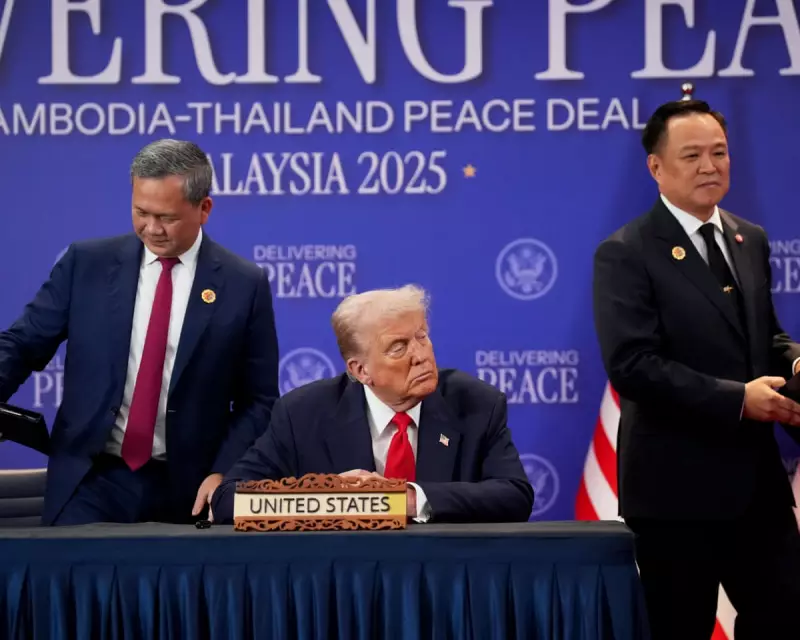
The United States has taken decisive action against Thailand after the collapse of a ceasefire agreement with Cambodia, temporarily suspending crucial trade negotiations in a move that underscores Washington's commitment to maintaining stability in Southeast Asia.
Trade Talks Suspended Amid Border Tensions
According to Thai officials, the Office of the US Trade Representative delivered a letter on Friday night announcing the pause in trade discussions. The negotiations had been addressing significant US tariffs of 19% on Thai imports, making the suspension a substantial economic pressure tactic.
Thai foreign ministry spokesperson Nikorndej Balankura revealed that the American communication explicitly stated that trade talks could only resume once Thailand reaffirmed its commitment to the joint ceasefire declaration brokered by former President Donald Trump.
Trump's 'Tariff Diplomacy' in Action
The situation took another dramatic turn when President Trump himself commented on the diplomatic manoeuvre while travelling to Florida. "I stopped a war just today through the use of tariffs, the threat of tariffs," Trump told reporters aboard Air Force One, highlighting his unconventional approach to international conflict resolution.
Trump had personally overseen the signing of the ceasefire agreement in Malaysia this October and has frequently cited it as an achievement worthy of Nobel Peace Prize consideration. The agreement had temporarily halted the worst fighting in a decade between Thai and Cambodian forces, which last July saw dozens killed and 300,000 people displaced through gunfire, artillery exchanges, and airstrikes.
Ceasefire Unravels Amid Fresh Accusations
The fragile peace began collapsing earlier this week when Thailand announced it was suspending the ceasefire deal, accusing Cambodian forces of laying fresh landmines along their shared border. Thai authorities reported that one soldier lost a foot after stepping on a newly placed mine while on patrol.
Since the suspension announcement, violence has escalated along the Thai-Cambodia frontier, with one person killed and several others wounded by gunfire, raising concerns about a return to full-scale tit-for-tat fighting between the neighbouring nations.
The border dispute between Thailand and Cambodia has deep historical roots, dating back to disagreements over colonial-era maps drawn by French cartographers. Both nations claim ancient temples located along the contested border, with these cultural sites frequently becoming flashpoints for military confrontation.
Despite the American pressure, Thai government spokesperson Siripong Angkasakulkiat attempted to downplay the connection between trade and border issues, stating that the temporary suspension of talks occurred before a Friday night call between Thai Prime Minister Anutin Charnvirakul and President Trump. Siripong insisted that "tariff negotiations will continue and remain separate from border issues."
However, Nikorndej indicated that Prime Minister Anutin had explained the border situation to Trump during their conversation, and the American president had "expressed understanding regarding the issue." This suggests ongoing diplomatic channels remain open despite the public pressure being applied through trade mechanisms.