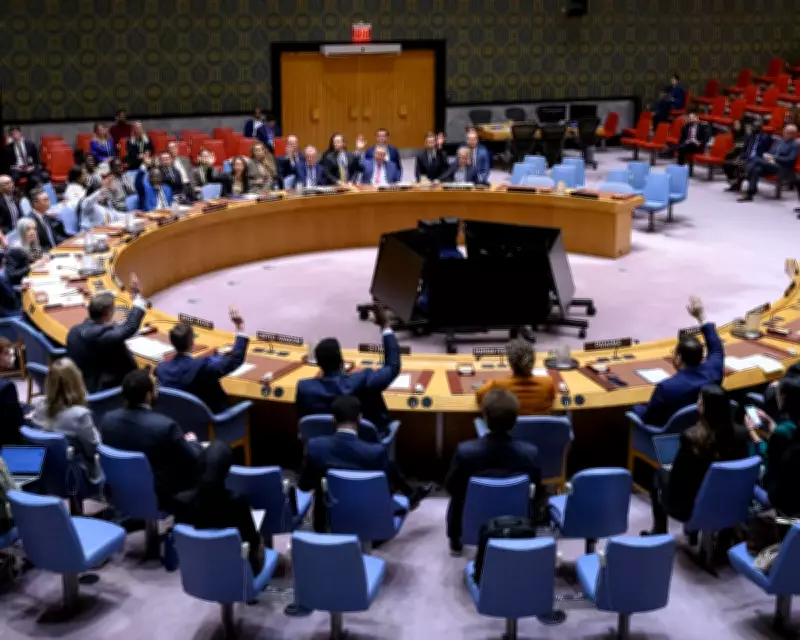
The Trump administration is seeking to pressure the Palestinian Authority to drop its bid for a UN General Assembly vice-presidency, fearing it could allow Palestinians to chair high-profile debates on the Middle East.
US Pressure on Palestinian Leaders
In a State Department cable dated May 19, the US instructed its embassy in Jerusalem to issue a formal protest to the Palestinian Authority (PA) leaders, demanding they withdraw the bid by May 22. The cable warned that "consequences will follow" if they failed to comply.
The Palestinian observer mission at the UN is seeking one of 16 vice-presidential positions on the General Assembly, which are due to be elected on June 2 alongside the president of the assembly's next year-long session. The US mission has "repeatedly appealed" to the Palestinians to stand down, according to the cable.
Concerns Over High-Profile Sessions
The cable expressed concern that in a worst-case scenario, the next president of the General Assembly might assist the Palestinians in presiding over high-profile sessions related to the Middle East or during UNGA81 high-level week, a week of summits and leaders' speeches planned for September in New York.
The Palestinians are currently running as one of four delegations on an Asia-Pacific group slate. Although the vice-presidential role is less prominent than the presidency, the cable noted that vice-presidents could be deputised to oversee General Assembly sessions.
Previous Withdrawal and Current Bid
The communication said that Palestinian diplomat Riyad Mansour, the long-serving representative of the Palestinian mission, withdrew his candidacy for General Assembly president in February after American lobbying. Washington saw this as a sign that he "understood the gravity of the issue and intended to be constructive." However, the cable warned that the vice-presidency bid "calls that into question" and accuses the PA of prioritising "symbolic appointments" over substantive engagement.
The candidacy, the cable reads, "undermines President Trump's Comprehensive Plan," which is the administration's 20-point proposal for a US-led reconstruction of Gaza involving the creation of the US-chaired Board of Peace.
Threats and Consequences
The cable stated: "A bully pulpit for Mansour would not improve the lives of Palestinians and would significantly damage US relations with the PA. Congress will take it extremely seriously." It added: "To be clear. We will hold the PA responsible if the Palestinian delegation does not withdraw its VPGA candidacy, and consequences will follow."
The cable suggested using two specific threats. It recalled that in August, before the previous UN summit week, the Trump administration denied and revoked all visas for Palestinian officials, but a few days later waived the restrictions on officials already assigned to the mission. "It would be unfortunate to have to revisit any available options," the cable said, in an apparent threat to revoke the visas of the Palestinian UN mission.
Additional Pressure Points
Separately, under a section titled "if raised," US diplomats were instructed to remind the Palestinians that if they did not "engage in good faith without internationalizing disagreements in courts," they would make no progress in recouping tax and customs revenue owed to them but withheld by the Israeli government.
The funds, which account for 60% of total PA revenue, have been largely blocked since the start of the Gaza war in October 2023 by Israel's far-right finance minister, Bezalel Smotrich, who has called for the destruction of the PA. Smotrich revealed on Tuesday that the International Criminal Court was seeking an arrest warrant against him, though he did not specify the charges. He has been under ICC scrutiny for his central role in expanding settlements and displacing Palestinians in the West Bank.
The US State Department has been approached for comment.