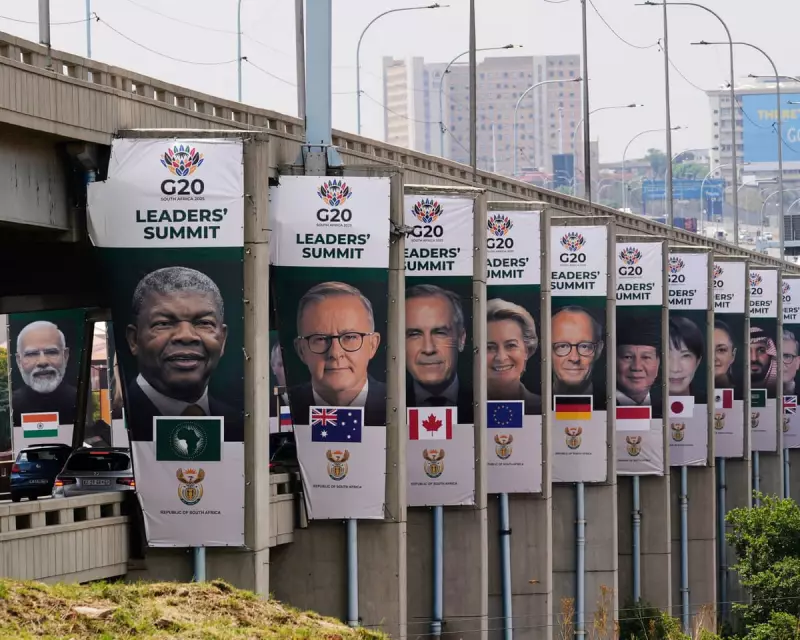
South Africa has launched a stinging rebuke against the United States, accusing the Trump administration of attempting 'coercion by absentia' after it confirmed a full boycott of the upcoming G20 leaders' summit in Johannesburg.
Diplomatic Standoff Over Summit Declaration
The diplomatic crisis escalated when Washington sent a formal note confirming that no US officials would attend the G20 leaders' summit on 22-23 November - the first ever to be held on African soil. More significantly, the US stated it would not accept any declaration issued at the conclusion of the gathering.
According to reports from Agence France-Presse, the note from the US embassy in Pretoria insisted that Washington would accept only a 'chair's statement' rather than a traditional leaders' declaration. The communication stated unequivocally: 'South Africa's G20 priorities run counter to US policy views, and we cannot support consensus on any documents negotiated under your presidency.'
Clashing Priorities and Accusations
Chrispin Phiri, spokesperson for South Africa's foreign ministry, delivered a robust response to the American position. 'Washington's absence negates its role over the G20's conclusions,' Phiri stated. 'But we cannot allow coercion by absentia to become a viable tactic; it is a recipe for institutional paralysis and the breakdown of collective action.'
The confrontation stems from fundamental disagreements over South Africa's agenda for its G20 presidency, which includes two key priorities:
- Improving debt sustainability for low-income countries
- Securing more finance for a 'just energy transition' away from fossil fuels
The Trump administration had previously expressed hostility toward these objectives, with US Secretary of State Marco Rubio claiming in February that South Africa's themes of 'solidarity, equality, & sustainability' amounted to 'anti-Americanism'.
Broader Implications for Global Governance
The dispute reflects wider tensions about the direction and composition of the G20 forum. The US, which is scheduled to take over the G20 presidency next year, has criticised the organisation's expansion beyond its original focus on global financial and economic issues when founded in 1999.
US Treasury Secretary Scott Bessent emphasised this position at an Oval Office event, stating: 'We have whittled down the G20 back to basics... the G20 had become basically the G100 this past year.'
South Africa has significantly expanded participation for the Johannesburg summit, inviting an additional 22 countries beyond the core membership of 19 major economies and the European Union.
South African President Cyril Ramaphosa addressed the unusual circumstance of handing over the presidency to an absent successor, telling reporters: 'I have said in the past I don't want to hand over to an empty chair. But the empty chair will be there, probably symbolically hand over to that empty chair and talk to President Trump.'
The annual G20 leaders' summit traditionally concludes with a communique representing collective positions. Last year's statement faced criticism from Ukraine and Western allies for failing to mention Russia's invasion of Ukraine.
This year's confrontation raises significant questions about the future of multilateral cooperation as major powers increasingly diverge on fundamental policy directions and forum management.