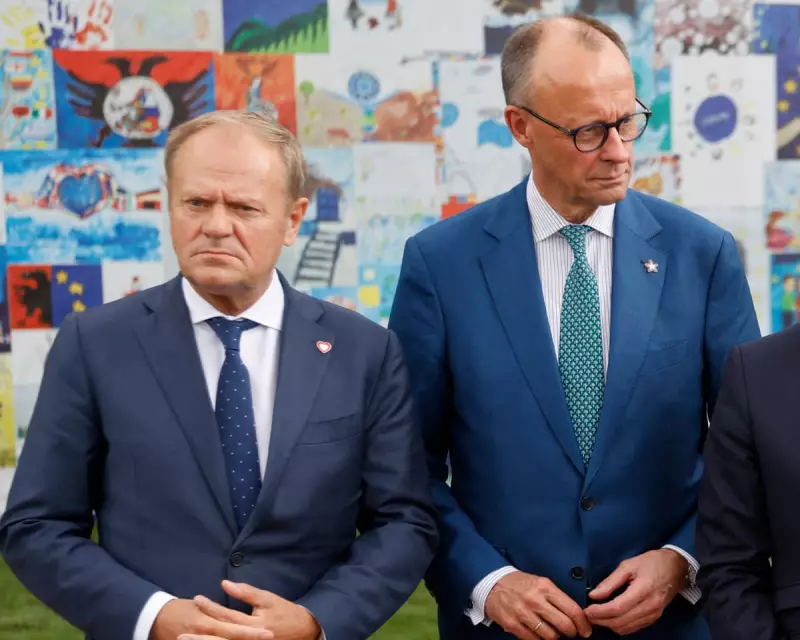
Polish Prime Minister Donald Tusk and German Chancellor Friedrich Merz are set to meet in Berlin on Monday for high-level intergovernmental talks, with a public show of support for Ukraine expected to dominate the headlines.
A Relationship Under Strain Despite Public Unity
The meeting, the first of its kind since Merz took office, comes at a critical juncture. Amid growing pressure from the United States for a peace deal with Russia, Warsaw and Berlin aim to project a united front as central Europe's largest and most militarily capable nations. However, analysts warn that this display of unity papers over increasingly complex and strained bilateral relations.
Poland, historically viewed as the junior partner, no longer accepts that subordinate role. This shift stems not only from its remarkable economic transformation since 1989 but also from a Polish perception that it avoided German policy missteps on issues like migration and relations with Russia. Dr Agnieszka Łada-Konefał, vice-director of the German Institute of Polish Affairs, notes that Poles have grown more self-assured, with Germany remaining a constant reference point.
This confidence exists alongside a near-record level of aversion. A landmark 25-year tracking study co-led by Łada-Konefał reveals that Polish positive sentiment towards Germans is at a historic low, with only slightly more Poles holding a favourable view than a negative one. This contrasts sharply with German attitudes, where the percentage expressing negative views of Poles is at its lowest ever recorded.
The Weight of History and Political Exploitation
Experts attribute the sour Polish mood to years of anti-German rhetoric from the previous Law and Justice (PiS) government, which routinely framed political rivals, especially Tusk, as agents of Berlin. This narrative was amplified by the surging far-right Confederation alliance. Łada-Konefał argues that while politically motivated, these messages resonated with deep-seated, dormant uncertainties within Polish society about Germany.
This politicisation has hamstrung Tusk's government, making it difficult to reset relations without first securing a significant concession from Berlin. "Any actions will inevitably be viewed through that prism," says Dr Ben Stanley of SWPS University in Warsaw, referring to the potent political distinction between being a defender of Polish identity or a supposed German proxy.
Hopes for a fresh start were briefly raised when Merz made Poland the destination of his second foreign trip. However, these were quickly dashed by a public clash over border controls, an issue of profound sensitivity in Poland, as Merz faced domestic pressure from the far-right Alternative für Deutschland on migration.
Symbolic Slights and Unresolved Grievances
Further friction stems from Poland's lingering resentment over Germany's initially slow response to Russia's full-scale invasion of Ukraine and frustration that Berlin appears more central to peace talk discussions than Warsaw. Professor Aleks Szczerbiak of the University of Sussex highlights a potent symbolic moment: during a recent leaders' trip to Kyiv, Tusk travelled in a separate train carriage from Merz, French President Macron, and UK Prime Minister Starmer.
While logistical, the optics during a tense Polish presidential campaign were, in Szczerbiak's words, "terrible," and were exploited by Tusk's opponents to claim he was relegated to "second class" in European diplomacy. Experts suggest Germany could send a powerful signal by advocating for a more central role for Poland in negotiations, recognising its status as Ukraine's neighbour, key logistics hub, and home to 1.5 million Ukrainian refugees.
Yet the most profound and intractable tensions are historical. The legacy of the Nazi German invasion in 1939 remains a raw nerve. Polls indicate 58% of Poles believe Germany should do more in compensation. In 2022, Poland's parliament almost unanimously adopted a motion stressing the country had never been properly compensated, rejecting Berlin's stance that a communist-era waiver from the 1950s settled the matter.
A report commissioned under PiS calculated reparations at a staggering €1.5 trillion (£1.3 trillion). Arkadiusz Mularczyk, the former deputy foreign minister who led the work, calls it a "conservative" estimate. While Tusk's government has distanced itself from the formal demand, it has urged Berlin to "think creatively," particularly regarding the 60,000 living Polish victims of German wartime aggression. Reports suggest a German offer of a €200 million lump sum was rejected last year as insufficient.
The issue of Nazi-looted artefacts also persists, with numerous items sought by Poland appearing in German collections. Polish media reports suggest Monday's meeting may see a "historical return" of some looted valuables. However, a long-awaited permanent memorial in Berlin to Polish victims of Nazism remains in limbo, with only a temporary stone currently in place.
Professor Robert Traba, vice-chair of the Foundation for German-Polish Cooperation's advisory council, warns of a critical "asymmetry" in knowledge and attention. He notes that in Germany, postwar reckoning focused on Franco-German and German-Jewish reconciliation, leaving "the space for Polish-German reconciliation... hardly existent." A review of German history textbooks he led in 2018 found scant mention of key Polish wartime suffering.
Traba concludes that the provisional nature of the current Berlin memorial stone inadvertently symbolises the state of relations: "more of a provisional arrangement, not a genuine relationship" between two neighbours who have the potential to reshape European politics. The Berlin summit may showcase unity on Ukraine, but mending the deeper fractures will require a far more concerted and sensitive effort from both capitals.