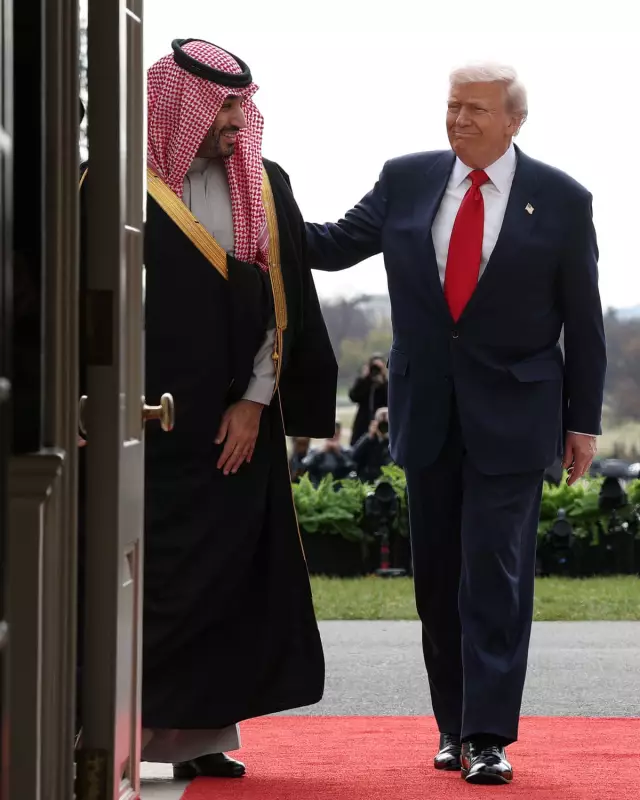
Lavish Welcome Signals Shift in US Foreign Policy
The White House welcome bestowed on Saudi Crown Prince Mohammed bin Salman represented the most extravagant reception of the Trump presidency, serving as a clear statement of Washington's foreign policy priorities. Despite being billed as a working visit, the occasion surpassed previous state visits in its grandeur.
President Trump greeted the prince on the south lawn, the White House's largest stage, complete with uniformed men on horses bearing flags and a flypast of fighter jets. Inside the Oval Office, Trump appeared thoroughly besotted, repeatedly grabbing the prince's hand and declaring what an honour it was to claim his royal friendship.
When questioned about the 2018 murder and dismemberment of Washington Post journalist Jamal Khashoggi - the primary reason Prince Mohammed hadn't visited for seven years - Trump lashed out at the reporter and her network. He described Khashoggi as "extremely controversial" and insisted the prince knew nothing about the murder, directly contradicting US intelligence conclusions.
Military and Economic Deals Reshape Regional Dynamics
The F-35 stealth fighter jets featured in the flypast are part of a potential sale to Saudi Arabia that Trump confirmed would proceed without conditions. Crucially, he stated that specifications for Saudi F-35s would match Israel's, challenging the long-standing principle that Israel maintains a qualitative military edge over other US allies in the region.
"[Saudi Arabia] is a great ally and Israel's a great ally," the president declared. "As far as I'm concerned, I think they are both at a level where they should get top of the line." This language represents a significant departure from traditional US-Israeli relations and marks one of several recent setbacks in their bilateral relationship.
Equally important, the administration announced it would lift the ban on selling advanced AI chips to Saudi Arabia and the United Arab Emirates. This decision significantly boosts Riyadh's ambitions to become a global tech hub with energy-intensive datacentres forming the foundation of the future AI economy.
Gregory Gause, a visiting scholar at the Middle East Institute in Washington, compared the potential US-Saudi partnership in AI to the US corporate-led development of Saudi oilfields in the 1930s, suggesting it could create a more substantial guarantee of American commitment to Saudi security than any formal agreement.
Israel's Diminishing Influence in Trump's Transactional World
Several recent events indicate at least a temporary shift away from Israeli primacy in US Middle East policy. On Monday, a US-drafted UN security council resolution included language about a possible pathway to an independent Palestine, despite desperate Israeli efforts to remove the clause.
Earlier, in late September, Trump humiliated Israeli Prime Minister Benjamin Netanyahu during his White House visit, forcing him to call his Qatari counterpart from the Oval Office to apologise for bombing Doha in a bid to kill Hamas officials. Trump had reportedly received very little notice of the plan to bomb a close regional ally.
In Trump's transactional administration, Israel struggles to compete against Gulf wealth. Prince Mohammed promised $1 trillion in Saudi investment in the US economy, while Qatar provided Trump with a $400 million luxury plane to use as Air Force One. Saudi Arabia, Qatar and the UAE have together invested nearly $5 billion in a fund managed by Trump's son-in-law Jared Kushner.
Trump has consistently demonstrated greater affinity with absolute rulers than elected leaders. Prince Mohammed faces none of the coalition constraints troubling Netanyahu, and consistently signals that if the US disappoints, Saudi Arabia will turn to China for hardware and security guarantees.
However, some analysts question whether these developments constitute a fundamental reset in US Middle East policy. Daniel Levy, president of the US/Middle East Project, argues that despite surface changes, US policy remains driven by people with shallow understanding of the region essentially taking cues from Israel and regional rulers.
The prospect of Saudi normalisation with Israel under the Abraham Accords was discussed but politely shelved by the crown prince, who made clear that normalisation would depend on a solid commitment to a Palestinian state - considerably more than the vague language in Monday's security council resolution.