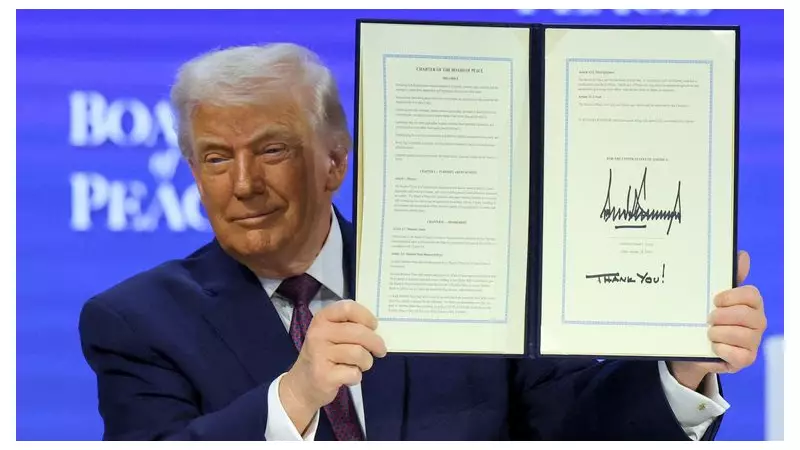
Trump's Board of Peace: From Gaza Oversight to Global Ambition
Originally conceived as a modest group to monitor the Gaza ceasefire, Donald Trump's Board of Peace has transformed into a far more expansive international initiative. The former president announced the organisation's charter during a signing ceremony in Davos, describing it as a "very exciting day, long in the making." This development marks a significant evolution in Trump's foreign policy vision, with the board now aiming to address global conflicts beyond the Middle East.
Structure and Leadership of the Controversial Initiative
Under the current plans, Donald Trump will serve as the inaugural chairman of the Board of Peace, a position he could potentially hold for life. The charter reportedly grants the chairman extensive executive powers, including veto authority over decisions and the ability to remove members, albeit with some limitations. The White House has selected key figures for the founding executive board, including Secretary of State Marco Rubio, special envoy Steve Witkoff, Jared Kushner, and former British Prime Minister Tony Blair.
Participation comes at a substantial cost, with nations required to contribute one billion dollars each to secure permanent membership status. Approximately sixty countries have received invitations to join this ambitious peacekeeping body, though responses have been mixed across the international community.
International Responses: Acceptance and Rejection
According to senior Trump administration officials, around thirty-five nations have agreed to participate in the Board of Peace initiative so far. Middle Eastern allies form a significant portion of the accepting countries, including Israel, Saudi Arabia, the United Arab Emirates, Bahrain, Jordan, Qatar, and Egypt. Other participating nations span multiple regions, with NATO members Turkey and Hungary joining alongside Armenia, Azerbaijan, Morocco, Pakistan, Indonesia, Kosovo, Uzbekistan, Kazakhstan, Paraguay, and Vietnam.
More controversially, Belarusian President Alexander Lukashenko has accepted his invitation, raising eyebrows among Western democracies. The inclusion of authoritarian leaders has become a particular point of contention, with Russia's President Vladimir Putin receiving an invitation despite ongoing international tensions.
Several European nations have declined participation, including Norway, Sweden, and France. Italy's economy minister Giancarlo Giorgetti cited constitutional concerns about joining a group led by another country's leader. In the United Kingdom, Foreign Secretary Yvette Cooper expressed reservations about Putin's invitation, confirming that Britain would not participate in the initial signing ceremony. Neither Russia nor China have publicly declared their intentions regarding the invitations.
Gaza Remains Central to the Board's Original Mandate
The Board of Peace maintains its original connection to the Gaza conflict, where it was established to help secure peace following last October's fragile ceasefire. The United Nations Security Council granted the board its initial mandate and authorised deployment of a temporary International Stabilisation Force in the region. Despite the ceasefire agreement, Gaza continues to experience episodes of deadly violence, with Israel and Hamas regularly accusing each other of violating peace terms.
Earlier this month, the Trump administration announced that phase two of the Gaza peace plan was underway, focusing on "the full demilitarisation and reconstruction of Gaza." Under this framework, fifteen Palestinian leaders would assume day-to-day governance responsibilities in Gaza, ultimately reporting to the Board of Peace for oversight and direction.
Relationship with the United Nations
The Board of Peace's potential impact on the United Nations represents a significant concern for many world leaders. While acknowledging criticisms of the UN's effectiveness in recent years, there appears to be limited appetite for creating a body that might undermine the established international organisation. Trump has suggested that the board could eventually replace some United Nations functions, describing the UN as an organisation that "hasn't been very helpful" and "has never lived up to its potential."
However, he has also indicated that the United Nations should continue operating "because the potential is so great." This ambiguous relationship between the new initiative and existing international structures has contributed to hesitation among some invited nations, who seek greater clarity about the board's precise remit and operational mechanisms before committing to participation.
The Board of Peace initiative emerges against a backdrop of recent US military actions, including strikes on Venezuela, and presidential threats regarding Greenland and potential intervention in Iran. As the international community continues to evaluate this ambitious proposal, questions remain about its practical implementation, funding mechanisms, and long-term implications for global diplomacy.