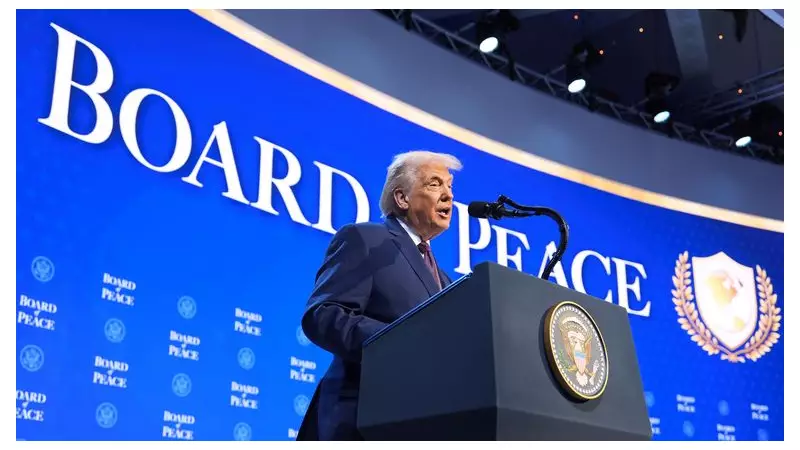
When first announced four months ago, Donald Trump's Board of Peace appeared tightly focused on the future of Gaza. However, recent developments at Davos have revealed a dramatically expanded vision, transforming this initiative into a potential challenger to established international institutions like the United Nations.
A Shift in Ambition and Scope
The Board of Peace has undergone a significant evolution since its inception. What began as a Gaza-centric peace initiative has now broadened its horizons considerably. During the Davos gathering, the board's ambitions became more overt, its scope widened dramatically, and its pace accelerated noticeably.
The clear message emerging from these developments is: while Gaza remains important, the board now aims to address "everything else" in global diplomacy. This represents a fundamental shift in both purpose and potential influence.
Gaza as an Investment Opportunity
At the board's inaugural gathering, Jared Kushner delivered a revealing PowerPoint presentation that framed Gaza not as a warzone but as an investment opportunity. His vision presented Gaza as a potential paradise of free market economics, where investment and entrepreneurship could replace aid dependency.
This ambitious proposal stands in stark contrast to the current reality in Gaza, where vast numbers of people continue to live in temporary shelters amid extensive rubble that will require years to clear. The gap between this visionary economic model and ground conditions raises significant questions about practical implementation.
Challenging the United Nations
The Board of Peace's expansion raises important questions about its relationship with the United Nations. While it's unlikely to usurp the UN's position immediately, it represents a clear challenge to the established global diplomatic order.
The United Nations, despite its humanitarian credentials and global aspirations, faces mounting criticism from various quarters. Critics accuse the organization of institutional bias and widespread corruption, while some member states, particularly Israel, regard it with open contempt.
Israel's recent decision to demolish the Jerusalem headquarters of UNRWA, a UN agency supporting Palestinian refugees, underscores the deepening tensions. The UN has described this action as "an unprecedented attack," highlighting the deteriorating relationship.
International Reactions and Participation
Israel has confirmed its participation in the Board of Peace, with multiple officials expressing preference for dealing with the White House rather than the UN, despite concerns about American administration capriciousness. This preference reflects broader dissatisfaction with traditional diplomatic channels.
European nations, however, have shown more skepticism. The UK government, through Foreign Secretary Yvette Cooper, has expressed concerns about Russia's potential involvement and confirmed Britain will not participate in the signing ceremony. This European reluctance could significantly limit the board's international credibility.
A Changing World Order
The emergence of the Board of Peace symbolizes broader shifts in global diplomacy. America, traditionally positioning itself as leader and policeman of the free world, is now establishing alternative diplomatic structures that operate outside conventional frameworks.
Currently, the board appears largely reserved for Trump's allies and those seeking his friendship. With Trump serving as chairman for life and possessing the right to nominate his successor, the initiative carries distinct personal and political characteristics.
The potential inclusion of major powers like Russia, India, or China could dramatically alter the board's dynamics, transforming it into an organization with significant gravitational pull in global affairs. Such developments would represent a fundamental reshaping of diplomatic relationships and power structures.
Uncertain Future and Global Implications
The 2028 American presidential election looms as a crucial factor in the board's future trajectory. A potential Democratic administration could fundamentally alter America's commitment to this initiative, creating uncertainty about its long-term viability.
We are living through a period of unprecedented diplomatic experimentation and unpredictable outcomes. The emergence of alternative structures like the Board of Peace creates discomfort for many accustomed to traditional international frameworks, while simultaneously offering new possibilities for those dissatisfied with existing institutions.
The coming months will reveal whether this initiative evolves into a genuine force in global diplomacy or remains an exclusive club of political allies. What remains clear is that the landscape of international relations continues to transform in unexpected and significant ways.