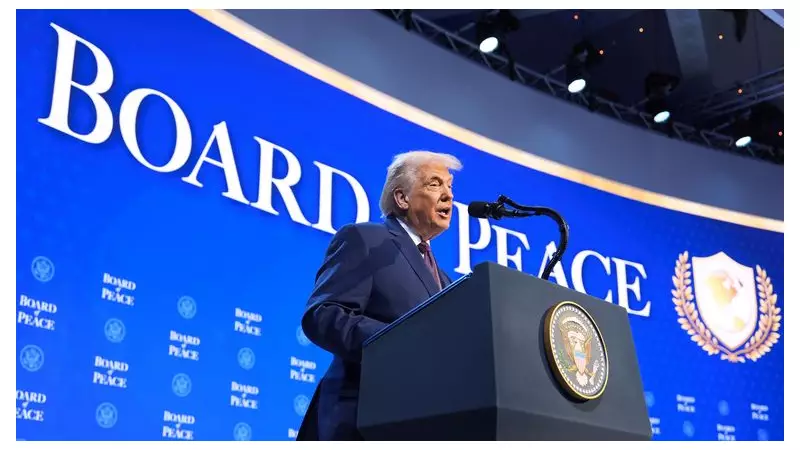
Trump's Board of Peace: A New Diplomatic Force Emerges
When first announced four months ago, the Board of Peace appeared tightly focused on the future of Gaza. Today, that vision has dramatically expanded. At the recent Davos gathering, the board's ambitions became overtly broader, its scope widened significantly, and its pace intensified. The clear message now is: yes to addressing Gaza, but yes to tackling global issues far beyond.
From Warzone to Investment Opportunity
During the board's inaugural meeting, Jared Kushner – serving as both Trump's son-in-law and roving diplomatic dealmaker – presented a compelling PowerPoint vision. His presentation outlined how Gaza could be radically redesigned and reimagined as a paradise of free-market economics. Kushner's central argument was evident: Gaza should be viewed not as a perpetual warzone, but as a prime investment opportunity and a chance to establish a new economic model.
He advocated moving away from a dependency on international aid, proposing instead a Gaza fuelled by private investment and entrepreneurial spirit. While this ambition appears enormous, it stands in stark contrast to the current reality where countless people sleep in makeshift tents amid rubble that will take years to clear.
A Potential Challenger to the United Nations?
Discussing sweeping revival is one thing; delivering it is another. This raises a crucial question: is it cynical to view this initiative – born from Middle Eastern conflict – as a potential challenger to the United Nations? The answer, honestly, is probably not. Underestimating the ambition of an American president has rarely proven wise.
The UN itself, despite its humanitarian credentials and global aspirations, faces an endless list of critics worldwide. Accusations range from institutionalised bias to allegations of wholesale corruption, undermining its authority. Israel, in particular, regards the UN with contempt. This week, Israel began work to demolish the Jerusalem headquarters of UNRWA, the UN agency for Palestinian refugees that Israel repeatedly accuses of enabling Hamas. The UN has rejected these criticisms, calling the demolition "an unprecedented attack."
Significantly, Israel will join this new board. Multiple Israeli officials have expressed a clear preference for dealing directly with the White House over the UN, regardless of the perceived capriciousness of the American administration. While countless others globally would defend the UN, even its own leader admits the organisation struggles to maintain its preeminent position in global diplomacy.
The Evolving World Order
The Board of Peace is unlikely to usurp the UN imminently. Indeed, there is a strong possibility it may never do so, especially if it continues to face scorn from European nations. However, it undeniably represents a significant challenge and a powerful symbol of how the world order is transforming before our eyes.
America, long the self-proclaimed leader and policeman of the free world, is now establishing its own diplomatic coalition. Currently, the Board of Peace appears largely reserved for Trump's allies and those seeking his friendship. Trump holds the position of chairman for life and retains the right to nominate his successor. The board's future should a Democrat win the 2028 US presidential election remains uncertain.
The dynamic could shift dramatically if major global powers like Russia, India, or China were to join. Their participation would grant the board immense gravitational pull and power, transforming it into something akin to a masonic lodge with nuclear capabilities. We live in an era of unprecedented diplomacy and unpredictable outcomes – a reality that makes many profoundly uncomfortable as traditional institutions face new challengers.