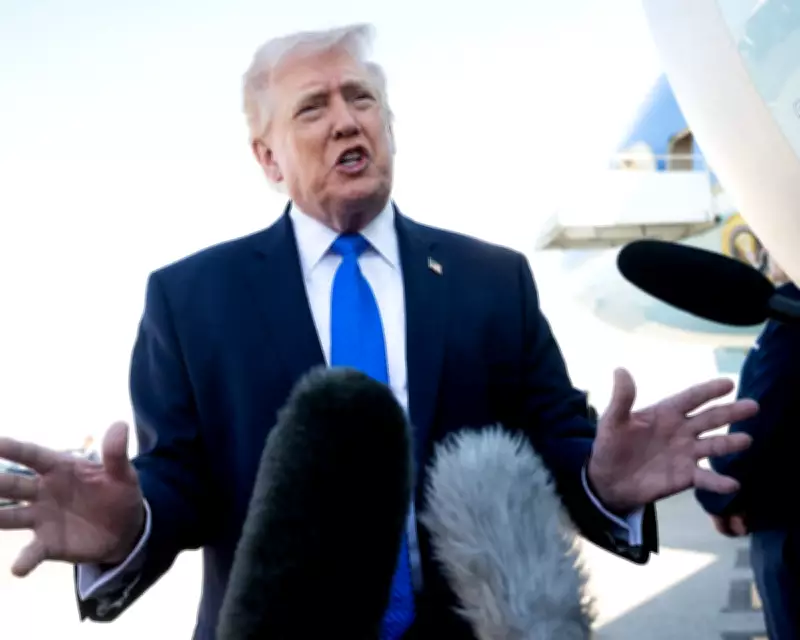
Trump's Fury at UK Over Iran Conflict Reveals Deep Transatlantic Rifts
US President Donald Trump has unleashed a torrent of anger against the United Kingdom due to its position on the Iran war, dramatically exposing the fragility of what was once considered an unshakeable special relationship. The White House backlash against Britain's refusal to be drawn into the conflict has triggered a significant diplomatic crisis, with Trump's capricious attacks highlighting how strained this crucial partnership has become.
Pattern of Presidential Outbursts Targets British Leadership
Throughout this week alone, Trump has repeatedly mocked the UK's naval capabilities, suggested allies concerned about jet fuel supplies should extract it themselves from the Strait of Hormuz, and announced that the United States is seriously considering withdrawing from NATO. These outbursts represent a distinct departure from the previously friendly dynamic between Trump and UK Prime Minister Keir Starmer, establishing a concerning pattern since the Iran conflict began.
"I think Britain is the first ally he thinks of. It is the special relationship, supposedly the closest ally," explains David Smith, the Guardian's Washington bureau chief. "Of all the countries in the world, Britain is the one he feels a certain kinship with because his mother was Scottish. He's of the generation that grew up with second world war movies and he's locked in with that idea of Britain and America together."
Historical Parallels and Contemporary Tensions
The current situation bears striking parallels to the 1956 Suez Crisis, when Britain and France were compelled to withdraw from Egypt under intense pressure from both the United States and Soviet Union. President Eisenhower's statement at the time - "We cannot, in the world any more than in our own nation, subscribe to one law for the weak, another law for the strong" - seems particularly relevant today, though with the positions dramatically reversed.
Prime Minister Starmer has maintained a cautious public stance, carefully avoiding direct criticism of Trump while firmly stating, "This is not our war, and we're not going to get dragged into it." On Wednesday, Starmer indicated that the UK would pursue closer ties with the European Union in response to the instability created by Trump's Iran conflict, signaling a potential strategic realignment.
The Delicate Balance of Transatlantic Dependence
European nations face a precarious balancing act. While the continent's collective security remains heavily dependent on American military power, European governments including Britain's are reluctant to participate in what appears to be an unpopular and directionless conflict with Iran. This creates an impossible dilemma: they cannot afford a complete rupture with the United States, yet they equally cannot afford to join a war their populations largely oppose.
For the United States, the Iran conflict has revealed the limits of unilateral power projection. Despite Trump's rhetoric, America still requires support from allies across Europe, the Gulf region, and globally to effectively project strength and maintain international influence.
Upcoming Diplomatic Challenges and Political Realities
The diplomatic calendar presents additional challenges, with King Charles scheduled to visit the United States later this month. Trump has promised the British monarch a White House banquet to commemorate the 250th anniversary of American independence, though many diplomats hope the Iran conflict will have concluded before this high-profile visit occurs.
Regardless of the war's status, King Charles will likely dine with an increasingly unpopular American president. Trump's approval ratings sank to just 33% in March according to a University of Massachusetts Amherst poll, with skyrocketing prices, a falling stock market, and the unpopular Iran war contributing to his political difficulties.
Public Perception and Potential Outcomes
While the consequences of the Iran conflict have affected Europe and Asia more directly, Americans are beginning to feel the impact through rising fuel prices that have surpassed $4 per gallon. "America is such a car country that's always an absolutely huge barometer," notes David Smith, though he cautions that many Americans remain disengaged from the distant conflict.
With no negotiated settlement in sight, Trump has signaled that the United States might exit the conflict without any formal agreement with Iran, potentially leaving other nations to manage the aftermath. The UK is already preparing to host talks involving 35 countries about reopening the Strait of Hormuz in response to this threat.
"I wonder if consciously or otherwise, it becomes very convenient for America to turn on its heels and disappear from Iran, and say 'OK, you guys get on with it. We've done the hard work,'" Smith speculates. "In a very cynical Trump fashion, he may think to himself in terms of the alternative reality he can project on Fox News where he can say he won the war and it's not America's problem any more."
The special relationship between the United States and United Kingdom now faces its most serious test in decades, with Trump's anger over Iran policy exposing fundamental differences in strategic priorities and diplomatic approaches that could reshape transatlantic relations for years to come.