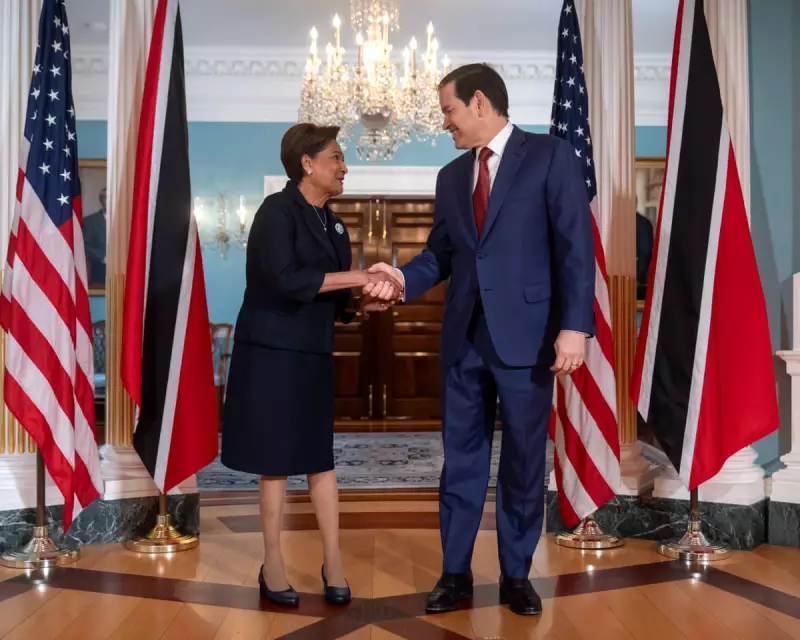
The Caribbean nation of Trinidad and Tobago finds itself dangerously exposed and diplomatically isolated following its decision to align closely with United States foreign policy against neighbouring Venezuela. This strategic positioning, which has seen Prime Minister Kamla Persad-Bissessar publicly side with Washington, has triggered a severe backlash from Caracas and left the dual-island state vulnerable at a critical geopolitical juncture.
The Price of Choosing Sides
For small states, the cardinal rule of geopolitics is maintaining strategic ambiguity and diplomatic flexibility. Trinidad and Tobago has violated this principle through its overt alignment with Washington, particularly during the escalating crisis in Venezuela. The consequences became starkly evident in October 2025, when Venezuela's parliament declared Prime Minister Persad-Bissessar persona non grata, accusing her of complicity in US aggression.
This diplomatic rupture follows years of deepening military cooperation between Port of Spain and Washington, including radar installations, joint exercises, and capacity-building initiatives ostensibly focused on counter-narcotics. However, as former US President Donald Trump acknowledged, the underlying motivation has always been about Venezuela's substantial oil, gas, and mineral resources.
A History of Strategic Missteps
The current crisis represents the culmination of decades of inconsistent foreign policy from successive Trinidadian administrations. Persad-Bissessar's approach has been particularly damaging, marked by rhetorical excess and the dismissal of regional Caribbean solidarity. Her memorable declaration that Trinidad and Tobago was "not the ATM of the Caribbean" during an earlier term signalled that regional cooperation within CARICOM was merely transactional.
This stance has backfired spectacularly. The nation now faces potential boycotts across the region and has alienated one of its most significant trading partners. The economic stakes are enormous: Trinidad and Tobago risks losing over $1.2 billion annually in potential oil and gas deals with any future Venezuelan government led by figures like Delcy Rodríguez.
Between Two Strongmen
The article argues that small states like Trinidad and Tobago gain no protection from moral binaries when caught between powerful authoritarian figures. Both Trump and Venezuela's Nicolás Maduro are portrayed as leaders who govern through pressure, spectacle, and personal loyalty rather than institutional strength. The distinction offers little solace when the consequences include economic collapse, refugee inflows, and long-term regional instability.
Venezuela's historical relationship with the Caribbean, particularly through the PetroCaribe initiative launched by Hugo Chávez in 2005, created deep economic and political ties that cannot be easily dismissed. Notably, Trinidad and Tobago hosts the largest number of Venezuelan refugees in the Caribbean, adding a humanitarian dimension to the diplomatic breakdown.
Sovereignty Violations and Colonial Echoes
The crisis exposes broader patterns of sovereignty violation in the region. The author highlights Britain's seizure of approximately $1.95 billion in Venezuelan gold held in London as a particularly egregious example, noting these funds were denied even during the COVID-19 pandemic when they could have financed medical relief.
This pattern includes the refusal to recognise Maduro's presidency after Chávez's death, the western-backed fiction of Juan Guaidó's parallel government, and the recent promotion of María Corina Machado as a "president in waiting" despite her invitation for foreign military intervention. The Trump administration has since discarded Machado, stating she lacks respect within Venezuela—a pattern Persad-Bissessar would do well to note.
Internal Divisions and Regional Estrangement
Internally, Trinidad and Tobago remains divided, with public attention likely to shift to domestic events like carnival. However, the regional estrangement will persist. If perceived as complicit in US military action against Venezuela, the nation faces complete exclusion from future energy agreements.
The article concludes with a sobering assessment: small states are not geopolitical actors but geopolitical spaces. When leaders forget this distinction, their people face impoverishment and their countries become expendable pawns in great-power conflicts. The hard truth for Trinidad and Tobago is that cockroach should indeed stay out of fowl business.