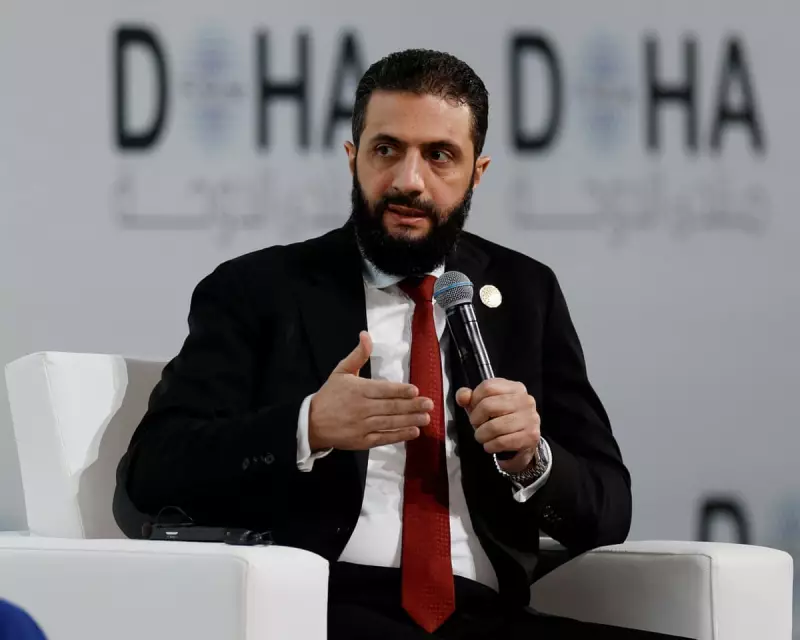
Syria's interim president has launched a scathing critique against Israel, accusing it of battling "ghosts" and exporting its internal crises across the region. The remarks from President Ahmed al-Sharaa come during a period of heightened military activity, with persistent Israeli airstrikes and ground incursions into southern Syria.
A 'Successful' Agreement Under Threat
Addressing an international conference in Doha on Saturday, Sharaa emphasised Syria's commitment to a key historical accord. He stated that Damascus has insisted on respecting the 1974 Disengagement Agreement with Israel, a pact he described as having "held for over 50 years." Sharaa framed this as a "successful agreement" that has maintained a fragile stability.
However, he issued a stark warning about current Israeli actions. Tampering with this longstanding deal and pursuing alternatives, such as establishing a demilitarised zone, "could lead us to a dangerous place with unknown consequences," Sharaa cautioned. This follows Israeli forces pushing into a UN-patrolled buffer zone in the occupied Golan Heights and conducting regular operations deeper into Syrian territory.
Israel 'Exports Crises' and Fights 'Ghosts'
Sharaa, who assumed power a year ago, claimed to have sent "positive messages to Israel regarding regional peace and stability." He contrasted this with what he portrayed as Israeli aggression. The president argued that Israel "extrapolates" its conflict with Hamas to justify broader military actions.
"Israel has become a country that is in a fight against ghosts," Sharaa told the conference. "They justify everything using their security concerns and they take 7 October and extrapolate it to everything that has happened around them." He added that Israel had transformed into a state that exports its crises to neighbouring countries.
To substantiate his accusations, Sharaa cited severe figures: Israel has launched more than 1,000 airstrikes and carried out 400 incursions into Syrian territory since the war in Gaza began. He specifically pointed to a recent attack on the town of Beit Jinn in the Damascus countryside, which he labelled a "massacre" claiming dozens of lives.
Diplomatic Manoeuvres and Domestic Claims
On the diplomatic front, Sharaa revealed that Syria is working with influential nations to pressure Israel to withdraw from occupied territories. "There are negotiations with Israel, and the US is involved with us in these negotiations," he said, noting broad international support for a withdrawal to pre-8 December borders.
The Syrian leader also faced questions about the proposed demilitarised zone, querying, "who will protect this zone if there is no presence of the Syrian army?" Israel maintains the zone is necessary to prevent invasions by groups linked to Hamas or other factions, and has already seized control of a 400 sq km demilitarised buffer zone in southern Syria.
Domestically, Sharaa defended recent People's Assembly elections, conducted under his interim presidency, as appropriate for a "transitional phase." Despite criticism of bias, he stressed that allowing the people to choose their government was a fundamental principle. Sharaa promised full elections within four years, separating the nation's rebuilding from individual leaders and focusing on institutions.
The president's comments arrive amid a complex backdrop, including a reported warning from former US President Donald Trump for Israel to cooperate with the Syrian leadership. The situation underscores the widening regional impact of the Gaza conflict and the precarious state of longstanding ceasefire arrangements in the Golan Heights.