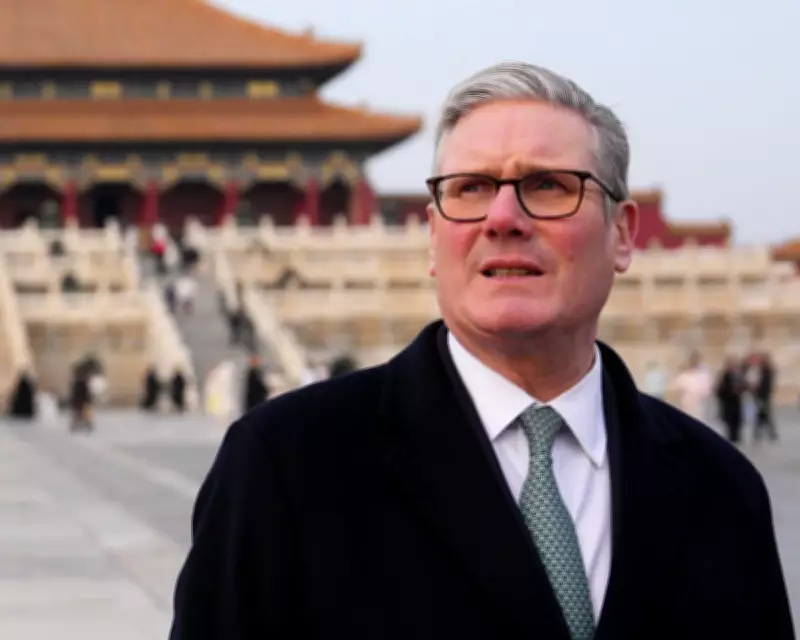
During a tour of Beijing's historic Forbidden City, Prime Minister Keir Starmer told accompanying reporters that he sought a "more sophisticated" relationship between the United Kingdom and China. This diplomatic overture occurred as part of the first visit by a British prime minister to China in eight years, signalling a potential recalibration of bilateral ties.
Chinese Media Applauds Economic Focus
Chinese state media outlets have responded with cautious approval, interpreting Starmer's journey as an act of economic pragmatism by a British leader facing domestic challenges. The presence of a delegation comprising fifty business and cultural leaders was highlighted as a clear indicator that the UK is prioritising its struggling economy over purely political concerns.
A Shift in Priorities
A social media account linked to the state-owned Beijing Daily articulated this perceived shift, stating: "If the Sino-British relationship in the past few years has been characterised by 'politics taking precedence and economics taking a backseat', then this time it is more like a reordering of 'economics taking precedence and politics taking a backseat'."
This sentiment was echoed by an account affiliated with China.org.cn, which framed the visit as a functional necessity driven by current global pressures rather than an ideological return to the so-called "golden era" of relations promoted nearly a decade ago.
Strategic Calculations and Independence
The coverage emphasised that Starmer's approach demonstrated a level of strategic independence from the foreign policy direction of the United States, particularly under the potential influence of a future Trump administration. Analysts quoted in the reports suggested London is recalculating its relationship with Beijing based on its own national interests, not merely following Washington's lead.
Professor Yin Zhiguang of Fudan University commented that Britain's diplomatic adjustment was "forced by reality", serving both to hedge against external risks and to address internal economic sluggishness. Similarly, former Global Times editor Hu Xijin suggested the UK's outreach was a pragmatic reaction to global political dynamics.
The Substance of the Visit
During his time in Beijing, Starmer announced new economic agreements designed to facilitate British businesses expanding their operations in China. Notably, the prime minister was reported to have avoided publicly pressuring President Xi Jinping over China's relationship with Russia, a move that state media outlet Guancha portrayed as wisely not taking "the bait" from Western journalists.
The overarching narrative from Chinese commentators is that this visit represents a pragmatic rebalancing. They argue that while security and political disagreements persist, both nations currently see greater value in fostering economic cooperation, with the UK seeking capital, orders, and growth, while China aims for stable partnerships and strategic influence in Europe.