
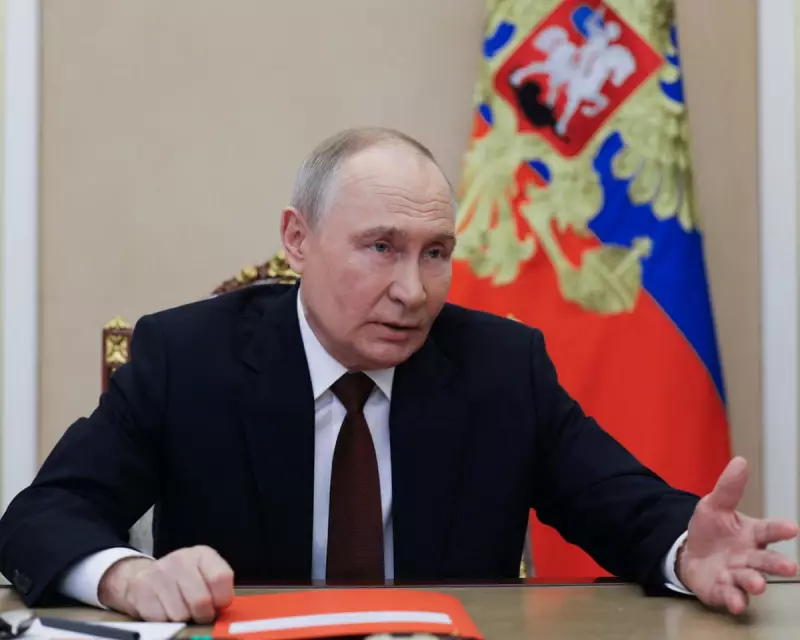
Kremlin's Calculated Silence Creates Negotiating Advantage
Vladimir Putin has positioned himself perfectly in the unfolding diplomatic drama surrounding leaked US-Russia peace proposals. The Russian president stated on Friday that the terms 'could form the basis of a final peace settlement', yet experts widely believe he will demand amendments favouring Moscow before committing to any agreement.
The 28-point peace plan, which emerged publicly last week, has thrown Washington, Kyiv and European capitals into confusion. This disarray creates precisely the scenario Putin has long sought: negotiations heavily weighted in Russia's favour, with Ukraine forced to consider unacceptable conditions while facing the potential loss of its most crucial ally.
Trump's Oscillating Stance Complicates Diplomacy
Since Donald Trump returned to power, both Putin and Ukrainian President Volodymyr Zelenskyy have worked tirelessly to convince the United States that their side isn't obstructing peace. The American president has alternated dramatically in his approach, targeting each side with angry social media posts and threats at different moments.
Following the Trump-Putin summit in Alaska, which reportedly left the US president dissatisfied, he briefly appeared to align more clearly with Kyiv, accusing Russia of blocking peace efforts. This shift prompted significant US sanctions targeting Russian oil.
However, last week's leaked peace proposal - primarily drafted in Florida by US property developer Steve Witkoff and Kirill Dmitriev, who leads Russia's sovereign wealth fund - has completely transformed the diplomatic landscape.
The exact origins of the plan and Trump's specific involvement remain unclear, yet the US president has enthusiastically embraced it. On Sunday, he returned to characterising Ukraine as the obstacle to ending the conflict, complaining on his Truth Social platform that Kyiv's leadership had 'EXPRESSED ZERO GRATITUDE FOR OUR EFFORTS.'
Ukraine Faces Impossible Choice in Negotiations
Meanwhile, Moscow has maintained remarkable silence. For days, Russian foreign ministry officials pretended ignorance, insisting they knew nothing about any peace initiative, before Putin himself finally commented late on Friday.
The structure of the American negotiation process inherently benefits Russia. Washington wants Kyiv to approve the plan before any US delegation travels to Moscow to finalise terms. The Kremlin believes that any move by Zelenskyy to accept something resembling the 28-point draft would trigger political chaos in Ukraine - an outcome Moscow would welcome.
Furthermore, Putin understands that Ukraine cannot simply abandon the talks: the nation remains dependent on US-supplied weapons and intelligence, and would face a potentially catastrophic winter if its primary ally withdrew support.
Even if Kyiv were to support the peace plan, Russian insiders and analysts anticipate Putin will demand additional concessions. 'The plan may be 70% acceptable, but the rest is something Putin will not agree to,' explained Anton Barbashin, a visiting researcher at the European Council on Foreign Relations.
Tatiana Stanovaya, a senior fellow at the Carnegie Russia Eurasia Centre, noted that the current proposal - which she described as clumsily drafted - contains excessive ambiguity, making it the type of document Putin would never sign. The vague wording regarding Ukraine's neutrality and NATO's future expansion would require concrete 'documents, timelines and commitments - none of which appear in the draft.'
According to Stanovaya, Putin is unlikely to retreat from his primary objective of subjugating Ukraine and will instead push for a revised version of the current plan that more comprehensively reflects Russian interests. Should diplomacy stall, she said Putin would see 'no problem with continuing the war' as the Kremlin believes Ukraine's position will deteriorate over time - particularly if Trump follows through on threats to halt American military assistance.
On Friday, Putin refrained from confirming he would sign the deal, partly because he's waiting to observe how apparent disagreements within the US administration regarding the plan develop, Stanovaya believes.
Marco Rubio, the US secretary of state, emphasised on Saturday that America 'authored' the peace plan, after a Republican senator claimed Rubio had distanced himself from the proposal and labelled it a Russian initiative.
'The Kremlin is watching to see which faction inside the US administration prevails. It's far too early for Moscow to celebrate,' Stanovaya commented.
Ukraine's hope, as in previous diplomatic rounds, is that together with European allies, it can reshape the proposal into something acceptable for Kyiv and persuade Trump to support that version. On Monday, the US and Ukraine produced a 19-point peace plan markedly more favourable to Kyiv, though it deferred the most politically sensitive questions for later discussion.
Moscow will almost certainly reject this counter-proposal, returning negotiations to square one. With events developing rapidly, Putin will likely remain in the background for now, according to Fyodor Lukyanov, a foreign policy analyst with Kremlin connections.
Lukyanov stated that Russia will maintain military pressure 'at its current level' until Ukraine accepts the original 28-point plan, after which Moscow would be prepared to move to detailed discussions. 'The ball is on the other side,' Lukyanov concluded.




