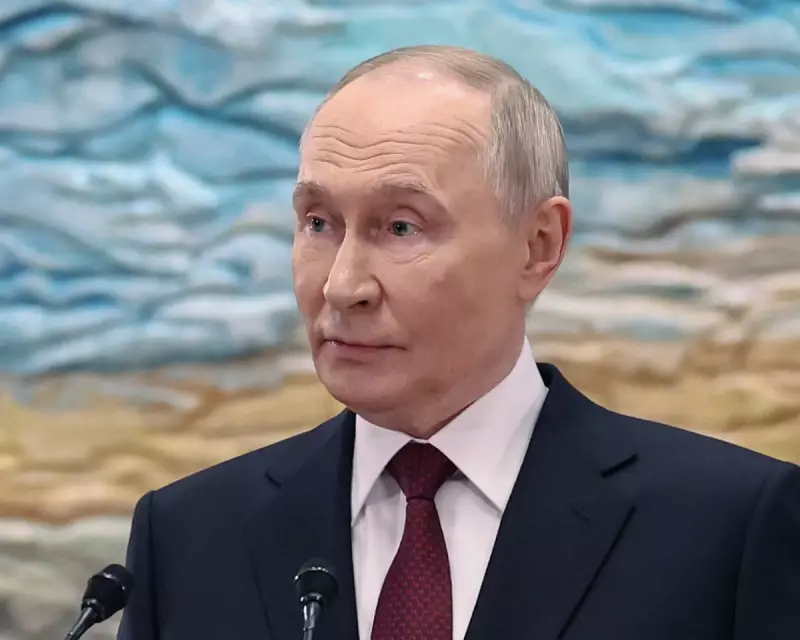
Russian President Vladimir Putin has declared that Ukraine must surrender territory currently under its control for any potential peace agreement to become viable, while simultaneously dismissing allegations of bias towards Moscow by US special envoy Steve Witkoff as "nonsense".
Putin's Uncompromising Stance on Ukrainian Territory
During a working visit to Kyrgyzstan, the Russian leader delivered a stark ultimatum to Ukrainian forces. Putin stated unequivocally that Russia would only halt its military offensive if Ukrainian troops withdraw from unspecified occupied regions. "If Ukrainian troops leave the territories they occupy, then we will stop fighting," he told reporters. "If they don't, we will achieve our aims militarily."
The Russian president acknowledged that a draft peace plan discussed by US and Ukrainian officials in Geneva could serve as a foundation for future negotiations. "In general, we agree that this can be the basis for future agreements," Putin confirmed, noting that Moscow had received a version of the proposal. He added that "we see that the American side takes our position into account in some areas" but emphasised that "in other points, we clearly need to sit down and talk."
Legitimacy Questions and International Recognition
In remarks that further complicate potential negotiations, Putin repeated his controversial characterisation of Ukrainian President Volodymyr Zelenskyy as "illegitimate". The Russian leader argued that this purported lack of legitimacy makes it legally impossible to sign a binding agreement directly with Kyiv.
Putin insisted that any future settlement would require broader international recognition, effectively sidelining the current Ukrainian leadership from what Russia would consider legitimate peace talks. This position represents a significant obstacle to diplomatic progress, as Ukraine and its Western allies universally recognise Zelenskyy's government as legitimate.
Controversy Surrounding US Envoy and Leaked Demands
Putin confirmed that Steve Witkoff, the US special envoy, is scheduled to travel to Russia early next week. The Russian leader forcefully dismissed accusations that Witkoff had demonstrated bias towards Moscow during peace discussions, labelling such claims "nonsense".
Witkoff, a longtime business associate of Donald Trump and property developer, has faced mounting criticism in both Europe and the United States following a leaked phone call. The recording revealed him advising a senior Kremlin aide on how Putin should approach negotiations with the former US president.
Analysis of Russia's recent negotiating strategy suggests a familiar pattern emerging since Trump's re-election. The Kremlin signals willingness to explore potential peace deals while showing no inclination to retreat from its maximalist demands, most of which are viewed in Kyiv as unacceptable and tantamount to capitulation.
Independent Russian political analyst Tatiana Stanovaya observed on social media platform X: "I see nothing at the moment that would force Putin to recalculate his goals or abandon his core demands. Putin feels more confident than ever about the battlefield situation and is convinced that he can wait until Kyiv finally accepts that it cannot win and must negotiate on Russia's well-known terms."
Several of these terms appeared in the original 28-point plan developed by US and Russian officials, which was leaked last week. The demands would require Ukraine to:
- Voluntarily cede territory that Moscow has failed to seize militarily
- Accept reductions or a complete halt to US military assistance
- Agree to an explicit ban on any future deployment of western troops to Ukraine
This latter provision would specifically prohibit troop deployments envisioned under the Franco-British "coalition of the willing" initiative. The uncompromising nature of these conditions, coupled with Putin's renewed questioning of Zelenskyy's legitimacy, suggests significant obstacles remain despite White House expressions of optimism about potential negotiations.