
French President Emmanuel Macron has issued a stark warning that Russian forces will "come back" and break their promises if Ukraine is forced to reduce its military capacity under proposed peace plans. The warning comes as European leaders push back against a US proposal that would see Ukraine cede territory and accept limits on its armed forces.
Global Resistance to Trump's Peace Framework
Speaking at the G20 summit in South Africa on Saturday, Macron emphasised that any viable peace agreement must include elements of deterrence to prevent future Russian aggression. "We know that if there are no elements of deterrence, the Russians will come back and break their promises," the French president told journalists gathered at the international meeting.
The proposal, championed by US President Donald Trump, calls for Ukraine to renounce NATO ambitions, accept military limitations, and cede occupied territories to Russia. However, Trump himself acknowledged that the current framework "is not my final offer" when speaking to reporters outside the White House on the same day.
Western leaders expressed significant concerns about the plan's implications. A joint statement from key European nations, Canada and Japan stressed: "We are clear on the principle that borders must not be changed by force. We are also concerned by the proposed limitations on Ukraine's armed forces, which would leave Ukraine vulnerable to future attack."
Frontline Developments and Diplomatic Manoeuvres
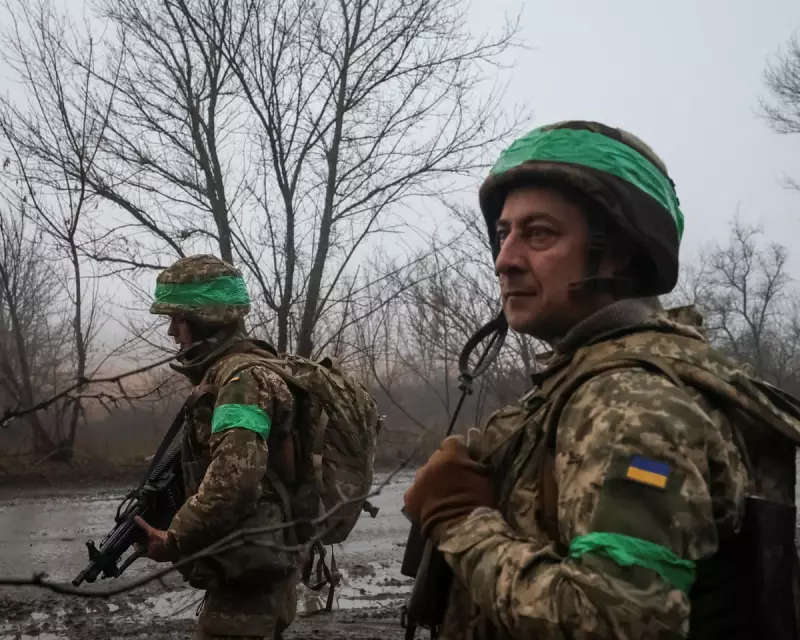
While diplomatic discussions intensify, fighting continues unabated along the frontline. Ukrainian military officials reported that Russian forces attempted to advance toward the central part of Pokrovsk in the Donetsk region, taking advantage of foggy conditions. However, these attempts proved unsuccessful according to Ukraine's general staff.
Meanwhile, US officials are reportedly pressuring Ukrainian President Volodymyr Zelenskyy to accept a peace deal in the coming days. US Army Secretary Dan Driscoll briefed NATO ambassadors in Kyiv on Friday, warning that "no deal is perfect, but it must be done sooner rather than later."
President Zelenskyy has maintained that any genuine peace must be founded on "guaranteed security and justice" for Ukraine. He has appointed a negotiating team led by his chief of staff, Andriy Yermak, which will soon meet with US counterparts in Geneva.
European Unity Against Russian Aggression
The diplomatic developments have prompted coordinated responses across Europe. German Chancellor Friedrich Merz emphasised that Europe must be included in any peace process, noting the broader continental implications of the conflict's outcome.
In a significant show of solidarity, eight Nordic and Baltic nations - Denmark, Estonia, Finland, Iceland, Latvia, Lithuania, Norway and Sweden - reaffirmed their commitment to supporting Ukraine through arms supplies and strengthened European defences. Their joint statement noted that "Russia has so far not committed to a ceasefire or any steps leading to peace."
As the conflict enters its 1,369th day, the Russian defence ministry claimed capture of two villages in eastern Ukraine, while Ukrainian drone attacks targeted energy facilities in Russia's Samara region, resulting in two casualties according to local authorities.




