The Backchannel Peacemaker
When diplomatic relations between Donald Trump and Vladimir Putin deteriorated this autumn, with the American president publicly accusing Moscow of obstructing peace in Ukraine and imposing significant sanctions on Russia's oil sector, an unexpected opportunity emerged for one particularly well-connected Russian official.
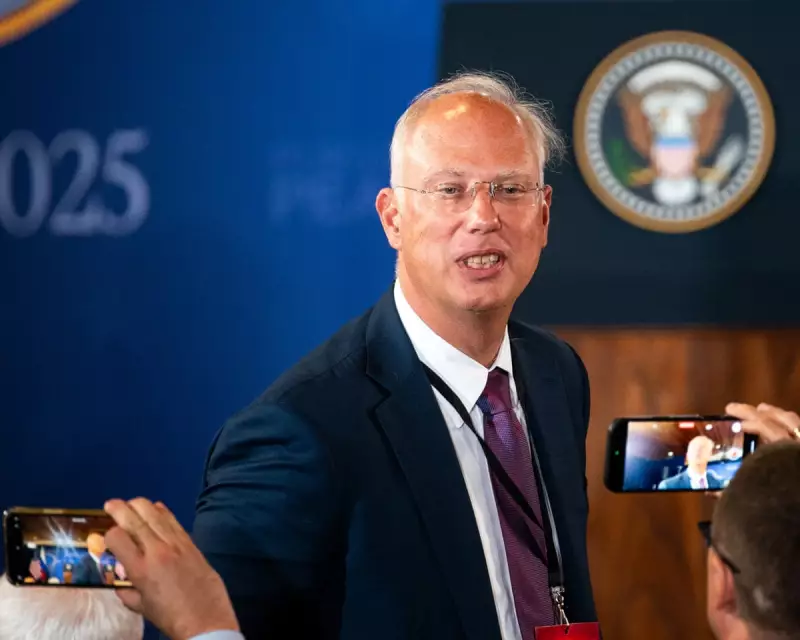
Kirill Dmitriev, the Harvard-educated head of Russia's sovereign wealth fund, boarded a flight to Florida in late October 2025. There he met Steve Witkoff, the property developer acting as Trump's unofficial envoy on Ukraine matters. Neither man possessed formal diplomatic experience, yet together they began drafting a peace proposal that would impose severe terms on Ukraine while granting Moscow extensive influence over the country's political and military sovereignty.
The emergence of this scheme in media reports has propelled Dmitriev back into the international spotlight - a position that multiple sources familiar with him over the years suggest he has actively sought throughout his career.
From Ukrainian Schoolboy to Kremlin Insider
Dmitriev's background might surprise those who know him as one of Moscow's most aggressive advocates. Born in Soviet-era Ukraine to prominent scientists, he attended Kyiv's elite Lyceum No 145, a competitive mathematics and physics school where classmates remember him as systematic and ambitious.
Volodymyr Ariev, now a Ukrainian MP who studied alongside Dmitriev, recalled: "He was quite arrogant... but very systematic, and if he wanted to achieve something, he worked on that." At fifteen, Dmitriev participated in a school trip to the United States that solidified his fascination with America.
His educational journey took him to Stanford University, followed by an MBA at Harvard Business School. In a 2000 New York Times feature about Harvard, Dmitriev expressed enthusiasm for the networking opportunities, noting he travelled to New York four times monthly for "business development, to establish strategic alliances and meet with clients."
The Meteoric Rise Through Finance to Politics
After positions at McKinsey and Goldman Sachs, Dmitriev's significant business breakthrough occurred not in Moscow or New York, but in Kyiv. Between 2007 and 2011, he managed Icon Private Equity, a Ukrainian fund overseeing approximately $1 billion, primarily belonging to oligarch Victor Pinchuk, son-in-law of former Ukrainian president Leonid Kuchma.
Through Pinchuk, Dmitriev connected with Vladimir Dmitriev (no relation), then leading Russia's state development corporation VEB. Together they persuaded the Kremlin to establish Russia's foreign investment fund (RDIF), which would attract American, European and Gulf capital into Russia.
The $10 billion fund proved an ideal platform for the smooth-talking Dmitriev, who became a regular presence at Davos, Riyadh, and global investor summits. During this period, his personal connections to the Kremlin deepened significantly. His wife, Natalia Popova, developed a close professional relationship with Putin's younger daughter, Katerina Tikhonova, and remains deputy director of Tikhonova's research institute, Innopraktika.
Navigating Sanctions and Cultivating Trump Connections
Sanctions following Russia's 2014 annexation of Crimea complicated Dmitriev's efforts to promote Moscow internationally, but Trump's 2016 election victory presented new opportunities. A former RDIF colleague revealed that Dmitriev immediately ordered the fund to issue a statement supporting the incoming president the morning after Trump's win.
Robert Mueller's investigation into Russian election interference documented how Dmitriev leveraged his UAE network, developed through RDIF investors, to establish back-channel communications with Trump's first administration.
Following Russia's full-scale invasion of Ukraine in 2022, Washington sanctioned Dmitriev. However, Trump's return to power provided him with another opening. He began signalling to the White House that substantial financial opportunities existed in any peace agreement, promoting prospects for multi-billion-dollar contracts in the Arctic and other areas of US-Russia cooperation.
Current Peace Efforts and Internal Tensions
Dmitriev specifically cultivated his relationship with Witkoff, capitalizing on the property developer's enthusiasm for deal-making. Together they facilitated the February release of American schoolteacher Marc Fogel in a prisoner swap, presenting it as an initial step toward improving Washington-Moscow relations.
Beyond Witkoff, Dmitriev has actively courted other prominent Maga figures and amplified far-right talking points. An avid X user, he regularly posts about Europe's migration "crisis," accuses "globalists" of promoting "pro-trans programmes," and has even used QAnon-style slogans popular with Trump's most extreme supporters.
Despite his Ukrainian origins - at fifteen he told a US journalist that Ukraine's rising nationalism would help "break the power of the communist system" - Dmitriev has transformed into one of the Kremlin's most loyal advocates. Ariev noted that most childhood friends have severed contact with him, with one close school friend recently wounded while serving in the Ukrainian army.
Internal Kremlin Dynamics
Dmitriev's rapid ascent has created friction within Russia's established foreign policy circles. One Kremlin source revealed they offered to assist Dmitriev with American outreach and drafting potential pathways to end the Ukraine war - assistance he declined.
His relationship with long-serving Foreign Minister Sergei Lavrov is notoriously strained. The rift became publicly apparent during peace talks in Riyadh last February, when Lavrov attempted to exclude Dmitriev by removing his chair, according to two separate sources. Dmitriev ultimately joined the meeting after contacting Putin directly.
As one source close to the Kremlin observed: "Dmitriev has made enemies in Russia. But right now, he is untouchable because he is proving to be very useful for Putin."