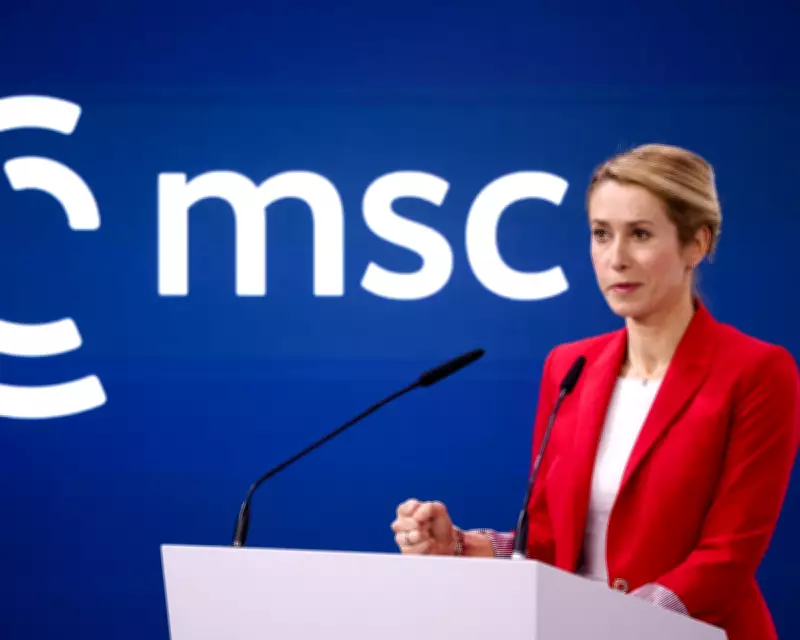
EU's Kallas Dismisses Notions of Europe's Decline, Details Russia's Strategic Weakness
In a robust address on the main stage, EU's Kallas has firmly rejected assertions that Europe is facing what some describe as "civilizational erasure." Responding to recent comments, including a speech by Rubio the previous day, Kallas asserted with a hint of sharpness that "contrary to what some may say, woke decadent Europe is not facing civilizational erasure." She emphasized the enduring appeal of the European Union, noting that numerous countries, not limited to European neighbors, are eager to join the bloc, with Canada cited as a prime example.
Russia's Persistent Challenge and Diminished Power
Kallas underscored that Russia continues to present a significant and ongoing challenge to European security. She clarified that this threat originates in Ukraine but extends far beyond, warning that "Russia's endgame is not Donbas." The EU official pointed to Russia's persistent efforts to sabotage and undermine member states, highlighting a pattern of destabilization that requires vigilant attention from European leaders.
However, Kallas provided a stark assessment of Russia's current state, urging a clear-eyed perspective. She declared, "Russia is no superpower." After more than a decade of conflict, including four years of full-scale war in Ukraine, Russia has made minimal territorial gains, barely advancing beyond the lines established in 2014. The human cost has been devastating, with approximately 1.2 million casualties reported.
Economic and Social Fragmentation in Russia
The address detailed Russia's profound internal struggles. Kallas described the nation as "broken," with an economy "in shreds." Key factors contributing to this decline include Russia's disconnection from European energy markets, which has severely impacted its financial stability. Additionally, she noted a significant exodus of Russian citizens fleeing the country, further eroding its social and economic fabric.
Kallas concluded with a critical warning about the current geopolitical landscape. She stated that "the greatest threat Russia presents right now is that it gains more at the negotiation table than it has achieved on the battlefield." This insight underscores the need for strategic diplomacy and unity among EU members to counter Russia's attempts to leverage its weakened position into advantageous settlements.