Polish and Irish Leaders Condemn Hungarian Foreign Minister's Alleged Russia Ties as 'Repulsive' and 'Sinister'
In a strong joint condemnation, Polish Prime Minister Donald Tusk and Irish Prime Minister Micheál Martin have labeled the Hungarian government's actions as "repulsive" and "sinister." This criticism follows the publication of leaked audio recordings that allegedly capture Hungary's Foreign Minister Péter Szijjártó telling Moscow he would attempt to amend the European Union's sanctions list to Russia's liking.
Leaked Audio Sparks EU-Wide Outrage
The controversy erupted when a joint media investigation, published by The Insider along with four regional media organizations—VSquare, Delfi, FrontStory, and the Investigative Center of Ján Kuciak—released a report based on leaked phone calls between Szijjártó and Russian Foreign Minister Sergei Lavrov. The report, released just days before a critical Hungarian election, has intensified concerns that Hungary is working from within the EU to advance Russia's interests.
In one of the recordings, Szijjártó is alleged to have told Lavrov, "I am always at your disposal." Another recording appears to show him offering assistance with other EU sanctions affecting Russia. These revelations have added to a growing sense of alarm among EU member states about Hungary's alignment with Moscow.
Strong Reactions from EU Leaders
Polish Prime Minister Donald Tusk described the audio as "disheartening" and a confirmation of what he called a "deeply disturbing" relationship between Budapest and Moscow. "What these recordings have revealed is more than just the political dependency of the Budapest government on Moscow; it has exposed just how unacceptable and bizarre this relationship truly is," Tusk stated.
He further emphasized the gravity of the situation, noting that a foreign minister of an EU country is facing accusations of reporting to the Russian foreign minister and asking for patience while carrying out tasks seemingly in Russia's interest. "One could hardly imagine anything more repulsive," Tusk added.
Irish Prime Minister Micheál Martin echoed these sentiments, stating that the investigation reportedly confirms what many have long suspected. "I think it is a very sinister development," Martin said. "The deferential tone in the conversation was alarming ... It's unacceptable."
The EU's top diplomat, Kaja Kallas, also weighed in, asserting that European ministers should work for Europe, not Russia, highlighting the broader implications for EU unity and security.
Hungary's Response and Election Context
Szijjártó did not deny that the calls with Lavrov took place. Instead, he claimed that his conversations had been intercepted by foreign secret services. "It is a huge scandal ... that foreign secret services were continuously wiretapping my phone calls and that these foreign secret services have now made these phone calls public one-and-a-half weeks before the Hungarian parliamentary election," he said in a video posted to social media.
The leaked audio emerges as Hungarian Prime Minister Viktor Orbán and his Fidesz party face their toughest electoral battle in 16 years. Most polls suggest that Orbán and Fidesz are trailing behind Péter Magyar, a former top Fidesz member, and his opposition Tisza party. The election, scheduled for 12 April, is being closely watched internationally, as the outcome could significantly impact the EU's dynamics and global far-right movements.
Broader Implications for EU-Russia Relations
Orbán has maintained close ties with Russian President Vladimir Putin following the full-scale invasion of Ukraine and has repeatedly blocked EU efforts to present a united front in support of Ukraine. This has led some critics to refer to him as "Putin's Trojan horse in the EU." Last week, it was alleged that Szijjártó had routinely called Lavrov to pass on details of confidential EU meetings.
After initially dismissing these allegations, Szijjártó later acknowledged that he had conferred with Lavrov before and after EU foreign minister meetings about their agenda and decisions, describing such conversations as part of "diplomacy." However, this explanation has done little to assuage the concerns of other EU leaders, who view these actions as a potential threat to European solidarity and security.
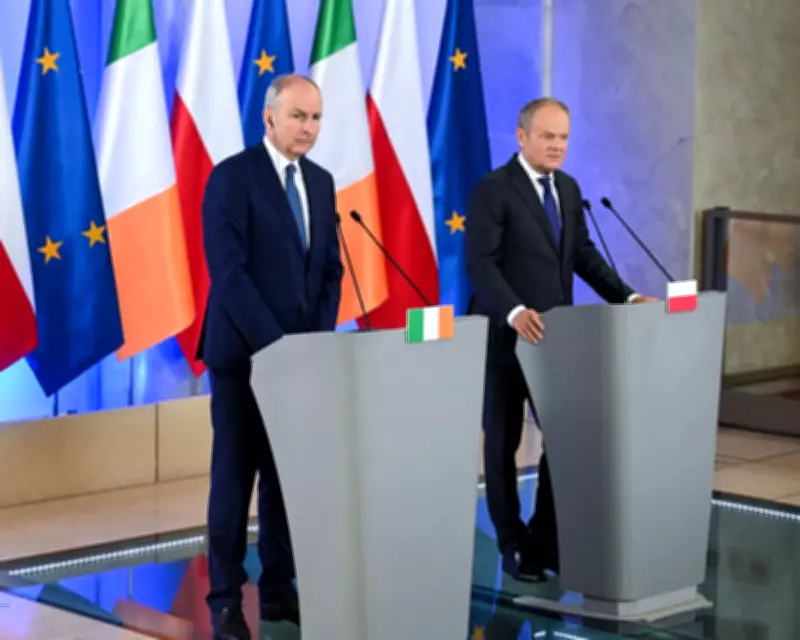
The bilateral meeting between Tusk and Martin in Warsaw on 31 March 2026 underscores the coordinated response from EU nations in addressing these allegations. As the Hungarian election approaches, the international community remains vigilant, with the results poised to reshape the political landscape within the European Union and beyond.